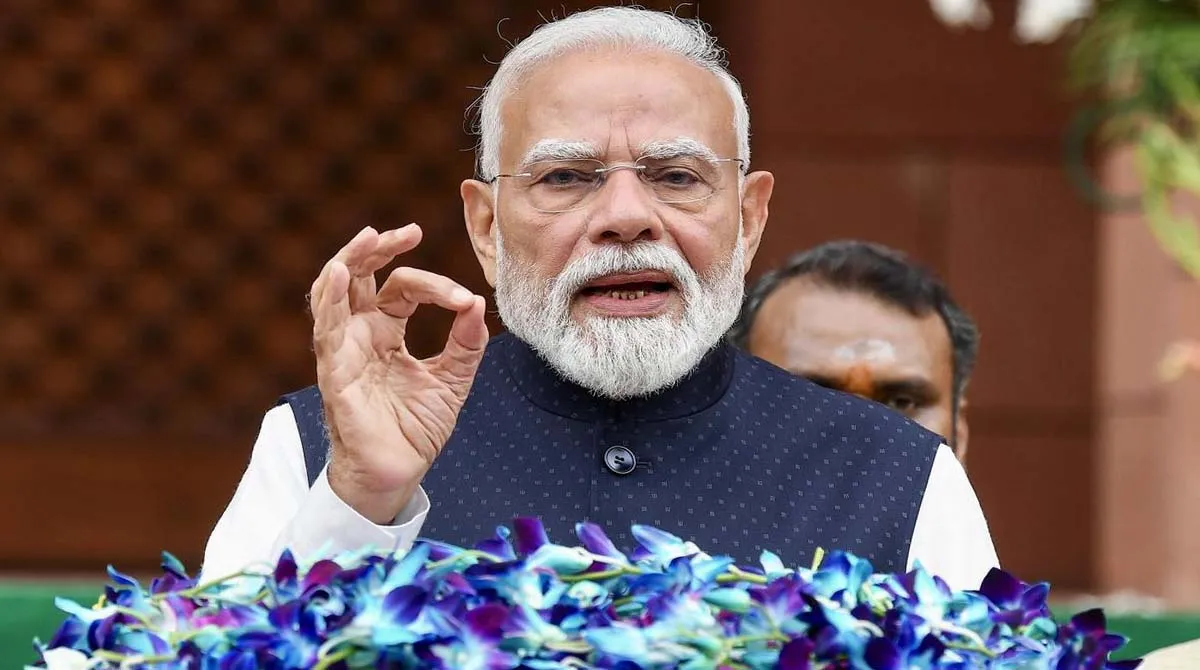
Prime Minister Narendra Modi on Thursday laid special emphasis on the active participation of the country's young generation and inclusion of their new ideas in the policy making process. He clearly said that greater institutional dialogue and better collaboration should be established between government departments, universities and youth power, so that new, innovative and different approaches can come to the fore while formulating policies for the country.
Prime Minister Modi said this while presiding over the third high-level review meeting held with the secretaries of various ministries.
Youth are not just beneficiaries but main participants in policy making
According to the official statement issued by the Prime Minister's Office (PMO), PM Modi said that by establishing a wider connection between the government and the youth, such creative ideas can emerge, which will help in making the country's policies and the direction of overall development more accurate and effective. He underlined that the youth of the country are not just beneficiaries of government schemes and policies, but they can also be important participants in the entire process of policy making.
Direct communication will increase between universities and government departments
During the meeting, the Prime Minister discussed in detail the need to increase coordination between the country's universities and government ministries. He said that a large number of youth are involved in research, innovation and new experiments in higher educational institutions of the country. In such a situation, it is very important to strengthen the institutional communication mechanism to convey the ideas of these talented youth and researchers directly to the government.
According to PM Modi, regular interaction between universities and government departments will help in understanding the real problems at the ground level and finding practical solutions to them. Additionally, fostering direct engagement with the youth will provide an opportunity to policy makers to closely understand the new aspirations, priorities and expectations of the changing generation. The Prime Minister stressed on developing it on a comprehensive and practical level instead of limiting it to just a formal dialogue.
Example of collective efforts given during Covid and West Asia crisis
In this high-level meeting with the secretaries, the Prime Minister laid special emphasis on the need for coordination and collective efforts between various government departments. To prove his point, he gave the example of the Covid-19 global pandemic, when officials from different departments of the central government came together and did historic work.
Better coordination between departments from many different sectors like health, civil administration, logistics, supplies and transport proved to be crucial during the pandemic crisis. Similarly, the Prime Minister also referred to the recent diplomatic crisis that erupted in West Asia, where situations were handled with prompt coordination between Indian officials and ministries during the crisis. He said that when different departments work together for a common national goal, solutions to even the most complex problems can be found faster.
Big effort to increase connection with the youth of the country
This call by the Prime Minister to increase dialogue with universities and youth is being considered as part of his broader strategy, under which he wants to directly connect the country's huge youth population with nation building. Keeping in mind India's huge youth demographic dividend, the Central Government is continuously engaged in expanding the role of youth in areas like education, employment, skill development, startups and new experiments.
Big message amid the backdrop of NEET controversy and examinations
This important statement of the Prime Minister has come at a time when in the past, protests were seen by candidates and student organizations on issues related to National Eligibility cum Entrance Test (NEET) in many different parts of the country including Jantar Mantar in Delhi. The questions raised regarding the medical entrance examination had given rise to a wide public debate regarding the country's overall examination system, transparency and education policies.
Amidst such a sensitive environment, the Prime Minister's emphasis on establishing direct communication with the youth of the country and giving space to their suggestions at the policy level holds special political and administrative importance. However, this message of the PM during the meeting was not limited to any one particular examination or immediate development, but was given in the broader context of overall policy making.
Universities will improve public policies
The Prime Minister called upon the country's educational institutions and universities to play a more active role in policy making. In universities, there is continuous research work on various subjects by experts, professors and researchers. If this coordination between the government and academia improves, then this research and knowledge can be directly used to make policies of public interest more practical.
This input from experts and youth will make it easier for the government to understand the changes coming in areas like new technology, employment opportunities, modern education system, climate change, health services and social development in time.
The solution will come only through better coordination between departments.
The basic message of the Prime Minister in the review meeting was that today the government is facing many such complex challenges, the solution of which is not possible at the level of any one isolated ministry or department. In such a situation, bringing ministries, academic experts, universities and youth on a common platform can make policy making more inclusive and effective.
After these instructions of PM Modi, it now remains to be seen what further concrete and institutional steps the government takes to ensure this participation of youth and universities at the administrative level.
Disclaimer: The information given in this article is based on the official press statement issued by the Prime Minister's Office (PMO) and the minutes of the high-level review meeting.