The government of India is tightening its focus on road safety. This time, it has proposed certain specific amendments to the Central Motor Vehicles Rules. Under these, the automatic headlamps on new two-wheelers could be restricted to operating in low-beam mode. The permitted intensity of the high beams could also be reduced by roughly 33%! Vehicles will issue audio warnings if riders/ drivers use high beams in urban areas, at low speeds. Additionally, buses and heavy vehicles will need to use reflective tapes to ensure visibility at night and in poor weather conditions. The amended rules are expected to come into effect from April next year, if approved.
One of the biggest proposed changes concerns Automatic Headlamp On (AHO) systems on two-wheelers.
Under the proposed rules, ‘automatic’ headlamps on new two-wheelers would have to operate only in passing-beam, or low-beam, mode. At present, it is possible to switch into the high beam if the rider intends to. The proposed amendment aims to curb unnecessary high-beam use. If the ‘automatic’ mode is enabled, the rider will not be able to switch into high-beam.
Under the new rules, changes will be made to new two-wheelers. Existing motorcycles and scooters already running on Indian roads would not be affected by this move.
Of late, several awareness campaigns and government-level efforts were conducted to encourage motorists to use low beam and avoid unnecessary high-beam usage. These, however, failed to deliver the desired results, eventually forcing the Ministry of Road Transport and Highways to consider the above step.
The government is also looking at reducing the maximum permitted intensity of high-beam headlights.
For two-wheelers, the proposed limit could fall from 1.5 lakh candela to 1 lakh candela. For four-wheelers, the maximum intensity could be reduced from 2.25 lakh candela to 1.5 lakh candela, (Candela is the unit used to measure luminous intensity.) A 33% cut.
The objective is to control the extremely bright headlights that can create severe glare for vehicles approaching from the opposite direction. It can affect the driver’s/ rider’s vision and situational awareness. This is becoming a bigger concern these days, as vehicles increasingly use powerful LED lighting setups.
The proposed rules also address another factor that affects glare: the colour temperature of headlamps.
According to the reported proposal, the maximum permissible colour temperature for headlamps and front fog lamps could be set at 6,500 Kelvin. To give you some perspective, higher Kelvin value means whiter and sometimes harsher light. Such light can create discomfort and increase glare for other motorists.
The amendments also say that the mounting height of the high-beam should follow the same prescribed height as low-beam.
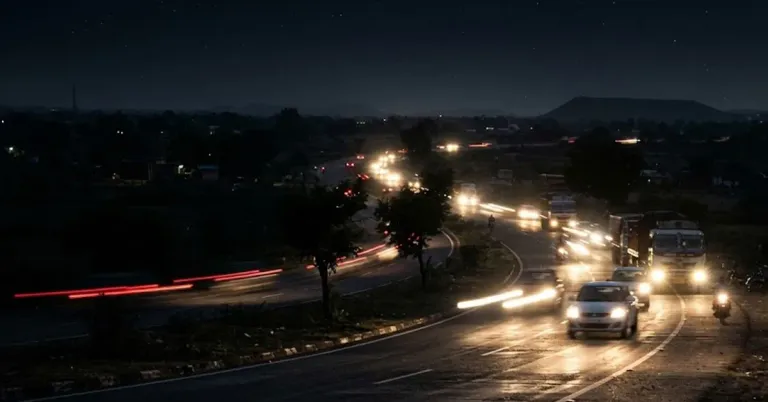
Perhaps the most interesting proposal is an automatic warning system for high-beam use.
Now comes the most interesting part. The Amendments propose the addition of an automatic warning system which will deliver audio alerts when the driver manually switches the high-beam on while driving in urban conditions. These are intended to remind the driver to return to low-beam.
The warning system will, however, be speed-sensitive. The alert will only go off at vehicle speeds of under 60 kph. If the speed is above 60 kph, the driver/rider will not receive the alert. This is so because high-beams are often necessary at high speeds and in areas with limited illumination (think of cruising on a dark highway).
The proposed safety measures are not limited to headlights. The government also wants buses and other heavy vehicles to become easier to spot at night.
The draft amendments could require such vehicles to use reflective tapes. These markings would make them more visible to approaching motorists, particularly during night-time driving and in poor weather.
This could be especially useful when a heavy vehicle is stationary or travelling slowly on a poorly lit road. Better visibility would give following and approaching motorists more time to identify the vehicle and react.
If implemented as proposed, these changes could significantly alter how headlights operate on new vehicles in India.
Source