Many of the cars on the road today look cookie-cutter, but a few look like a toddler’s drawing of a car come to life. We’re thinking of the Tesla Cybertruck, the Volkswagen ID.Buzz, and the Hyundai Santa Cruz. There’s no denying that each of these vehicles has something to offer buyers, and if you own one, you have to admit that they stand out from the crowd.
SUVs tend to follow design trends, from the boxy shapes of the ’80s to the more rounded ones of the early 2000s. And while some have defied the norm, like the modern Ford Bronco, the majority feature a practical four-door design with expansive storage and ground clearance. Two-door SUVs have never been mainstream, though options like the Ford Bronco Sport and the Jeep Wrangler keep the market alive. Ultimately, these smaller SUVs have never enjoyed widespread popularity, but there are a few that stand out as simply odd. You might spot one of these unique two-door SUVs on the road occasionally, but several are rare and elusive, even though they were sold in the U.S.
Bertone Freeclimber
When we’re ready to buy a new car, almost all of us visit a dealership and purchase a car off the lot. Sometimes we’ll order a specific color or trim from the factory and wait a few weeks for delivery, but very few have a custom, coach-built car in their garage –especially if it’s an SUV. Coach-built cars pair a custom body with a standard engine and chassis from a major automaker. Modern examples include the Rolls-Royce Sweptail but also the little two-door Bertone Freeclimber.
You’ve probably never heard of this SUV, as only a few were sold new in the U.S., but it’s a perfect example of “coach-built.” Introduced by Italian coach-builder Bertone in 1989, the Freeclimber also has Japanese and German roots. When the SUV segment was just starting to take off, Bertone selected the Rugger compact SUV from a Japanese company called Daihatsu. Also named the Rocky in some markets, the Rugger is one of the coolest off-roaders you can import into America.
Under the hood, Bertone replaced the Toyota engines with three six-cylinder options from BMW, including two gasoline engines and one diesel engine. The company left the Rugger’s steel ladder design and live-axle drivetrain alone, but redesigned the front grille with four headlights. Inside, the Italian company also added leather seats, along with gauges from an Italian company named Veglia. Bertone made only about 2,800 Freeclimbers, and today Classic.com reports that models sell for an average of $6,720.
Kia Sportage Convertible
Kia debuted the Sportage in 1993, and it hit the North American market in 1995, but those first iterations bear little resemblance to the popular compact SUV sold today. The first generation was available in two body styles: a four-door SUV and an odd, two-door convertible. Yes, you read that correctly: The Sportage was originally available with a soft top that sat over the second row. It was offered in the U.S. through 2002, but it didn’t sell well, so you’ve probably never spotted one on the road.
The original Sportage boasted a body-on-frame chassis and had a chunky, square silhouette. It was a practical SUV meant for off-road adventures. Buyers could opt for either rear-wheel drive or four-wheel drive. The powertrains came from Mazda and included a 2.0-liter four-cylinder engine and a 2.0-liter turbodiesel engine. In fact, the Sportage was inspired by the unique Bongo, and it shared other mechanical parts with the Mazda.
The first-generation Sportage underwent a few redesigns, and it holds the title as the first vehicle to offer knee airbags. These were added in 1997, likely in response to the vehicle’s less-than-stellar crash test ratings. Buyer response was lackluster, even in its country of origin, and the model was discontinued. Two years later, Kia launched the second-generation Sportage, which offered more modern amenities and was not available as a two-door convertible.
Nissan Murano CrossCabriolet
You may have a Nissan Murano sitting in your garage — it’s a popular SUV, and in 2025 JD Power named it the Best Midsize SUV. The current model is available with a starting price of about $44,000, and while it offers all the latest in tech and safety features, it’s missing one key ingredient that Nissan felt was necessary in 2011 – a retractable, soft-top roof.
The Murano CrossCabriolet wasn’t your typical convertible. Rather than a purpose-built ragtop, Nissan simply took the roof off of the standard Murano SUV and changed little else. Only one trim was available, with a powerful 3.5-liter V6 engine putting out 265 horsepower. It handled like an SUV rather than a convertible, plodding around corners rather than steering agilely like most soft-tops. Nissan noticed a gap in the market and sought to fill it, but was it successful?
In some ways, yes. The Murano CrossCabriolet wasn’t a one-off and lasted through 2014. It offered a touchscreen well before they became standard, and the retractable roof included a rear glass window so drivers could still see when the roof was closed. It was a complicated system that owners could control with a simple press of a button. This Nissan had only two doors but offered seating for four, and there was also a decent amount of cargo space. It was pricey, however, starting at more than $47,000 in 2011, and it never broke any sales records. Today, you can buy one for anywhere between $5,000 and $20,000, depending on condition.
Isuzu VehiCross
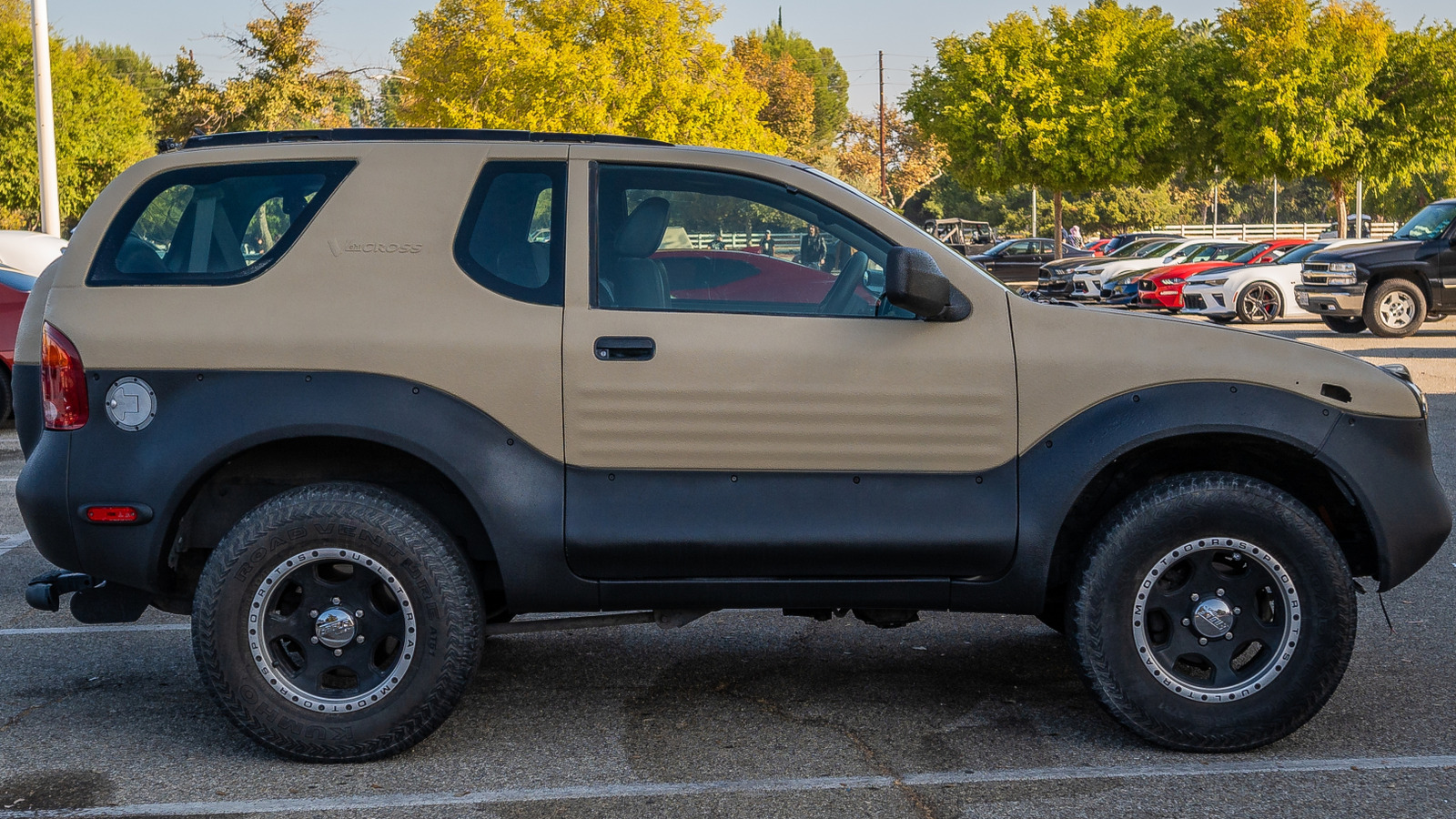
The pint-sized Isuzu VehiCross was sold in the U.S. from 1999 through 2001. It was the early days of the SUV boom, and boxy was still the name of the game. The VehiCross bucked that trend with smooth lines that were ahead of its time. The two-door SUV featured a stubby body with high ground clearance and thick plastic body cladding on the bottom of the vehicle. A molded spare tire cover was built right into the rear hatch, and a small grille with two fang-like vertical inserts in front was complemented by two narrow, snake-eye headlights. Whether it’s an eyesore or a cult classic is up to you to decide, but you can’t argue its rare style.
Under the hood, the VehiCross had a 3.5-liter V6 engine with a very respectable 215 horsepower. In fact, the SUV won both the 1998 Paris-Dakar Rally and 1999 Australian Safari Rally in its class. The SUV also boasted low and high-range four-wheel drive and had an independent torque system that used sensors to send power to each wheel. The interior was as striking as the exterior, with two-toned black and red leather seats and red door panels. The VehiCross turned heads, but it had an MSRP of $28,900, or more than $58,000 in 2026 dollars! Only about 4,000 were sold in the U.S., and Isuzu only made about 6,000 VehiCross models in total, so they are a rare sighting today.
MINI Paceman
MINIs may not have mass-market popularity in the U.S., but you’ve certainly spotted them tooling around. They’re easily identifiable by their iconic round headlights, compact shape, bright paint and contrasting roof colors. Even if you own one, however, you may not know that MINI also sold a subcompact crossover SUV called the Paceman. It was similar to the automaker’s popular Countryman, but had two doors instead of four and a boxy silhouette. Produced from 2013 through 2016, it struggled to find its niche and was ultimately discontinued due to lackluster sales.
The base Paceman had a 1.6-liter engine and front-wheel drive. The all-wheel drive model added a turbocharged four-cylinder with 181 horsepower. The interior sported MINI’s iconic circular screen, gauges, and vents, along with seating for four. The base model cost $23,550, which was more expensive than the Countryman. Ultimately, it felt too bulky for many MINI customers, and too impractical compared to the Countryman, which has four doors. Still, if this MINI SUV appeals to you, you can buy one today for less than $10,000. Reviewers found it fun to drive, and it’s a good option if you’re looking for an enjoyable weekend driver.