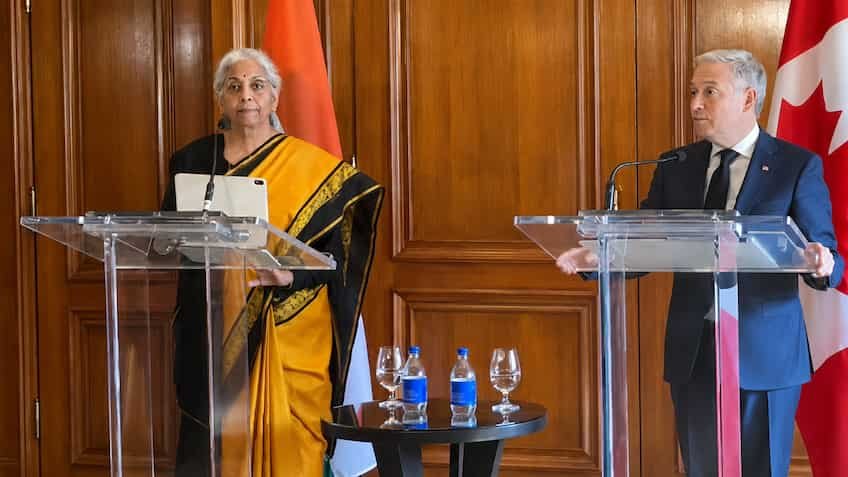
In the Ministerial 'Economic and Financial Dialogue (EFD)' organized with the aim of giving new impetus to bilateral economic relations between India and Canada, both the countries have taken many important and far-reaching decisions. In this high-level talks, it has been agreed to promote cross-border payment system, fintech innovation, modernization of financial services and institutional capital investment between the two countries. This meeting, held amid global economic uncertainties, is going to prove to be a major milestone towards stronger economic partnership, trade facilitation and integration of digital financial infrastructure between the two democratic countries. A new era of cooperation in cross-border payments and fintech innovation The main focus of the dialogue was digital financial technologies and simplification of cross-border payments. Both sides positively discussed the potential interlinkage of Canada's financial payments systems with India's advanced digital public infrastructure (DPI) and UPI technology. This collaboration will directly benefit the citizens of both the countries, especially the large Indian diaspora, students and small-medium business establishments (MSMEs) living in Canada. This will not only drastically reduce the cost of foreign remittances, but the transaction speed will also be made secure and smooth in real-time. It has also been agreed to provide regulatory support to fintech startups and financial institutions of both the countries for technological exchange and innovation in each other's markets. Roadmap for heavy investment in Canadian pension funds and infrastructure Given India's fast growing economy and huge domestic market, Canadian institutional investors and pension funds (e.g. CPPIB, CDPQ) have shown keen interest in increasing investments in Indian infrastructure, renewable energy, logistics and real estate sectors. During the dialogue, India highlighted the immense opportunities that exist for global investors in its strong macroeconomic fundamentals, production-linked incentive (PLI) schemes for the manufacturing sector and National Infrastructure Pipeline (NIP). The two countries also discussed in detail transparent policies for investors, dispute resolution mechanisms and financial regulations that provide security to long-term capital flows. Focus on Green Finance and Sustainable Climate Projects Special emphasis was placed on promoting green and climate financing to address the global challenges of climate change and achieve the Sustainable Development Goals (SDGs). Both countries have decided to cooperate on the development of sovereign green bonds and ESG based financial products to raise funds for renewable energy projects, green hydrogen, electric mobility and sustainable infrastructure. Technical expertise will be shared across financial regulators to create a common sustainable finance framework, making it easier to attract global private capital into the clean energy sector. Common stance on financial regulation and global multilateral fora India and Canada reiterated their commitment to pursue common economic interests at multilateral fora such as the G20, the International Monetary Fund (IMF), the World Bank and the Financial Stability Board (FSB). It has been agreed to further strengthen real-time information exchange between Financial Intelligence Units (FIUs) to combat money laundering and terrorist financing (AML/CFT). Additionally, discussions have also moved towards creating a common cyber defense mechanism to counter the impacts of Artificial Intelligence (AI) and cybersecurity on the financial system. Trade and strategic partnership will get new strength. This dialogue is very important not only for the financial sector but also for restoring the overall trade balance and diplomatic trust of both the countries. Experts believe that with the ease of financial and banking channels, there will be a rapid increase in bilateral trade in goods and services. Technical teams from the finance ministries and central banks of both the countries will now work continuously under a Joint Task Force for the implementation of these agreements.