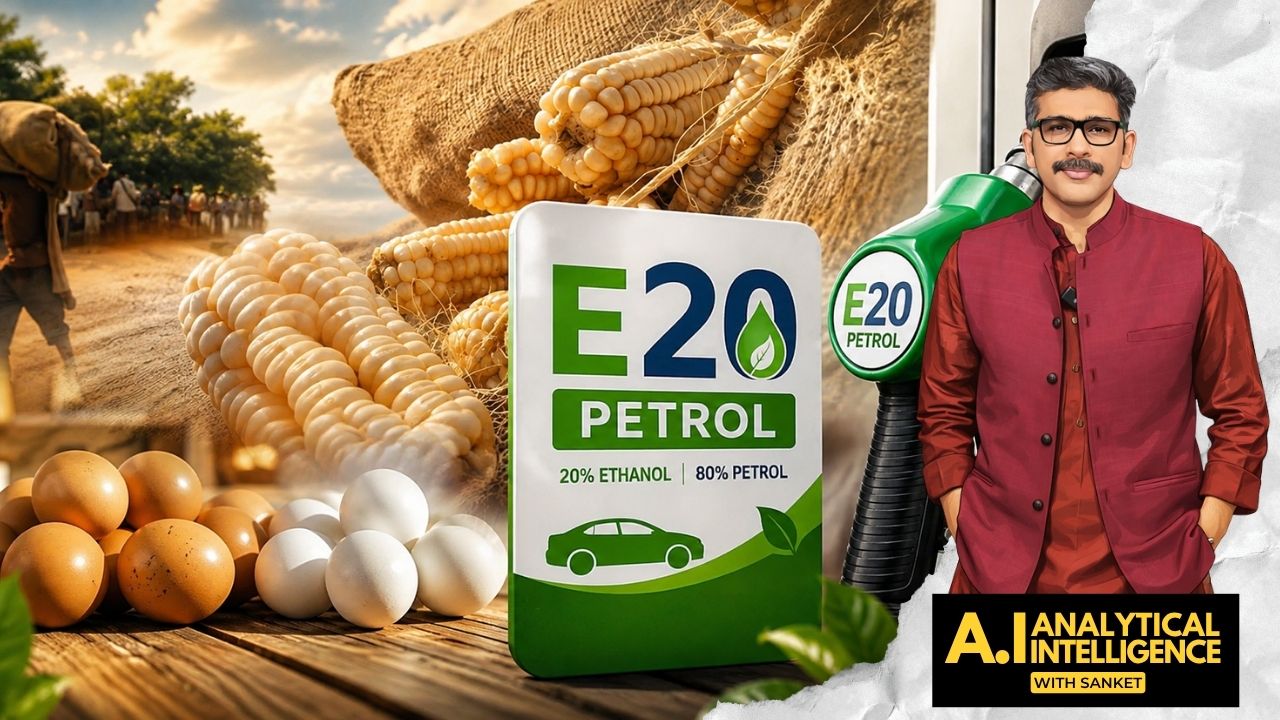
India should not raise ethanol blending beyond 20 per cent until the government assesses its impact on food prices and agricultural supply, former Agriculture Secretary Siraj Hussain said, as concerns grow over maize availability, poultry feed costs and consumer prices.
Speaking to The FederalHussain said the ethanol policy had helped create an assured market for crops such as maize and sugarcane, improving returns for farmers who had long struggled with low prices and delayed payments. However, he argued that pushing blending beyond 20 per cent could upset the balance between food, fuel and agricultural needs, particularly if more maize and other crops are diverted towards ethanol.
Maize diversion raises concerns
The former Agriculture Secretary acknowledged that higher maize prices have contributed to rising poultry feed costs and egg prices, but said ethanol should not be blamed for the entire increase. He pointed to other factors, including a decline in soybean acreage, while warning that expanding maize production without ensuring sufficient demand could also hurt farmers.
Also read | E20 debate: Is govt pushing ethanol at the cost of food security?
Hussain also opposed large-scale diversion of government rice stocks for ethanol at low prices, arguing that food stocks should not be diverted excessively when the priority should be maintaining food affordability. He said the government should first assess the broader impact of the ethanol roadmap on food supplies and prices before considering any blending target beyond 20 per cent.
The concern is already visible in the poultry sector, where maize is a key feed ingredient. Former NAFED managing director Sanjeev Kumar Chadha said diversion of maize towards ethanol has tightened supplies and contributed to higher feed costs and egg prices.
The pressure is particularly visible in the poultry sector, where maize accounts for about 60% of feed, according to Chadha. He said diversion of maize towards ethanol has added to supply pressures and contributed to higher poultry feed costs and egg prices. With more than six million jobs linked to the poultry sector, Chadha said the immediate priority should be to improve the availability of feed ingredients, including through imports if necessary.
Boost maize, diversify cropping
Chadha argued that India needs to raise maize production and diversify its cropping pattern instead of remaining heavily dependent on crops such as paddy. He also said policymakers should consider allowing imports of genetically modified feed if required to ease supply constraints. At the same time, he cautioned against viewing ethanol as the sole reason for rising food prices, saying demand, supply, weather conditions and other factors also influence commodity prices.
Chadha also questioned whether India’s pursuit of energy security through ethanol could end up undermining that very objective if the diversion of crops forces the country to import food commodities. He said the long-term strategy should focus on expanding acreage under maize, soybean and sugarcane while ensuring remunerative returns for farmers, alongside a more predictable import policy that does not expose farmers and traders to sudden policy changes.
He also flagged sugar as an area where policymakers need to better balance domestic availability and demand. With festival-season demand typically putting additional pressure on supplies, Chadha said decisions on exports and imports should be based on a careful assessment of domestic production and consumption rather than repeated policy shifts.
Beyond maize, Chadha flagged onions and pulses as other commodities that could come under pressure. He said heavy monsoon rains have damaged stored onion stocks in some areas, raising the possibility of higher prices. Pulses could also see increased pressure ahead of the festival season as demand rises, a concern given their importance as a relatively affordable source of protein for a large section of India’s vegetarian population.
Balancing energy and food security
The discussion also shifted to the impact of ethanol policy on consumers. Consumer Voice COO Abhijit Bose said the issue should not be framed simply as a choice between ethanol and petrol, but as a question of whether India can pursue energy security without compromising food affordability. If blending targets rise beyond E20, he warned, consumers could face additional costs through vehicle performance, maintenance and fuel efficiency, arguing that the full consumer impact of such policies should be assessed before further implementation.
Bose said consumer interests need to be built into policymaking from the outset rather than addressed only after prices rise. He called for a mechanism to assess the likely impact of major policy decisions on consumers, arguing that those who buy food, fuel and other essentials cannot be treated as an “externality” of energy policy.
Also read | Forgotten in ethanol debate: Two-wheelers, not cars, are paying the real price for E20
The debate ultimately comes down to how India balances farmer incomes, energy security, food availability and consumer purchasing power. Hussain’s recommendation was to hold the blending target at 20% and assess its wider consequences before going further. He also questioned the economics of domestic ethanol at crude oil prices of around $70 a barrel, arguing that India needs to weigh the cost of pursuing higher blending against the potential impact on food supplies and affordability.