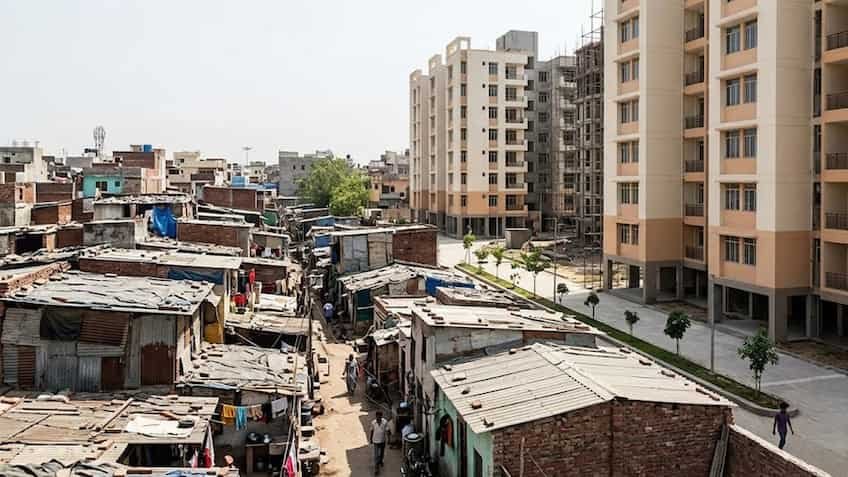
The Central Government and Delhi Development Authority (DDA) have taken a revolutionary step for the millions of poor and middle class families who have been living in slums (JJ Clusters) for years in the country's capital Delhi. In the 'Master Plan for Delhi 2047 – MPD-2047' unveiled by the Union Housing and Urban Affairs Ministry, a detailed roadmap has been prepared to provide permanent flats with modern amenities to more than 17 lakh slum dwellers of the capital in their own areas. The basic mantra of this master plan is 'Where there is a slum, there is a house' (In-situ Slum Rehabilitation). What this simply means is that instead of displacing the slum dwellers to a desolate outskirts 30-40 kilometers away from the city, they will be given permanent houses with ownership rights by building multi-storey modern residential societies on the same land where they have been living for decades. To implement this scheme at a faster pace, the government has completely redesigned the Public-Private Partnership (PPP) model, in which the country's big and reputed private real estate developers will directly carry out the construction work. Private builders will build permanent houses: Why the new PPP model has become attractive for developers Till now, the pace of in-situ slum redevelopment was quite slow, as private builders saw limited commercial benefits in it. But in the Master Plan 2047, the government has announced huge policy changes and huge discounts and attractive incentives for private developers: Floor Area Ratio (FAR) increased to 500: While in the old Master Plan, the FAR was 400 for the residential portion and 300 for the commercial portion, now it has been increased to a record 500 for both the components. By getting higher FAR, builders will be able to construct high-rise residential and commercial buildings with 15 to 20 storeys on limited land. Exemption for commercial sale on 60% land: Under the revised policy, free flats will be built for slum dwellers on at least 40% of the total slum plot. On the remaining 60% land, private builders will be able to build luxury flats, shopping complexes, corporate offices or retail outlets and sell them in the open market. This 'free-sale' component will enable builders to earn huge profits, due to which they are taking interest in slum rehabilitation. Plot area limit reduced: The minimum land requirement for group housing and slum redevelopment has been reduced to a flexible range of 2,000 to 3,000 square metres, which will enable easy cluster-based redevelopment of even small settlements. New cut-off date made 1 January 2025: Which families will be eligible for permanent flats? Historic amendments have been made in the Delhi Urban Shelter Improvement Board (DUSIB) Act and Delhi Slum Rehabilitation Policy 2026 regarding the scope of the scheme. While earlier the cut-off date of January 1, 2015 was applicable, now it has been extended by 10 years to January 1, 2025. New eligibility criteria after this change: Whatever slum or kutcha housing was present in the notified JJ Cluster of Delhi on or before January 1, 2025, that family will be considered legally entitled to a pucca flat under this in-situ scheme. The head of the family should have valid local residence certificate like Aadhar Card, Voter ID Card, Ration Card, Electricity Bill or Bank Passbook. Digital data of all eligible beneficiaries is being prepared by DDA and DUSIB through drone survey and biometric mapping, so that there is no scope for any kind of fraud in the allocation. What modern facilities will be available in the flats: Smart township will be built, not a slum. The in-situ flats to be built under the Master Plan 2047 will not be just brick-and-mortar rooms, but will be equipped with modern infrastructure on the lines of a gated society: 24×7 piped drinking water and underground sewerage: Every flat will have individual tap connection, modern modular toilet and round-the-clock electricity and water supply. Lift and fire safety: All high-rise towers will be fitted with automatic lifts, emergency power backup and modern fire fighting systems. Social Infrastructure: Primary health center (Dispensary), government school, Anganwadi centre, community hall and park for senior citizens will be developed within the campus. Green Energy and Solar Rooftop: Solar panels and rainwater harvesting systems have been made mandatory on the rooftops of societies, so that electricity consumption in common areas can be reduced to zero. Roads and commercial facilities: Shops will be allowed to be opened on the ground floor on 30 meter wide roads, so that local residents will be able to get employment and shopping facilities nearby. Success from Kalkaji and Ashok Vihar: Now work will be done in 750 settlements. This in-situ model has already been successfully tested by DDA in Delhi. 3,024 flats in Kalkaji and 1,675 multi-storey flats in Jailerwala Bagh in Ashok Vihar have already been constructed and handed over to slum dwellers, while the Kathputli Colony Redevelopment Project is in its final stages under the PPP model. Following the instructions of the Union Home Ministry and the Lieutenant Governor, in the first phase, tenders for 5 major JJ clusters are being issued and DPR for the next 50 sensitive clusters has been prepared. Around 750 slum clusters in Delhi are targeted to be converted into modern multi-storey residential complexes in the next few years in a phased manner. Where on-site construction is not possible due to geographical reasons, people will be shifted to nearby EWS vacant houses. Delhi Master Plan 2047: 40 lakh new houses and a new network of public transport Master Plan 2047 is not limited to just slum rehabilitation, but it is an ambitious vision of providing systematic shelter to the estimated population of 3.2 crore Delhi by the year 2047. Highlights of the master plan: A total of 40 lakh new houses: A total of 40 lakh affordable and modern houses will be built in Delhi, of which 18 lakh houses will be developed in Transit-Oriented Development (TOD) zones near the Metro corridor. Regularization of 1,511 unauthorized colonies: 45 lakh residents will get ownership rights and basic facilities on 'as is where is' basis. Affordable Rental Housing: Affordable rental houses will be built for migrant workers, students and youth with 50% FAR incentive. Last-Mile Connectivity: Namo Bharat (RRTS), an integrated network of over 400 km long metro network, electric buses and cycle tracks is being built to reduce dependence on private vehicles. This modified PPP model of 'Where there is a slum, there is a house' is going to prove to be the biggest game changer in the direction of making Delhi slum-free and a world-class, clean and inclusive capital.