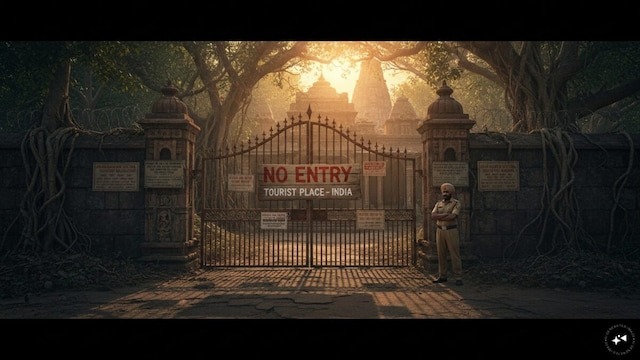
India is such a vast and diverse country where every year millions of tourists come to make their holidays memorable and discover new places. There is no dearth of snowy mountains, beautiful beaches, dense forests and historical forts in our country, which attract tourists from all over the world. But do you know that there are some very beautiful and mysterious places on the geographical map of India where the visit of common citizens and tourists has been completely banned by the government and administration? Yes, it is true that there are many such restricted and secret areas in the country where even birds cannot be killed and entering there without any special government permission or permit is considered a legal crime. There are very serious reasons behind the no-entry of common tourists at these places like national security, activities of the country's intelligence army, conservation of rare and dangerous wildlife, or protection of age-old tribal cultures and primitive castes. In today's modern era, where people look for secluded and unheard places away from the crowd, the mystery of these restricted places always creates a great curiosity in the minds of people. Let us today tell you in detail about 6 such safest and restricted places in India, where the visit of common tourists is completely prohibited and you will be surprised to know the reason behind them. 1. North Sentinel Island (Andaman and Nicobar): The world's most dangerous and isolated primitive area, North Sentinel Island, which comes under the Andaman and Nicobar Islands of India, is considered one of the biggest mysteries for geographers and tourists around the world. On this small island in the Bay of Bengal, there lives an ancient and primitive tribe called Sentinelese who has not had any kind of contact with the modern world and external civilization till date. This tribe has a highly aggressive and violent attitude towards outsiders, and whenever any sailor or outsider tries to go there, they attack him with bows and arrows. The Home Ministry of the Government of India and the local administration have imposed a complete ban on any person going within a radius of 5 kilometers of this island due to security reasons. The main objective of this rule, on one hand, is to protect the lives of the people of that dangerous and endangered tribe, on the other hand, it is also to protect them from diseases of the outside world which can prove fatal for them. This is why visiting Sentinel Island is a legal offense and it tops the list of most restricted tourist destinations in the world. 2. Some secret and untouched coral reef islands of Lakshadweep: No entry for general public to conserve nature. Everyone knows about Lakshadweep, India's most beautiful and blue sea union territory, where its sandy shores attract tourists. But do you know that tourists are not free to visit all the islands of Lakshadweep group, rather many of its small and sensitive islands are completely banned. Only a few selected islands like Bangaram and Kalpeni have been opened for tourists, while on many other islands there is a strict ban on the entry of common citizens. The main reason behind this is the conservation of the delicate marine ecosystem, rare coral reefs and marine creatures which can be destroyed due to human interference. The government and the environment ministry want to ensure that this precious treasure of nature is completely protected from human pollution and commercial activities. Therefore, if you are planning to visit Lakshadweep, you should know that you can visit only those selected places where official permission is provided by the administration. 3. Some parts of Ladakh's Pangong Tso Lake and Chusul Valley: Strategically and militarily sensitive area. Pangong Tso Lake, located in Ladakh, famous all over the world for its cold desert of India and its natural beauty, is the main center of attraction among tourists. But very few people know that a large part of this long and beautiful lake falls in the Tibet region across the Line of Actual Control (LAC) between India and China. Due to being highly sensitive from security and strategic point of view, there is a strict restriction on the movement of common tourists in all the banks of this lake and its surrounding remote areas like Chusul Valley and Demchok. Without the permission of the Indian Army, you can go only up to a certain limit, and beyond that the Army stops you because the entire area comes under the high-security zone. This restriction is extremely necessary to protect the country's borders and maintain the secrecy of secret military activities, so that intelligence agencies of any foreign country cannot gather information about Indian strategic targets. 4. Bhangarh Fort of Rajasthan (at night): One of the scariest places in the world where restrictions start as soon as the sun sets. Bhangarh Fort, located in Alwar district of Rajasthan, famous for its historical forts and palaces, is famous in the country and the world as one of the most mysterious and haunted places in India. Although thousands of tourists come here during the day to see the history and architecture, but the Archaeological Survey of India (ASI) and the local administration have completely banned staying or entering the fort premises at night. According to local people and old folk tales, there are many scary stories associated with this fort due to which no person is able to muster the courage to go here after dusk. For security and to prevent the activities of anti-social elements, strict instructions have been issued at the administrative level that the main gate of Bhangarh Fort should be closed after sunset and entry of anyone there should be prohibited. This is such a unique attraction that offers a wonderful blend of history, fear and adventure and attracts tourists. 5. Remote border villages with Inner Line Permit (ILP) in Arunachal Pradesh and Sikkim Arunachal Pradesh and Sikkim, two very beautiful and hilly states of North-East India, are known for their natural greenery, snow-capped mountains and Buddhist monasteries. But there are many such remote border areas and villages of these states which are located very close to the international borders of China and Bhutan, and to go there even the common citizens of the country have to obtain a special Inner Line Permit (ILP). Without this valid permit, you cannot even step into those sensitive areas, and for foreign nationals the rules for entering these areas are even more stringent and complex. The main objective of this arrangement of the government is to ensure that the security arrangements on the international borders of the country remain tight and no suspicious person can reach the border villages without verification. To see these caves, lakes and mountains of the North-East, tourists first have to visit administrative offices and only after getting permission, they are able to travel to these restricted areas. 6. Jarawa Reserve Forest Area of Andaman: Strict law to prevent external interference in tribal lifestyle. The habitat of 'Jarawa Tribe' is situated in the areas called the main part of Andaman and Nicobar Islands, around which a huge reserve forest area has been created. The government has declared this entire area as a tribal conservation area and there is a complete ban on tourists stopping, taking photographs or contacting the tribals even on the main road (Andaman Trunk Road) passing through here. In the past, inhuman incidents like some tour operators taking tourists close to these tribals and teasing them had come to light, after which the Supreme Court and the administration took a very strict stance on this. In today's time, entering the Jarawa Reserve area without administrative security and a special valid reason is a punishable offence, which can even lead to jail time. This ban is proof that modern society has no right to interfere in the native culture of the tribals, their freedom and their secluded life, and the government is fully committed to their safety.