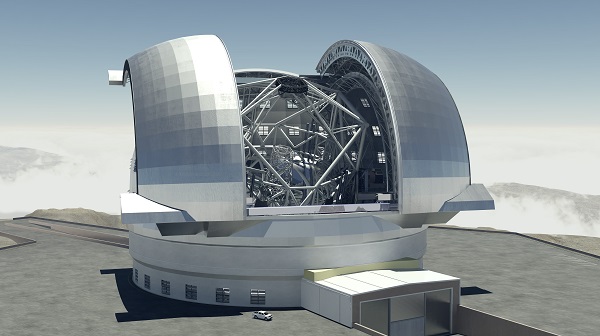
santiago. Human efforts to understand the mysteries of the Universe are now reaching another milestone. More than 70 percent of the construction work of the Extremely Large Telescope (ELT), the world's largest telescope being built in Chile's Atacama Desert, has been completed. The huge main structure of this ambitious project of the European Southern Observatory (ESO) was recently successfully rotated on its axis for the first time.
According to scientists, this test is an important achievement in the construction of the telescope. The ELT is expected to begin observing the universe in the late 2030s.
First test of 35 lakh kg structure conducted
The main structure of ELT weighs about 3,500 tonnes i.e. 35 lakh kilograms. To study objects in any direction in space, it is necessary to rotate this huge structure with utmost precision. For the first time, this capability was tested by rotating it on its axis.
The main mirror of ELT will be about 39 meters i.e. 128 feet wide. This huge mirror will work to collect extremely weak light coming from distant space.
Keeping an eye on Earth-like planets
The ELT's most important scientific achievements will include the study of rocky Earth-like planets orbiting other stars. Scientists will try to get a direct picture of such planets.
When the light of an outer planet passes through its star's atmosphere, the ELT will be able to do a very precise analysis of that light. This can help scientists identify the gases present in the planet's atmosphere and understand whether conditions favorable to life exist there.
Millions of times more powerful than the human eye
The capability of ELT can be gauged from the fact that it is said to be about 100 million times more powerful than the human eye. Its images are expected to be about 16 times clearer than those of the Hubble Space Telescope.
Hubble studies the universe in space at an altitude of about 500 kilometers from the Earth, while the ELT is being installed on Earth at an altitude of about 3,046 meters on Chile's Cerro Armajones mountain. Atacama's extremely dry and clear environment is considered favorable for astronomical observations.
The secrets of the early universe will be revealed
The purpose of ELT is not just to search for exoplanets. Through this, scientists will try to study the early galaxies formed after the Big Bang. This could help us understand what the early universe was like and how the first galaxies formed.
Apart from this, telescope can also play an important role in measuring the speed of expansion of the universe and understanding mysterious topics like dark matter and dark energy.
Will a picture of a world like Earth appear for the first time?
Currently, scientists detect many outer planets on the basis of changes in the light of their stars. ELT will try to take this study one step further. Its state-of-the-art capability will increase the possibility of taking direct images of rocky planets orbiting other stars and analyzing the chemical signals present in their atmosphere.
If possible signs of life are found in the atmosphere of these planets, it could be one of the most important scientific discoveries in human history. However, the presence of a single gas in the atmosphere alone will not be sufficient to confirm life on a planet and scientists will have to study multiple independent lines of evidence.