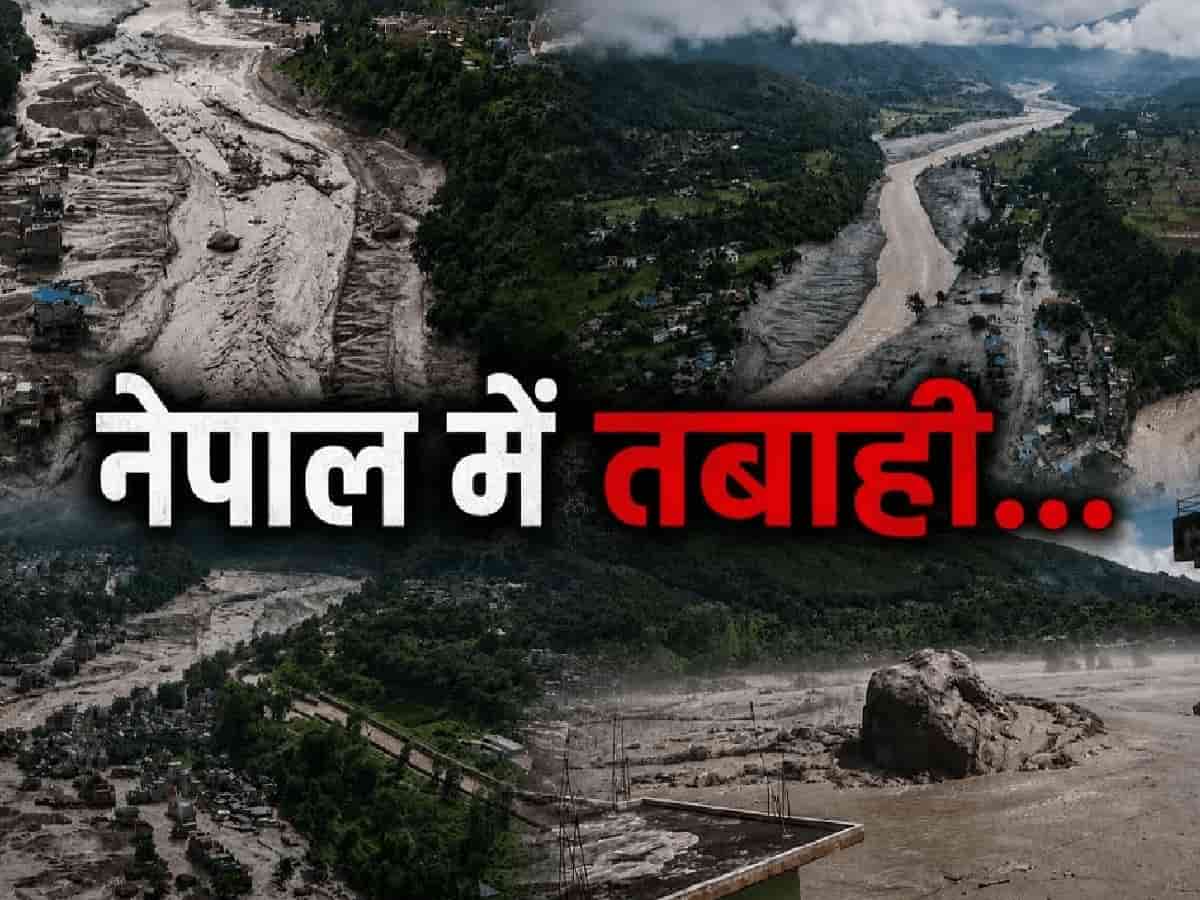
India has taken strict protective measures after the recent horrific natural disaster and glacier collapse on the border of Nepal and Tibet. Taking a lesson from this major accident, the Government of India and the neighboring hill states have greatly strengthened the surveillance system in their sensitive Himalayan areas bordering China and Nepal. Officials on Saturday confirmed that all important glaciers and glacial lakes located in the border mountain areas will now be under special and continuous monitoring, so that any potential danger can be detected in time. US Geological Survey report and Nepal disaster data According to the preliminary and detailed report released by the US Geological Survey (USGS), the devastating disaster that occurred on the Tibet-Nepal border on August 26 was actually caused by the sudden collapse of a huge glacier. After this terrible incident, a huge flow of water, mud and rocks suddenly moved towards the plains and valley areas below, destroying the villages and towns along the way. According to official and available data, so far more than 633 people have been confirmed dead in this unexpected disaster, while about 3,000 people are still reported missing, for whom relief agencies are busy searching. Big step by Uttarakhand government, high alert in sensitive areas. Uttarakhand, one of the most beautiful and geographically sensitive Himalayan states of India, has immediately taken strict steps after this tragedy in Nepal. Uttarakhand Disaster Management Minister Madan Kaushik, while talking to leading news agency AFP, clarified that in view of our common border with Nepal and almost similar challenging geographical conditions, the state government has taken a historic decision to increase surveillance as a precautionary measure. He bluntly said that since our geographical location is very similar to Nepal, we have issued strict instructions to our disaster management and related departments to closely monitor all the active glaciers and dangerous glacial lakes in the region. The administrative and relief teams of the state have been asked to be on full alert and keep a constant eye on the weather and geological activities, so that any emergency situation can be identified at an early stage and lives can be saved safely. Geographical Sensitivity of Uttarakhand and Threat of Thousands of Glacial Lakes According to experts and environmentalists, Uttarakhand holds a prominent place among the most ecologically sensitive regions of India. According to government data and scientific surveys, there are around 1,266 glacial lakes present in this mountainous state alone, which are constantly changing with time and due to global warming. Scientists and environmental experts from India and abroad have been warning for a long time that the entire Himalayan region is highly sensitive to the ill effects of global warming and climate change. These vast Himalayan glaciers, which are the source of Asia's major rivers and provide life-sustaining water to nearly two billion people, are now melting at a faster rate than in history. Due to this, the sword of a major natural disaster always hangs over the mountain communities and settlements. The risk of landslides is increasing due to the melting of permafrost and the weakness of the mountains. Scientists believe that due to rising temperatures, not only the glaciers are melting, but the ice that has been permanently frozen for centuries within the rocks of the mountains, i.e. permafrost, is also melting. Melting of permafrost greatly weakens the internal stability and grip of mountain slopes, due to which the risk of sudden large-scale landslides and rockslides increases manifold. Such geographical upheavals can cause massive devastation at any time, and the Nepal incident is the most recent and painful example of this. Opinion of international scientists: The possibility of such incidents in the future cannot be ruled out. Meanwhile, scientists around the world are busy studying in depth the exact and possible causes of the Nepal-Tibet disaster. Speaking to AFP, several international experts warned that such horrific incidents could be repeated in other mountainous regions in the future. Simon Cox, chief scientist of New Zealand's prestigious GNS Science Research Institute, explained that when a huge part of a mountain suddenly collapses, the terrain around it also becomes unstable. According to him, due to such a process, there is always a possibility of a large-scale collapse or avalanche again in the same area. The US Geological Survey (USGS) also says that this collapse of the glacier on the Nepal-Tibet border was so powerful that the energy released from it was estimated to be equivalent to a strong earthquake of about 5.2 magnitude on the Richter scale, due to which tremors and vibrations were recorded in several successive landslides in the area. Etienne Bertier, chief glacier expert at France's National Center for Scientific Research (CNRS), also confirmed that the possibility of such unexpected events in other parts of the world cannot be completely ruled out, although the complex and young geological structure of the Himalayan region makes the impact of these disasters more widespread. Scientists alert on the link between climate change and disaster Tristram Hales, an environmental risk and disaster expert at Cardiff University, shared the data and said that during the last decade, the number of such incidents has increased rapidly in mountainous regions around the world, and for this he cited the example of the Himalayas as well as European regions like Switzerland. Despite all this, however, many renowned scientists have advised caution against hastily linking this particular disaster directly to climate change. The International Center for Integrated Mountain Development (ICIMOD) in its official statement said that there is no doubt that climate change is seriously affecting the health of Himalayan glaciers, snow, permafrost and mountain slopes, but it is too early to conclude what role global warming alone played in this particular incident. According to experts, to put a concrete seal on this entire matter, detailed scientific research and in scientific language the so-called "attribution study" (Attribution Study) is required, only after completion of which concrete conclusions can be drawn on the direct and scientific relationship between climate change and this specific disaster. Till then, it would be wise for neighboring countries like India to keep their surveillance systems state-of-the-art and vigilant.