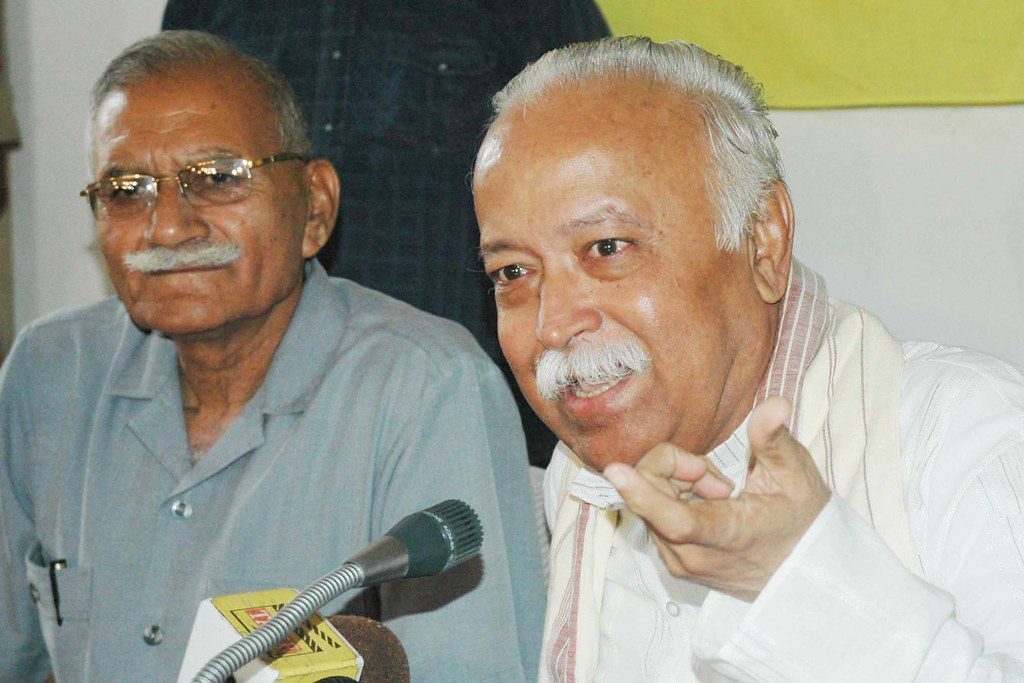
The RSS chief’s centenary tour is promoting pluralism, loyalty and service, but protests and calls to block his entry show that the organization is also fighting a global battle over the meaning of Hindutva.
By The Obnews Editorial Staff
The Rashtriya Swayamsevak Sangh is no longer speaking only to India. Over the final days of August, RSS chief Mohan Bhagwat moved through the most visible portion of a three country outreach tour, beginning in the United States, continuing to the Greater Toronto Area and then heading toward Britain. The official language of the tour has been unity, friendship and service. The political reality surrounding it has been far more contested.

On August 29, Bhagwat addressed the Universal Oneness Celebration at the Infosys Theater inside New York’s Madison Square Garden complex. The RSS said about 6,000 delegates attended from 39 states, hundreds of American cities and 29 countries. The next evening in Vaughan, north of Toronto, more than 2,000 people gathered for Hindu Vishwa Bandhu, or Embrace the World in Friendship, with the RSS saying 175 host organizations from all 10 Canadian provinces were represented. London is expected to be the final major stop, with a community leadership program announced but few public details available as of September 1.
This was not an official Indian government tour. Bhagwat holds no government office. Yet it would be a mistake to treat the journey as ordinary cultural travel. The RSS is the ideological source from which the Bharatiya Janata Party emerged, and Prime Minister Narendra Modi spent years as a full time RSS organizer before entering electoral politics. Bhagwat, who has led the RSS since 2009, therefore carries influence without holding a cabinet title or contesting an election.
The size of the organization helps explain why his overseas appearances receive such attention. Founded in Nagpur in 1925 by Keshav Baliram Hedgewar, the RSS entered its centenary year with a vast grassroots network. In March 2026, the organization said it was operating more than 88,000 daily shakhas in over 55,000 locations across India. It defines itself as a Hindu centred civilizational and cultural movement devoted to social organization, character building and service. Critics, including human rights groups and many scholars, describe it as a Hindu nationalist movement whose idea of India can marginalize religious minorities. That unresolved argument followed Bhagwat across every border.
A planned campaign to change the global conversation
The tour did not emerge suddenly. RSS leaders have openly described international outreach as a centenary priority. At a press conference in August, senior RSS official C.R. Mukunda said the foreign program had three central goals: to present what the organization considers a factual and positive account of India, Hindu society and the RSS; to promote Vasudhaiva Kutumbakam, the idea that the world is one family; and to increase dialogue with mainstream society about the interests and rights of Hindus and people of Indian origin.
That message also fits a broader campaign already underway. In May, RSS general secretary Dattatreya Hosabale told foreign journalists that he had met academics, policy makers and business leaders in the United States, Germany and Britain to counter what he called misconceptions that the RSS was backward looking, paramilitary, supremacist or hostile to non Hindus. He said more visits were planned in Europe and Southeast Asia. In other words, Bhagwat’s tour is the most visible part of an organized effort to establish the RSS as a participant in international civic and political conversation.
New York provided the largest stage. Organizers from American Hindus for Engagement and Dialogue framed the Madison Square Garden program around Raksha Bandhan, extending the festival’s idea of mutual responsibility beyond the family to society, humanity and the natural world. Bhagwat connected American pluralism with India’s idea of unity in diversity. He told Indian Americans that they owed loyalty and service to the United States as their karmabhoomi, or land of work, while living by the values inherited from their janmabhoomi, or land of birth.
His language was deliberately universal. He spoke about responsibility to farmers, workers and the environment, argued that diversity should be celebrated, and said, “Diversity is natural and unity is Truth.” According to the RSS account, 180 religious leaders from 30 countries endorsed a five point call for action rejecting the use of religion to justify humiliation, hatred or violence. The event also featured cultural performances and an interfaith observance of Raksha Bandhan.
During the wider New York program, Bhagwat made one of the tour’s most widely reported statements about Muslims. Speaking at a One World One Humanity gathering, he said that if a Hindu believed Muslims should have no place in Bharat, “he will not remain Hindu.” He argued that all people possess equal dignity and that different religious paths can lead toward the same truth. Bhagwat also visited the Bhakti Center in New York, paid tribute to ISKCON founder A.C. Bhaktivedanta Swami Prabhupada and participated in a food distribution effort for homeless people. Separate meetings were held with diaspora representatives, community leaders and business figures.
The publicity was unmistakable. Before the main address, Bhagwat’s image appeared on a Times Square billboard beside the words “Resolve, Harmony and Dialogue.” Supporters viewed the moment as overdue recognition for an organization they associate with discipline, cultural confidence and social service. It also revealed that the centenary tour was designed not merely to meet existing RSS supporters but to project a new public identity in the West.
New York also exposed the opposition
That effort immediately encountered resistance. New York Mayor Zohran Mamdani said he opposed the event and described the RSS vision as exclusionary, while acknowledging that the city did not appear to have jurisdiction to cancel a private gathering. A coalition of 61 interfaith, civil rights, Muslim, Sikh, Christian, Dalit and progressive Hindu organizations signed a letter against the appearance. Groups including Hindus for Human Rights, the Indian American Muslim Council and the Interfaith Center of New York held a news conference and helped organize a protest outside the venue.
The United States Commission on International Religious Freedom went further. Its chair, Asif Mahmood, urged Washington to consider sanctions against RSS members and to revoke Bhagwat’s visa, citing alleged religious freedom violations involving minorities in India. The commission is a bipartisan federal body, but its recommendations are advisory and do not bind the United States government. Washington did not act on the request. India’s foreign ministry rejected the commission’s criticism as biased, while the RSS denied accusations of intolerance and repeated that it seeks cultural unity rather than supremacy.
This is the central contradiction the tour is trying to overcome. Bhagwat’s words in New York were inclusive, especially his rejection of excluding Muslims. Critics respond that speeches abroad must be judged against the conduct and rhetoric associated with the wider Sangh network and the record of BJP governments in India. Supporters answer that opponents routinely collapse the RSS, the BJP, independent Hindu groups and individual extremists into a single category, ignoring service work and Bhagwat’s repeated statements on coexistence. The tour did not settle that dispute. It carried it into mainstream American public life.
Why the Toronto stop mattered even more for Canada
The Canadian appearance carried a different weight. It was Bhagwat’s first visit to Canada and the first reported visit by an RSS chief since K.S. Sudarshan came in 2005. Security was tight, and the Vaughan venue was reportedly disclosed only about 24 hours before the gathering. The timing was sensitive because Canada India relations are recovering from a severe diplomatic breakdown, even as concerns about foreign interference and threats against Canadian Sikhs remain part of the national debate.
At the Toronto area event, Bhagwat returned to the language of diversity and service. He argued that India should seek to become a Vishwaguru, a source of knowledge and moral leadership, rather than a Mahashakti pursuing domination. He cited India’s historic acceptance of persecuted communities, the Maharaja of Jamnagar’s protection of Polish refugees during the Second World War and Indian evacuations of foreign nationals from conflict zones. His broader claim was that the rise of India should produce a more united and emancipated humanity, not a hierarchy controlled by India.
Former Alberta premier and former federal defence minister Jason Kenney shared the stage, as did Kashmir Singh Dhaliwal, representing Vancouver’s Khalsa Diwan Society and the historic Ross Street gurdwara. Kenney praised the renewed momentum in Canada India relations and referred to Prime Minister Modi’s expected visit to Canada later in 2026, prompting chants of “Modi, Modi” from sections of the audience. Their presence gave the gathering a significance beyond a private religious meeting, connecting community organization, Canadian public life and the improving bilateral relationship.
The visit had already produced an unusually direct political confrontation. NDP foreign affairs critic Heather McPherson and immigration and public safety critic Jenny Kwan asked the federal government to deny Bhagwat entry and renewed their party’s call to list the RSS as a terrorist entity. A separate letter signed by 267 Canadian organizations, advocates and community leaders urged an admissibility review and argued that Bhagwat’s presence could deepen fear among minority communities.
More than 100 Canadian organizations answered with their own letter supporting his right to visit. They argued that serious allegations required credible evidence and that any admissibility decision should follow Canadian law and due process rather than political pressure. Bhagwat ultimately entered Canada and the event proceeded. That outcome did not resolve the accusations, but it demonstrated how sharply Canadian Hindus, Sikhs, Muslims, civil liberties advocates and political parties disagree over what the RSS represents.
Why New York, Toronto and London were chosen
The destinations reflect demographic and political strategy. The United States had an estimated 4.86 million people of Indian origin in 2023, according to Pew Research Center, and about 48 percent of Indian Americans identify as Hindu. Hindu Swayamsevak Sangh USA, a related cultural organization operating outside India, says it has more than 220 branches across the country. Canada’s 2021 census counted 828,195 Hindus, with nearly seven in ten living in Ontario. New York and Toronto therefore offer large, organized and increasingly influential audiences, not simply symbolic venues.
These communities are also becoming more active in public policy, philanthropy, business, education and elections. That gives diaspora organizations the capacity to improve India’s image, advocate against anti Hindu hatred and strengthen bilateral relationships. It also creates the risk that political conflicts from India will be imported into countries whose citizens include Hindus, Sikhs, Muslims, Christians and others with sharply different memories and fears. Bhagwat’s instruction to remain loyal to one’s karmabhoomi was therefore one of the tour’s most important messages. Its credibility will depend on whether all sides place Canadian, American and British civic peace above overseas political rivalry.
The British leg is expected to continue the same approach through a community leadership program in London. Full details were not publicly available at the time of publication, but the sequence is already clear. Large public celebrations build visibility. Smaller meetings with community, faith, business and civic leaders build durable relationships. Inclusive civilizational language seeks to move the RSS from the category of a disputed Indian movement into the category of a legitimate global social institution.
The real test begins after the tour
By the measure of attendance and attention, the outreach has already succeeded. Thousands entered the venues, hundreds of organizations attached themselves to the programs, major political figures responded, and international media treated the RSS as a force whose actions matter beyond India. Even the protests reinforced the tour’s importance by showing that opponents also believe the organization has meaningful international reach.
But visibility is not the same as persuasion. The lasting question is whether the inclusive language used in New York and Toronto becomes a consistent basis for engagement with Muslims, Sikhs, Christians, Dalits and dissenting Hindus, including critics who will never accept the RSS worldview. If the organization wants Western audiences to judge it by Bhagwat’s words on pluralism and equal dignity, it will also face demands for openness, accountability and an honest response to allegations made in India and abroad.
For supporters, this was a confident centenary message from a movement that survived bans, political hostility and decades of misunderstanding to become one of India’s most influential institutions. For critics, it was a carefully produced reputation campaign intended to soften a majoritarian project. The fairest conclusion is that both interpretations now shape the debate, and neither can simply be wished away.
What changed in New York and Toronto is the arena. The RSS is no longer allowing its global reputation to be formed only by governments, academics, human rights organizations or its political opponents. It is making its own case directly to the diaspora and to Western public life. Bhagwat’s tour is therefore larger than a celebration of 100 years. It is an attempt to define what the next century of Hindu organization and Indian influence abroad will look like.