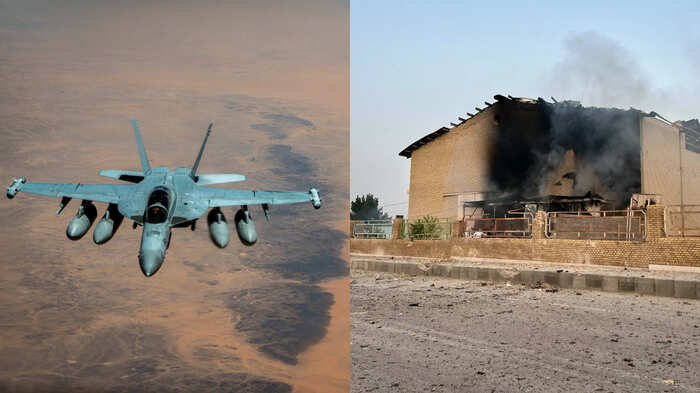
The biggest, horrifying and sensational news of this time is coming out from the smoldering geopolitical scenario of the Middle East, which has taken the entire world's breath by surprise. Amidst US military actions and increasing tension over the Strait of Hormuz, Iran has now launched a very aggressive and silence-shattering counterattack. According to the latest reports, Tehran-backed forces and the Iranian army have targeted major US military bases and airbases located within the borders of Jordan, Kuwait and Bahrain. These strategic targets have been attacked one after the other by sophisticated ballistic missiles and suicide drones, which has created panic in the entire Gulf region. After this dangerous and violent incident, a big question has arisen among global defense experts and political analysts whether a full-time and destructive war is going to start once again between America and Iran? Let us understand each and every aspect of this high-voltage conflict and its far-reaching consequences in detail and in depth. The whole story of this fierce counterattack by Iran and the scene of devastation on American bases. The kind of rhetoric and military threats that were going on between America and Iran for the last few weeks had given clear indications that the situation could become explosive at any time. After the US Army strengthened its defense lines in the Gulf countries and adopted an aggressive stance against Iran, Tehran also no longer considered it appropriate to remain silent. Iran has deviated from its traditional war policy and chosen the path of multi-directional missile and drone strikes. Jordan, Kuwait and Bahrain are the countries where the US's most sensitive and important Air Force stations and logistics hubs are located, through which the US military conducts its activities throughout the Middle East. Due to the thunder of Iranian drones and cruise missiles, sirens sounded in many areas of these countries and clouds of smoke were seen rising into the sky. This attack has proved that Iran is now ready to go to any extent to protect its security and strategic interests. Clouds of danger have increased in the strategically important countries Jordan, Kuwait and Bahrain. If we look at the map of the Middle East, Jordan, Kuwait and Bahrain are counted among America's closest and oldest allies, which have hosted American military bases on their land for a long time. US Air Force fighter planes, strategic radar systems and thousands of American soldiers are deployed at these bases. When Iran targeted the targets located inside these countries, it clearly meant that Tehran is no longer limited to just its domestic defense, but it wants to break the backbone of America's regional network. After these attacks, there has been huge diplomatic pressure on the governments of Jordan, Kuwait and Bahrain. On one hand, they are worried about their sovereignty and the safety of their citizens, on the other hand, due to their strategic agreements with America, dealing with this crisis is proving to be a tough task for them. Will the Gulf war start once again? A big threat looms on global peace. After this strong counterattack by Iran, the eyes of the whole world are fixed on the next steps of Washington and Tehran. The recent aggressive statements made by US President Donald Trump and the subsequent attacks have added fuel to the fire. If the US takes large-scale military action or retaliatory air strikes in response to this attack, this smoldering flame in the Middle East could turn into a fierce regional war. Such a conflict will have a direct impact on the international crude oil supply, which may lead to an energy crisis in the global market. Apart from this, serious concerns have also arisen regarding the safety of millions of foreign citizens and expatriates working in the Gulf countries. The coming few days are going to prove to be the most sensitive and decisive in history in terms of international diplomacy and global peace.