Had Bengali superstar Uttam Kumar been alive, he would have turned 100 today (September 3). A century after his birth, generations of Bengalis still haven’t quite figured out how to talk about him without slipping into either nostalgia or hagiography. He was the great romantic hero, the ‘Mahanayak’ (superstar), the man whose face could sell a film before the first frame had rolled. But in between all of these identities, he was also an actor who spent much of his career living inside an image he had helped create.
Bengali superstar Uttam Kumar as he is best remembered. Photo: Wikimedia Commons
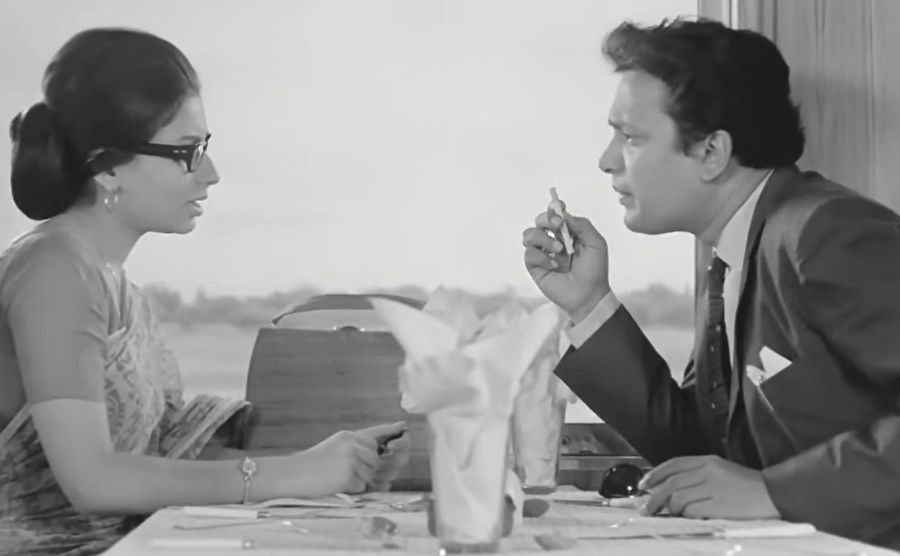
Perhaps the best film to understand that contradiction is Nayak (1966). Satyajit Ray’s film opens with Arindam Mukherjee, a Bengali movie star travelling by train from Calcutta to Delhi to collect an award. Everyone in the compartment knows him. Some admire him, some dislike him, some want something from him. Arindam has learnt to manage all of it. When journalist Aditi (Sharmila Tagore) begins asking questions, he initially responds with the relaxed charm of someone who has spent years performing familiarity. Then, slowly, the performance begins to loosen.
This is where Nayak becomes mischievously meta. Ray didn’t have to invent a movie star for Arindam. He had Uttam Kumar. By 1966, Kumar had been West Bengal’s biggest male star for more than a decade, after a career that had begun with very little certainty about what, exactly, he was supposed to become.
Rise to stardom
Born Arun Kumar Chattopadhyay in a lower-middle-class family in 1926, the actor grew up in North Kolkata. His father worked as a film operator at Metro Cinema and giving him exposure to the theatrical and cinematic life of the city. He acted with the family theatre group Suhrid Samaj, made posters, sketched and watched plays. After college, practical considerations took over and he joined the Port Trust. He spent his days at the job and his evenings watching theatre. But, eventually, cinema found him.
The start was slightly reluctant. His first film, Maya Dore (1947), was never released. In Drishtiheen (1948), he was still Arun Kumar Chattopadhyay. Then came Kamona, where he was credited as Uttam Chatterji, followed by another return to Arun Chatterjee. The name finally settled with Sahajatri (1951): Uttam Kumar.
Also read: Dolly Parton obit: Why fans of the ‘Queen of Country’ will be singing ‘I will always love you’
The career itself took longer to settle. Early failures earned him the cruel industry nickname “Flop Master General”. Then came Nirmal Dey’s Basu Paribar (1952), followed by Sharey Chuattar (1953) and finally, Agni Parikshya (1954), the film that changed the trajectory of his career, cementing his cachet as a romantic hero. The pairing with Suchitra Sen that followed would produce one of Indian cinema’s great screen romances and make Uttam Kumar a phenomenon well beyond the usual definition of a successful actor.
There was a particular kind of fantasy at work here. Kumar’s heroes were handsome and assured, certainly, but they were also unusually available to feeling. They could sulk, hesitate, cry, lose, apologise. They could be suave without being cold. They inhabited the Bengali ‘bhadralok’ (gentry) ideal — cultured, romantic, urbane — with enough vulnerability to make the fantasy feel attainable. For generations of Bengali women and men, Uttam Kumar represented a version of masculinity that could be desired and inhabited at the same time.
Uttam Kumar and Suchitra Sen in a poster of their hit film, Saptapadi. Photo: Wikimedia Commons
The films that paired Kumar and Sen turned this into a cultural language of their own. Take, for instance, Harano Sur (1957), Saptapadi (1961) and Grihadaha (1967), each of which gave Bengali audiences a hero who could be intensely romantic without needing to dominate the room.
By the mid-1960s, however, Uttam Kumar had become much bigger than any one role. He was producing, directing, writing, singing and composing. He had made more than 100 films and would eventually appear in over 200.
He tried Hindi cinema, with mixed results and even turned down roles that might have taken him further into the Bombay industry. His superstardom was, in many ways, a specifically Bengali phenomenon. That was its strength and its limitation.
Being 'Mahanayak'
Then Ray came calling. The casting of Nayak has always had an element of provocation to it. Ray had worked repeatedly with Soumitra Chatterjee, an actor of extraordinary range and one of his most important collaborators. But for this film, he chose the man who already carried the weight of popular cinema on his shoulders.
As Arindam Mukherjee heads to Delhi to receive an award, Ray turns the journey into an excavation of what that achievement has cost him.
Indeed, there is something perversely appropriate about Uttam Kumar playing a superstar terrified of becoming disposable. The film’s great scenes are built around that anxiety. Arindam remembers the theatre actor he once disappointed, the compromises that helped him climb, and the people he stepped over with greater clarity than he seems prepared for. In one extraordinary dream sequence, money first appears as a source of pleasure and then becomes something suffocating. Later, sitting across from Aditi, the famous man gradually stops behaving like the famous man. His voice changes. His face loses some of its practiced ease as the pauses become longer.
In his carefully calibrated performance, Kumar understands exactly how much to withhold. A raised eyebrow, a cigarette, a glance towards the window, a smirk: the smallest gestures carry the history of someone accustomed to being watched. It helps that Subrata Mitra’s camera keeps returning to that face, in mirrors and close-ups, as if attempting desperately to locate the person underneath the star.
A poster of Nayak. Photo: Wikimedia Commons
Even then, Nayak never quite humiliates him. Arindam is vain, selfish and capable of cowardice. But in Ray’s hands and in Kumar’s eyes, we are also allowed to see him as frightened, lonely and painfully conscious of what his success has demanded. The film allows those things to coexist. So does Kumar’s performance.
And perhaps this is why Nayak has remained so central to the way we understand Uttam Kumar. The film catches him at the precise moment when the distinction between actor, character and celebrity had become almost impossible to separate. Arindam is fictional, but the audience already knows his face. His fame precedes him into every compartment, every conversation, and every close-up. Ray uses the machinery of Uttam Kumar’s own stardom to ask what happens when a performer becomes inseparable from the person audiences believe they know.
The man behind the image
In the book Mahanayak Revisited: The World of Uttam Kumar, published in 2013, author Swapan Mullick recalls the peculiar disappointment of finally meeting the star he had spent years observing on screen. By his own admission, the real man was guarded, cautious and considerably less forthcoming than the fantasy demanded.
It is an experience that feels almost like an unwitting sequel to Nayak. The star had always been easier to know than the man.
That question has only become more interesting with time. The modern Indian superstar exists everywhere at once — in films, advertisements, interviews, social media, gossip — and the distance between public persona and private self has become increasingly difficult to maintain. Uttam Kumar arrived at a similar problem decades earlier, in a far less saturated media culture. His image was built through cinema, magazines, songs, gossip and the intensely personal relationship Bengali audiences developed with his films. The scale might have been smaller, but the devotion was still enormous.
There is also something significant about the fact that this mythology was built around a Bengali man. Uttam Kumar gave Bengali cinema its own idea of the male star at a time when Hindi cinema was developing very different templates of masculine glamour. His was a star persona rooted in romance, wit, vulnerability and a distinctly Bengali sophistication. He could be larger than life without ever seeming entirely removed from ordinary life.
To call him simply a romantic hero, then, feels inadequate. To call him ‘Mahanayak’ explains the scale of his fame but says less about the strange intimacy of it. Uttam Kumar became part of Bengali life in a way very few actors manage anywhere: his films supplied people with gestures, mannerisms, fantasies, a famous hairstyle, songs and ways of imagining love. And his face became a kind of cultural shorthand.
A century after his birth, that may be his most enduring achievement. Though ironically, the superstardom and the image of a romantic hero may have somewhere overshadowed the actor he was, a National Award recipient for his performance in the 1967 films Antony Firingee and Chiriyakhana (the latter, his second collaboration with Ray).
Also read: 30 years since 1st album, why Colonial Cousins feel there’s still much to discover about their music
Bengali cinema has produced extraordinary actors, radical filmmakers and films of enormous consequence. Still, Uttam Kumar occupies a different place within that history. He represents the moment when an actor became a star, the star became a cultural figure and the cultural figure became inseparable from the audience that created him.
Perhaps that is why Uttam Kumar still feels so alive on screen. We know the image already. We know the Mahanayak, the romantic hero, the man West Bengal once wanted him to be and wanted to love. What keeps us watching is the fleeting possibility that, somewhere beneath all that certainty, a man named Arun Kumar Chattopadhyay could still be there.