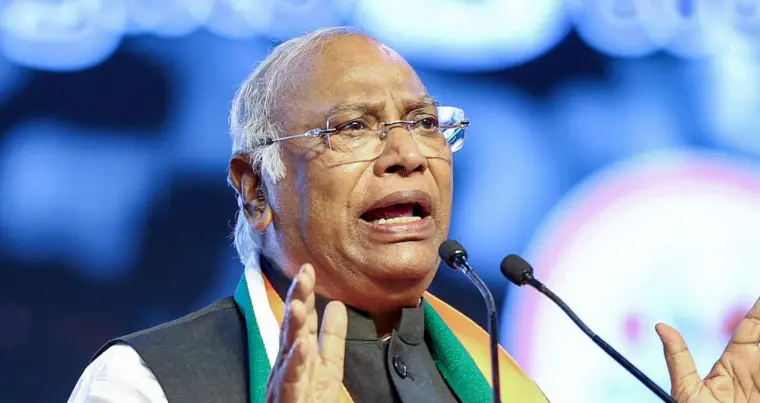
Congress President Mallikarjun Kharge gave a big statement regarding the development of rural India. Dr. Y.S. organized at Mavalankar Bhawan, Delhi on Wednesday. Speaking at the Rajasekhara Reddy Award ceremony, he said that instead of remembering villages and rural communities only during drought, flood, crop failure or during elections, a development model should be designed which can provide them economic and social security even before any crisis.
New Delhi: Congress President Mallikarjun Kharge has stressed the need for long-term policies and socio-economic security at the Center for the development of rural India. Dr. Y.S. organized in Delhi. Addressing the Rajasekhara Reddy (YSR) Awards ceremony, Kharge said that instead of remembering villages and rural communities only during drought, flood, crop failure or during elections, a development model should be created which provides security to the people even before the possible crisis.
Telangana Chief Minister Revanth Reddy was also present in the program organized at Mavalankar Bhavan. During the ceremony this year's Dr. Y.S. Rajasekhara Reddy Award M.S. Presented to the Swaminathan Research Foundation.
Benefits of development reach weaker sections
Kharge said that former Andhra Pradesh Chief Minister Y.S. Rajasekhara Reddy and agricultural scientist Dr. M.S. An important common aspect of Swaminathan's ideology was that the benefits of development should reach the weakest sections of the society. He said that farmers, poor families and rural communities should not depend only on relief based schemes. Instead, what is needed are policies that provide them the basis for a dignified life, permanent employment and economic security.
Mention of YSR's padyatra and welfare schemes
Congress President Y.S. Recalled the political journey of Rajasekhara Reddy and various welfare schemes implemented during his tenure as Chief Minister. According to Kharge, before becoming the Chief Minister, YSR had tried to understand the problems of the common people during a padyatra of about 1,400 kilometers.
After coming to power, his government started many schemes for the poor and deprived sections. These included initiatives like Aarogyasri Health Scheme, housing, land to landless families and free electricity for farmers. Kharge linked these schemes to the social security of rural and poor families.
Emphasis on sustainable agriculture after green revolution
Kharge received Dr. M.S. in Indian Agriculture. Swaminathan's contribution was also underlined. He said that the Green Revolution took India out of food grain shortage and import dependence and moved it towards food self-sufficiency. However, he said that Swaminathan's thinking was not limited to just increasing agricultural production.
His emphasis was on such an agricultural system in which the income of the farmers, the environment and the future of the rural society would also be protected. This broad approach is linked to the concept of Evergreen Revolution.
Rural challenges increasing due to climate change
The Congress President described climate change as a growing challenge facing the rural economy. Irregular monsoons, floods, droughts and changes in weather can have a direct impact on farmers' crops and the income of rural families. He said that the impact of agricultural crisis is not limited to farms only. Due to reduction in income, children's education may be affected and the debt burden on families may increase.
In such a situation, there is a need to provide better markets to farmers, increase employment in rural areas, strengthen women's economic participation and connect tribal communities with technology and new opportunities.
Emphasis on making rural development a permanent priority of the government
Kharge said that the development of rural India has been an important part of the political and governance thinking of the Congress. He also mentioned Indira Gandhi's land reforms, Rajiv Gandhi's technology mission and the Panchayati Raj system as well as the food security and social security programs implemented during the UPA government.
He described YSR's welfare model as an expression of this broader vision. According to him, a more effective approach could be to provide rural India with a strong economic and social security system in advance rather than providing assistance after the crisis.