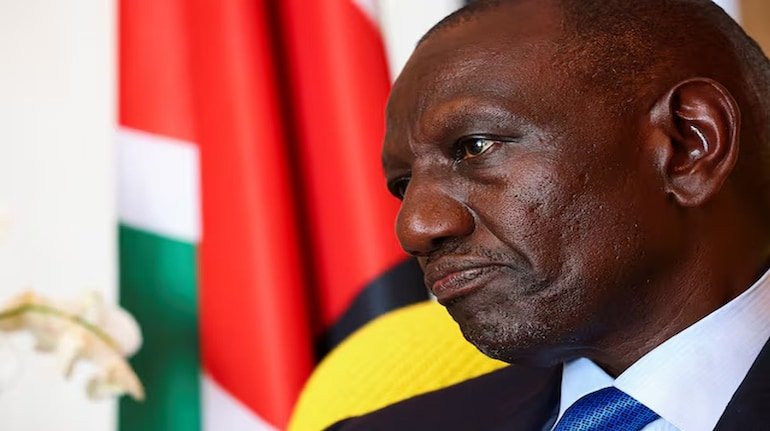
A very shocking news has emerged from the global corporate corridors and the stage of international politics. President of East African country Kenya William Ruto has taken a very aggressive stance against the Tata Group, which is counted among the most prestigious and trusted industrial houses of India. The Kenyan government has taken a major policy decision raising questions over the historic soda ash mining and processing business run by Tata Chemicals, the flagship company of the Tata Group. President Ruto, using very sharp and strong words in a public meeting, raised questions before the countrymen that "Are we slaves of others?" This harsh statement has created a stir not only in the African continent but also in India and international business circles. Dark clouds of uncertainty are now looming over the future of this giant project that has been going on for more than a hundred years. Historical business of Lake Magadi: A journey of more than 100 years At the root of this entire controversy is the famous salt water lake 'Lake Magadi' located in Kajiado County, Kenya. This area is considered to be the world's largest and richest natural deposit of high quality natural trona ore and natural soda ash (Sodium Carbonate). This plant was established during the colonial period in the year 1911 as Magadi Soda Company. The company operated continuously from the period of British rule until independent Kenya. During the year 2005–2006, Tata Chemicals Limited, the chemical arm of the Tata Group, completed the global acquisition of UK-based Brunner Mond Group, under which the control of Magadi Soda came completely into the hands of Tata Chemicals Magadi Limited (TCML). Thus, the Tata Group has been successfully operating this century-old plant for the last two decades and it has become one of Tata's oldest strategic investments in Africa. 'Are we slaves?': President William Ruto's sharp stance While addressing a huge crowd in Kajiado County, Kenyan President William Ruto gave this explosive speech among the local public. The President alleged that the foreign-owned company was allowed to exploit this invaluable natural resource for more than a century, but in return the country and local society did not receive the promised industrial benefits. Ruto said that despite operating on lease for 100 years, the company had not developed any big industrial system in Kajiado that could do full value addition of raw materials within the country. At the climax of his speech, he said in the local language and Swahili-English accent that Kenya could no longer remain a mere raw material exporting colony. He asked a direct question whether the people of the country are still economic slaves of foreign powers and are deprived of the profits of their own resources. Root cause of dispute: Lack of value addition and local industrialization The main objection of the Kenyan government and local leadership is that huge quantities of high quality soda ash is extracted from the Magadi plant and exported directly to foreign markets. The primary use of soda ash is in the manufacturing of glass (glass manufacturing), detergents, textiles and heavy chemicals. President Ruto's economic strategy has now focused on 'in-house manufacturing' instead of 'exporting raw materials'. The government argues that if Kenya has the best soda ash in the world, why does the country have to import glass and bottles from abroad. The President clarified that his government will now give preference to companies that will set up huge glass manufacturing factories and downstream chemical plants on Kenyan soil, thereby providing direct technical employment to thousands of local youth. Local Maasai Community, Old Conflict of Land Tenure and Royalties The tension between Tata Chemicals Magadi and the local community is not just a contemporary one, but has a long background over land rights and royalty distribution. The Lake Magadi area is traditionally the home of the Maasai tribe. The local Maasai community and the county government have long complained that not enough of the plant's royalties and land rates were spent on local infrastructure development, hospitals, schools and clean drinking water projects. Additionally, there have been legal disputes in court regarding lease renewal terms and local charges imposed by the county government. Capitalizing on this public sentiment, President Ruto has made ignoring local development the main basis of his action. Search for new options: Plan to hand over responsibility to two new companies President William Ruto in his speech not only talked about stopping the work of Tata, but also announced a new action plan. He said that the government is now going to invite new industrial partners in this sector. According to Ruto, the government is in talks with two new industrial companies that will be awarded major projects in the Magadi area. One of these companies will set up a huge glass manufacturing factory locally, which will produce glass for domestic use as well as for the entire East and Central Africa. Whereas, another company will be entrusted with the responsibility of making advanced chemicals related to soda ash. The President made it clear that any company that uses Kenya's resources will have to mandatorily do processing and job creation locally. Global position of Tata Chemicals and impact of this decision Tata Chemicals, the chemical arm of the Tata Group, is considered to be the third largest producer of soda ash in the world. The company's production network extends to India, USA, United Kingdom and Kenya. The Kenya-based Magadi plant has an annual production capacity of millions of metric tonnes of natural soda ash, which is in high demand in the markets of Asia, Middle East and Rest of Africa for its high purity. If the Kenyan government legally takes over the operation completely or terminates the lease, it could prove to be a short-term blow to Tata Chemicals' global supply chain. However, market experts believe that the Tata Group is fully capable of protecting its rights and contracts through international laws, bilateral trade agreements and arbitration forums. Potential Diplomatic Impact on India-Kenya Bilateral Relations Kenya and India have centuries-old historical, cultural and strong trade relations. India is among Kenya's top trading partners and investors. In such a situation, this type of rhetoric against a top Indian corporate giant from a public platform has become a topic of discussion in the diplomatic circles of both the countries. Analysts believe that this rhetoric may have been aimed at domestic politics and uniting the support of the local public, but when it comes to actual investment policies and bilateral treaties, the governments of both the countries will have to adopt the path of dialogue. The Government of India has always been conscious of protecting the interests of Indian investors in the African continent, hence the possibility of high-level talks in this matter cannot be ruled out in the coming days. Way forward: Will talks yield a solution? After this tough step by the President of Kenya, now all eyes are on the official steps of the Tata Group and the Kenyan government. International legal experts say that shutting down a 100-year-old operation and a large multinational investment overnight is not so easy from the legal point of view. International arbitration, huge compensation claims and bilateral investment protection treaties come in the way of such decisions. It is possible that in the coming weeks, Tata Group representatives may present a new proposal to the Kenyan government to set up a glass factory or downstream unit at the local level, which would both address the President's concerns and ensure the smooth operation of the historic Magadi plant.