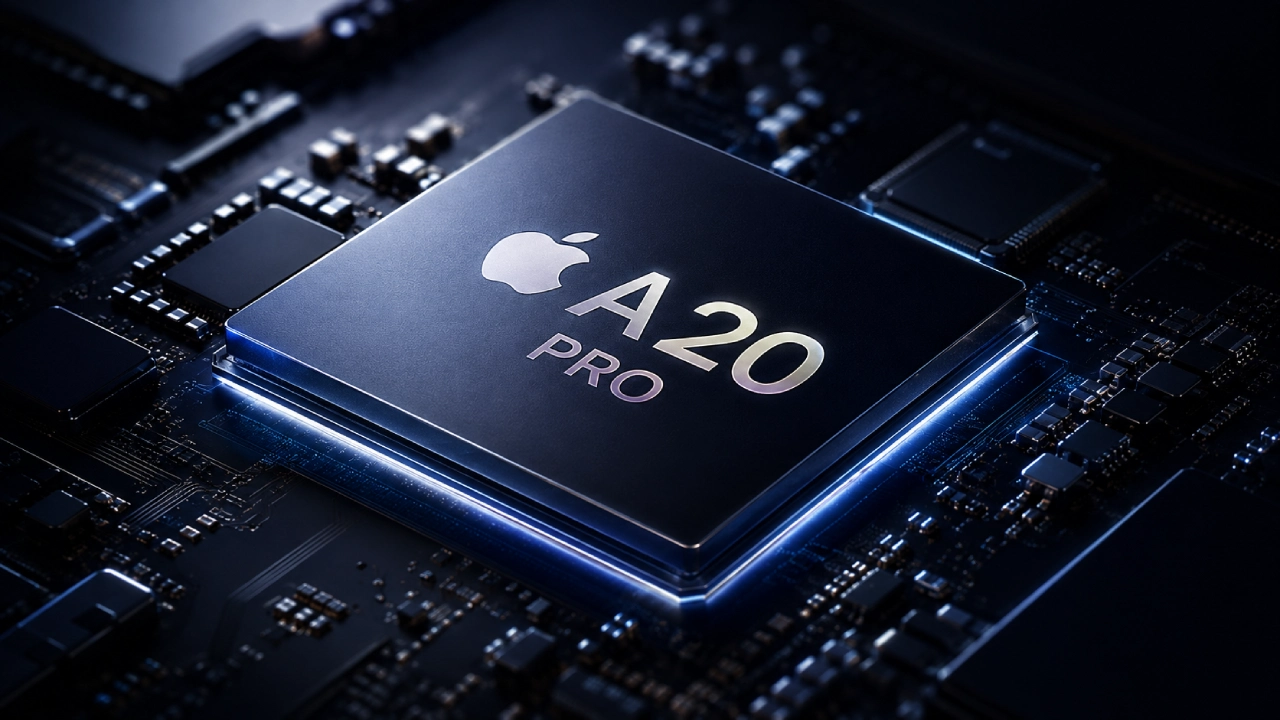
Some Weibo user mapped solder ball positions against die shots to guess the Apple A20 Pro chip layout, which sounds wild until you remember solder ball positions joints actually tie right into physical processor units.
Apple keeps quiet, leaving this mostly speculative. Apple hasn’t confirmed anything, and this remains a 65% speculative leak at best.
Centered CPU cores and a top-positioned GPU match older designs anyway, and the CPU sits dead center, and the overall layout points to a two performance core plus four efficiency core configuration—same as the A19 Pro. Memory subsystems and graphics tell a different story entirely, though nobody really knows for sure yet.
Apple A20 Pro chip: Unleashing a 7-Core GPU
GPU cores on the A20 Pro allegedly jump from six on the A19 Pro to seven, a 16.7% increase. That’s not incremental—that’s a meaningful generational leap. Mobile gaming, augmented reality, on-device rendering, all of it benefits directly from another graphics core chewing through workloads.
Raw core count only tells part of the performance story. Sustained frame rates depend on thermal headroom, memory bandwidth, and how efficiently the scheduler distributes work across those cores. Apple’s GPU architecture has historically extracted more performance per core than Qualcomm or MediaTek designs, so a seventh core compounds on an already efficient foundation.
Gaming impact:
Expect smoother high-refresh-rate gameplay, better ray tracing performance if Apple continues pushing that envelope, and more headroom for AAA titles coming to iOS. The iPhone 18 Pro and iPhone 18 Pro Max are almost certainly getting this chip next week, and mobile gamers should notice the difference in demanding titles.
Breaking the Bottleneck: Why a 96-Bit Memory Bus Changes Everything
Memory bandwidth on the A20 Pro is jumping from a standard 64-bit LPDDR5x interface up to a massive 96-bit bus, bringing a 50% bandwidth increase that actually matches iPad-class silicon for once.
Seven GPU cores would totally choke on the old narrow pipe, honestly.
Key specs mentioned:
- 96-bit bus
- LPDDR5x memory
- iPhone 18 Pro
- A20 Pro
Heavy tasks like 4K video editing, mobile gaming at high frame rates, on-device AI processing crave this kind of throughput.
For context, this kind of interface width has historically been reserved for iPad-class silicon. Bringing it to the iPhone 18 Pro closes the gap between phone and tablet performance in meaningful ways.
Cache and Concurrency: Boosting Efficiency Without Compromise
L2 cache for the efficiency cores allegedly grows from 6MB on the A19 Pro to 8MB on the A20 Pro—a 33% increase. The performance cores retain their existing 16MB L2 cache, which makes sense since they already had plenty of headroom.
Why does efficiency core cache matter?
Larger caches mean those low-power cores can keep more data close to the CPU instead of reaching out to system-level cache or main memory. That reduces latency, cuts power consumption, and helps background tasks run smoothly without waking up the performance cores.
The system-level cache size remains unknown.
The leaker believes it won’t shrink given the new image signal processor and neural engine requirements, but that’s speculation layered on speculation. Still, the logic tracks—Apple’s ISP and NPU workloads have grown every generation, and starving them of cache would undermine the entire chip’s efficiency story.
Head-to-Head: A19 Pro Versus A20 Pro Spec Breakdown
| Spec | A19 Pro | A20 Pro (Alleged) | Change |
| GPU Cores | 6 | 7 | +16.7% |
| Memory Interface | 64-bit | 96-bit | +50% |
| Efficiency L2 Cache | 6MB | 8MB | +33% |
| Performance L2 Cache | 16MB | 16MB | No change |
| CPU Configuration | 2P + 4E | 2P + 4E | No change |
| Neural Engine | Current gen | New version expected | Upgrade |
| ISP | Current gen | New version expected | Upgrade |
| System-Level Cache | Unknown | Unknown | Unknown |
Final Verdict
This leak paints the A20 Pro as Apple’s most aggressive phone chip jump in years. Seven GPU cores, a 50% wider memory bus, and fatter efficiency caches—it’s the kind of generational leap that makes upgrading feel less like incrementalism and more like a genuine performance unlock.
Whether it powers just the iPhone 18 Pro lineup or also lands in the foldable iPhone Ultra, Apple’s silicon team appears to be swinging hard in 2026.