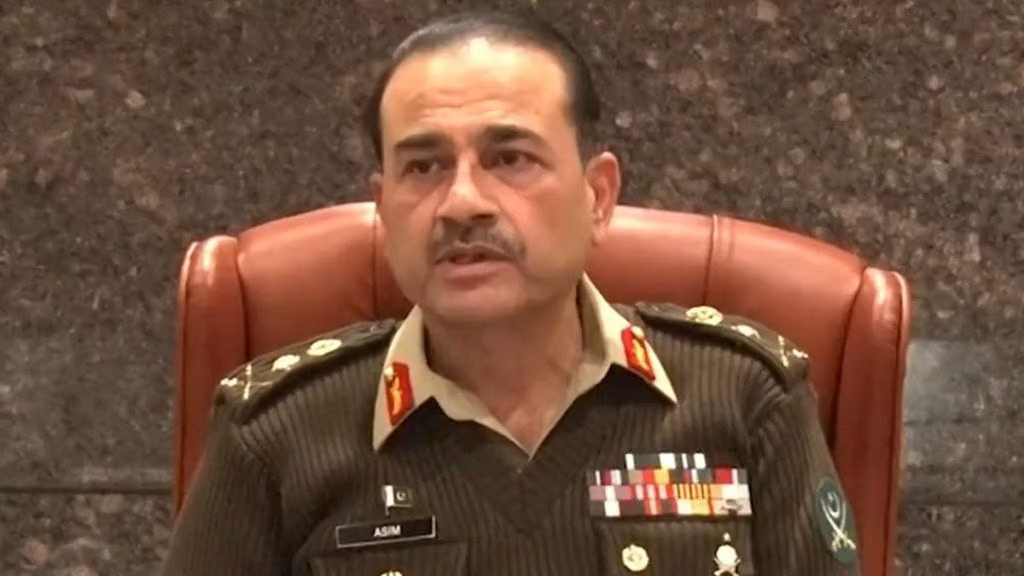
After 50 years, Pakistan changed the structure of its military command and this reshuffle has given a new strategic signal raising concerns for India. Field Marshal Asim Munir has now become not only the Army Chief of Pakistan but also the top command of all three armies as the Chief of Defense Forces. This change has happened at a time when tension and distrust between the two countries is already deep after the India-Pakistan military conflict of 2025.
In such a situation, the question is arising whether this new centralized command system of Pakistan can make its response more rapid and coordinated in any future military crisis against India? Especially when in the new system, Munir has got the central responsibility of operational coordination between the Army, Navy and Air Force. That is, if the tension between India and Pakistan increases in the coming time, then the competition may be seen not only on the border but on many fronts like missiles, drones, air power, cyber and electronic warfare.
Why did the military command change?
Pakistan has made a major change in its top military command structure after almost five decades. After the 27th Constitutional Amendment of 2025, a new post of Chief of Defense Forces i.e. CDF was created. After this, in 2026, this system was given a legal basis through the Defense Forces of Pakistan Act. The new structure aims to establish better coordination between the Army, Navy and Air Force and create a unified command for modern multi-domain warfare.
Will the command of all three armies be run from one remote?
In the new arrangement, Field Marshal Asim Munir is also playing the role of Chief of Defense Forces along with Chief of Army Staff. Its purpose is to increase jointness between the three armies. In modern warfare, along with land, air and sea, drones, missiles, cyber and electronic warfare have also become important. In such a situation, Pakistan is moving towards a command system where all these capabilities can be used together more quickly.
How much has Asim Munir’s strength increased?
The role of CDF has become very important in the new command structure. By being the Army Chief and getting the top role in the joint command structure of the three armies, Asim Munir has become more influential than before in Pakistan’s military decision-making system. With this, an attempt has been made to bring military operations, strategic planning and coordination between different armies under a central leadership.
Was Munir’s tenure also extended?
The new system has had a major impact on the tenure of Asim Munir. His five-year tenure as CDF begins from the date of his new appointment. This means that he can remain at the top of Pakistan’s military leadership till 2030. This is important from India’s point of view because New Delhi will have to manage strategic relations with the same influential military leadership in Pakistan for many years to come.
Will military interference increase further in Pakistan?
With this change the political debate within Pakistan is also intensifying. Supporters say that unified command is necessary in the era of modern warfare, while critics argue that it can further increase the influence of military leadership. Especially in national security and strategic matters, when the role of military leadership becomes stronger, it is natural that the question of balance of power between the civilian government and the army arises.
What is the biggest question for India?
The most important thing for India is that Pakistan’s military decision-making structure may be more centralized than before. After the India-Pakistan military confrontation of May 2025, both the countries have reviewed their military strategies and capabilities. In such a situation, Pakistan’s new command system can help in preparing a faster joint response between the Army, Air Force and Navy in any future crisis.
The biggest potential advantage of centralized command may be in speed of decision making and military coordination. It may be easier for Pakistan to combine air support, missiles, electronic warfare and maritime operations with military action on the ground into a single strategic framework. For India, this means that Pakistan’s response to any future military crisis will not be assessed solely on the basis of its army’s activities.
Is Pakistan’s rocket force a new challenge for India?
Pakistan has also included Army Rocket Force Command in its new military structure. Its purpose is to better organize traditional rocket and missile capabilities and strengthen the ability to conduct long-range conventional attacks. This is important for India because such capabilities can provide the option to engage military targets at depth in a conflict, even without the use of nuclear weapons.
Is the change in nuclear command a matter of concern for India?
Legal changes related to the National Command Authority have also brought Pakistan’s strategic and nuclear command system in line with the new military structure. The main concern for India will be how the nuclear decision-making process works between the military and political leadership in a crisis situation. It will be important to understand nuclear signals and the risk of escalating tensions in any India-Pakistan conflict.
Will India have to change its military strategy?
India does not need to change its entire military strategy, but it will be important to take into account Pakistan’s more integrated command system. India will have to assess Pakistan’s combined capabilities on land as well as air defense, missiles, drones, cyber, electronic warfare and maritime front. Along with this, the strategy to control tension and limit nuclear risk will also be important in any military crisis.