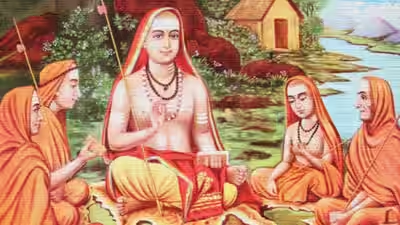
Quote of the day
There is sorrow in finitude. The Self is beyond time, space and objects. It is infinite and hence of the nature of absolute happiness
What does Shankaracharya mean to convey through these words?
Shankaracharya’s statement has three clear parts. First: “There is sorrow in finitude.” Anything finite or limited, like materialistic pursuits, including money, status, relationships, even the body, changes, ages, or ends. Because it can be lost or changed over the course if time, our attachment to it carries a hidden fear and, over time, disappointment. This is not pessimism; it is an observation about the nature of limited things.Second: “The Self is beyond time, space, and objects.” In Advaita Vedanta, the Self (Atman) is not the personality or the story of “me.” It is pure awareness, the silent witness behind thoughts, feelings, and sensations. Awareness itself does not age, does not occupy a space, and is not an object that can be gained or lost.Third: “It is infinite and hence of the nature of absolute happiness.” Because the ‘true awareness’ is not limited, it is not subject to being scared of being lost or consumed.Classical texts describe Atman as existence-consciousness-bliss, or sat-chit-ananda. When we identify with this deeper reality instead of only with the changing surface of life, a more stable sense of well-being becomes possible.
How are these words relevant now?
We are often drawn into comparisons today and constantly remind ourselves of what we do not have, what we might lose, and how we compare to others, which might unknowingly kick in feelings of anxiety, burnout, and loneliness.Shankara’s teaching offers a different center. It does not deny the world; it just changes our perspective to view it.When we realise our true self or awareness, either through practising mindfulness, limiting mindless social media scrolling, and acting with care, we still work, love, and plan, but we are no longer entirely defined by outcomes.