A protest at Paris’ Eiffel Tower has put the Bochasanwasi Akshar Purushottam Swaminarayan Sanstha, or BAPS, under scrutiny after staff unions alleged that female Eiffel Tower employees were asked to step away from their posts or remain out of sight during a private visit by a Hindu delegation linked to the organisation.
BAPS has rejected the allegations, saying that, to its knowledge, no one was denied access to the Eiffel Tower and stressing its commitment to “universal values of mutual respect”.
With BAPS now at the centre of a debate over gender equality and religious sensitivities in France, here is what to know about the organisation, its leadership, its practices and its history of controversies.
A global spiritual network
BAPS is a worldwide spiritual organisation that follows the Swaminarayan tradition, a Vaishnav sect of Hinduism. It runs more than 1,300 mandirs and over 5,025 centres across the globe. Its work spans religious activities, programmes for young people and families, education, culture, community service and humanitarian initiatives.
Also read | India condemns ‘despicable acts’ of vandalism on BAPS temple in California
One of BAPS’s most visible features is its imposing traditional stone temples. The organisation traces its origins to 1907, when Shastriji Maharaj established its first temple in Bochasan, Gujarat. The Bochasan mandir is also where the organisation got its name.
Over the decades, BAPS expanded from that beginning into a global network with a presence across India, North America, Europe, West Asia, Africa and Australia.
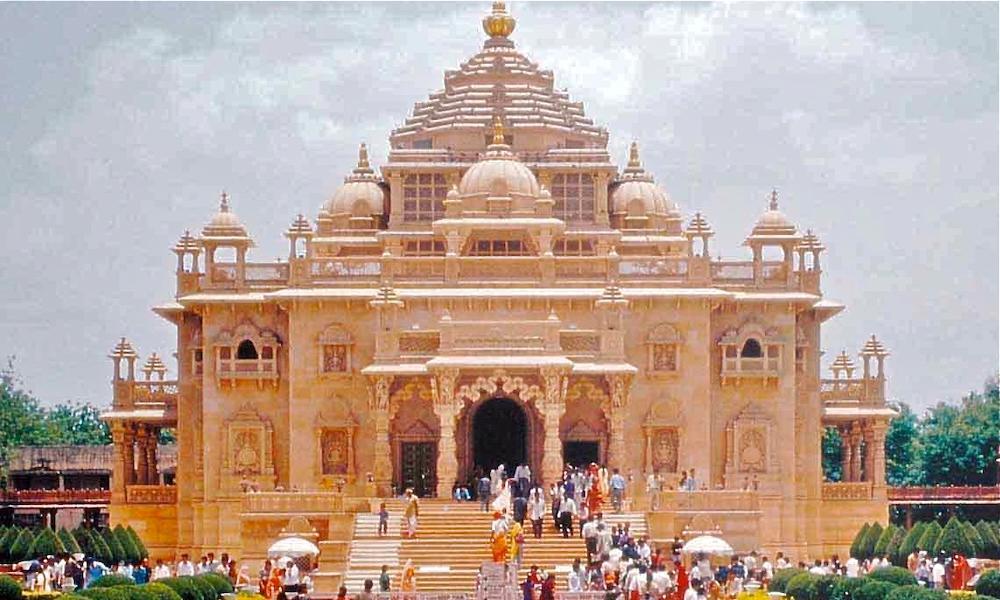
Among its best-known landmarks are the sprawling Akshardham complexes. The Akshardham complex in Gandhinagar, Gujarat, was the first major project of its kind and was inaugurated by Pramukh Swami Maharaj in 1992.
Landmarks of BAPS expansion
The Swaminarayan Akshardham in New Delhi, inaugurated in 2005, is another prominent BAPS landmark. The sprawling complex features a central temple, exhibition areas, gardens and several other cultural attractions.
The organisation’s temple in New Jersey is among its most striking projects. The BAPS Swaminarayan Akshardham in Robbinsville was inaugurated in 2023 and spreads across about 183 acres. Construction began in 2011 and took roughly 12 years to finish.
BAPS marked another major step in its global expansion in 2024 with the inauguration of the BAPS Hindu Mandir in Abu Dhabi. The temple was described as the first traditional Hindu stone mandir in West Asia. The temple stands on land in Abu Mureikhah provided by the UAE, which allocated 17.5 acres for the project.
BAPS’s 2019 annual report in the UK showed charitable expenditure of around £6.4 million that year, down from £11.7 million in 2018. The report also put its total net assets at about £14 million at the end of 2019, including roughly £12.07 million in unrestricted funds.
Questions over gender practices
While there is no clear evidence establishing gender segregation as a blanket BAPS policy, the organisation’s practices concerning women have drawn scrutiny.
A 2022 Indian Express report traced one such dispute to the late 1960s, when Hariprasad Swami and some followers sought to initiate female disciples. The proposal was opposed by Yogiji Maharaj, then the BAPS guru. Hariprasad Swami later broke away from BAPS and went on to establish the Sokhda sect.
The controversy at the Eiffel Tower is not the first BAPS-linked episode to raise questions about the participation of women.
In 2015, the launch of the Malayalam translation of APJ Abdul Kalam’s book Transcendence – My Spiritual Experience with Pramukh Swamiji triggered a controversy in Kerala.
The translator, Sridevi Kartha, claimed that she had been asked to stay away from the launch because of requirements imposed by the ashram of Pramukh Swamiji. As per a Hindustan Times report, Sridevi alleged she was asked not to attend the function as Brahma Vihari Das of BAPS Swami Narayana Sanstha did not like the presence of women on the stage along with him.
“The first three rows also should be reserved for Swami’s followers so that they can ensure that even impure shadow of women must not fall on him,” Sridevi sarcastically said in her Facebook post.
The dispute intensified, protesters gathered outside the venue and the book launch was ultimately cancelled. “We never wanted to insult the writer,” said OJ Johny, manager of the publishing firm. Johny also said that they normally do not invite translators for book release functions.
The 2024 Kolkata controversy
A similar controversy emerged in Kolkata in 2024. The Print reported that women sitting in the front rows at an ICAI event were asked to move before Swami Gyanvatsal, a religious figure associated with BAPS, addressed the gathering.
A video recorded at the event captured an announcement saying: “No ladies, no girls, no girl volunteers in sight, folks!”
The episode drew criticism. ICAI president Ranjeet Kumar Agarwal told The Print that the organisation would examine what happened and take “proper action”. The incident also stood out because it took place at a professional conference rather than at a religious event.
Allegations of worker exploitation
BAPS has also faced scrutiny over allegations relating to the treatment of workers. A 2021 report by The New York Times examined allegations of forced labour at the organisation’s large temple complex in Robbinsville, New Jersey.
Also read | All about Hindu temple in Abu Dhabi that Modi is set to inaugurate
Lawyers representing the workers alleged that possibly hundreds of Indian men, including many Dalits, had been taken to the US on religious-worker visas and put to work on strenuous construction tasks for around US$1 an hour. The lawsuit alleged that they worked close to 13 hours each day, stayed in trailers on the temple site, had their passports taken away and faced restrictions on communicating with visitors.
Agents from the FBI, US Department of Homeland Security and Department of Labor visited the site, and about 90 workers were reportedly removed. The lawsuit alleged that more than 200 Indian nationals had been recruited for the project.
BAPS rejected the accusations, maintaining that the workers were skilled artisans involved in specialised task of assembling intricate hand-carved stonework. The organisation said the allegations were without merit.