Anak Krakatau sent lava spewing into the sky and volcanic ash over Jakarta and Lampung Province, and remained active through the weekend.
Jakarta’s Soekarno-Hatta International Airport was the first to suspend flights on Sunday morning and did not resume operations until 12:30 a.m. Tuesday. The disruption affected nearly 3,000 flights and more than 340,000 passengers, according to Reuters.
Thu Trang, a traveler from Hanoi, found herself caught in a frustrating loop between her hotel and Soekarno-Hatta International Airport after her Sept. 6 return flight was rescheduled.
|
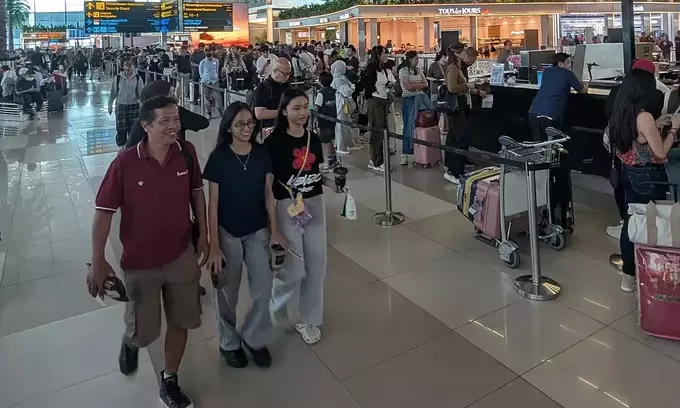
Soekarno-Hatta Airport on the morning of Sept. 8, 2026. Photo by Thu Trang |
She says passengers boarded the aircraft early on Sept. 6, only for it to taxi back and sit idle on the tarmac for over an hour before crew members asked everyone to disembark.
The airport temporarily opened at around noon, allowing passengers to leave while awaiting updates. Ground staff initially told her the flight had been pushed back to 9:00 a.m. on Sept. 7. The departure was subsequently delayed three more times, to 11:00 a.m., 3:00 p.m., and 9:00 p.m.
Early the next day, the airport’s website indicated operations had resumed. When she went to the terminal at 1:00 a.m., Trang was advised to wait until 3:30 a.m. But at 3:30a.m, airline staff were nowhere to be found.
She checked a few hours later on Flightradar24 and was left stunned: it showed her flight had taken off at 7:00 a.m. and was en route to Hanoi.
She had received no notification from either the airline or her booking platform.
By 11:00 a.m. on Sept. 8, Trang was still stuck at Soekarno-Hatta without official word.
Out of pocket by VND4 million (US$160) in extra expenses, the constant back-and-forth has taken a toll on her well-being while her work back home remains on hold.
“I’m exhausted and just want to go home,” she says, annoyed with the conflicting updates from officials.
Another tourist, Duy Manh, managed to avoid being stranded in Jakarta by rerouting through a third country.
Traveling with friends since Aug. 28, he was scheduled to fly from Surabaya to Jakarta on Sept. 6 and onward to Hanoi, and he had booked six months earlier for VND4 million.
When flights out of Surabaya were grounded on Sept. 6, his international leg was pushed to Sept. 8, and his domestic transfer to Sept. 9.
Lacking travel insurance and needing to return urgently for work, he abandoned his original itinerary to find a transit route through a third country.
On Sept. 7, he spent VND8.5 million (US$340) on a ticket from Surabaya to Singapore.
Reaching Changi Airport that afternoon, he managed to catch a connecting flight to Vietnam the following day.
“Even though the ticket was expensive, I consider myself lucky to make it back,” he says.
 |
|
Duy Manh at the Fort Canning Tree Tunnel, Singapore on the morning of Sept. 8, 2026 before heading to Changi Airport for his flight back to Vietnam |
Local volcanologists describe the eruption as an “anomalous event,” noting that strong winds and dry conditions spread volcanic ash, rich in sulfur and silica, over vast areas, posing severe risks to aircraft engines.
Indonesia reopened five airports past midnight on Tuesday following a two-day suspension of operations, according to BBC. However, Anak Krakatau erupted three more times on Tuesday morning, the volcano monitoring agency said.
While the eruptions were smaller than the earlier ones, they could still disrupt flights depending on the height of the ash plume and wind direction.
Airlines operating in the region also adjusted their schedules in response to the disruption.