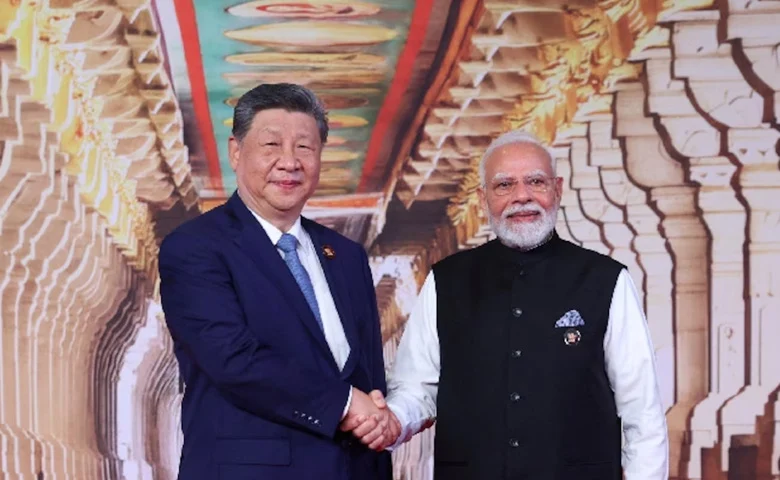
Modi Xi Jinping Bilateral Meeting: Delhi’s Bharat Mandapam has now become the epicenter of the Global South’s new diplomatic power. After the meeting between Prime Minister Narendra Modi and Russian President Vladimir Putin on the first day of the BRICS summit, the world’s attention was focused on the high-level bilateral meeting between Prime Minister Modi and Chinese President Xi Jinping on the second day. After 7 years, the Chinese President’s visit to India is not just a formal event, but is being seen as a very important event that will give a new direction to the future of India-China relations.
Xi Jinping on Indian soil after seven years
This is the fourth visit of President Xi Jinping to India during the tenure of Prime Minister Modi. Earlier he visited Ahmedabad in September 2014, Goa in October 2016 and Mahabalipuram in October 2019. However, after the 2017 Doklam dispute and the 2020 Galwan Valley violence, the relationship between the two countries came under unprecedented strain. Now, amid the changing global geopolitical circumstances and the growing role of the Global South, both superpowers have been active in re-establishing their relations on a stable and pragmatic basis.
General Secretary level talks at Bharat Mandapam
In this historic meeting held at Bharat Mandapam, Prime Minister Modi along with Foreign Minister S. Jaishankar and National Security Advisor (NSA) Ajit Doval were present. According to information released by the Ministry of External Affairs after these in-depth talks with the Chinese delegation, the two countries have agreed on seven important points:
To advance bilateral relations from a strategic and long-term perspective.
Never let mutual differences turn into disputes.
To find a permanent solution to the border dispute that is fair, logical and acceptable to both parties.
To further boost trade, commerce and cultural exchange.
To encourage contact and travel between the citizens of the two countries.
Finding positive solutions to economic as well as business concerns.
Supporting each other to face regional and global challenges.
Prime Minister Modi emphasized that peace and goodwill on the border is the main foundation for normalization of bilateral relations.
The new balance of power of the Global South
A special symbolic message was also put before the world during this bilateral meeting. The backdrop of the meeting was an image of the grand corridors of Rameswaram’s historic Ramanathaswamy Temple, symbolizing India’s rich cultural heritage and the emerging consciousness of the Global South. The joint presence of the top leaders of India, China and Russia at the BRICS forum has made it clear that developing countries are now asserting their strong claim in global policy-making against the influence of the West.
China’s stance on terrorism changed?
The BRICS joint declaration this year adopted a tough stance against terrorism. The declaration strongly condemned the terrorist attack in Pahalgam and endorsed a policy of ‘zero tolerance’ against terrorism. The declaration calls for stopping terrorist funding, taking tough action against United Nations (UN)-sanctioned terrorist organizations and ending double standards on terrorism. Although Pakistan is not directly named in this, China’s support signals a change in its traditional attitude.
LAC and the challenge of trade imbalances
Despite the diplomatic rapprochement, two major challenges still face India-China relations. The first challenge is to establish complete stability and lasting peace along the Line of Actual Control (LAC). It is India’s clear stance that bilateral relations cannot be normalized without border peace. Another major issue is the ever-increasing trade deficit, where India’s imports from China are many times higher than its exports. New Delhi wants Indian goods to have wider access to the Chinese market. Apart from this, India’s activism in QUAD and mistrust due to China-Pakistan axis are also major challenges.
Is this the beginning of a new era of friendship?
This meeting between Xi Jinping and PM Modi held after 7 years has proved that both the countries are now choosing the path of negotiations instead of tension. The visit is not an attempt to return to the old romantic narrative of “Hindi-Chinese brotherhood”, but the beginning of a new era of practical partnership, economic cooperation and controlled competition. The coming months will show whether this diplomatic warmth seen in New Delhi translates into lasting trust at the ground level.