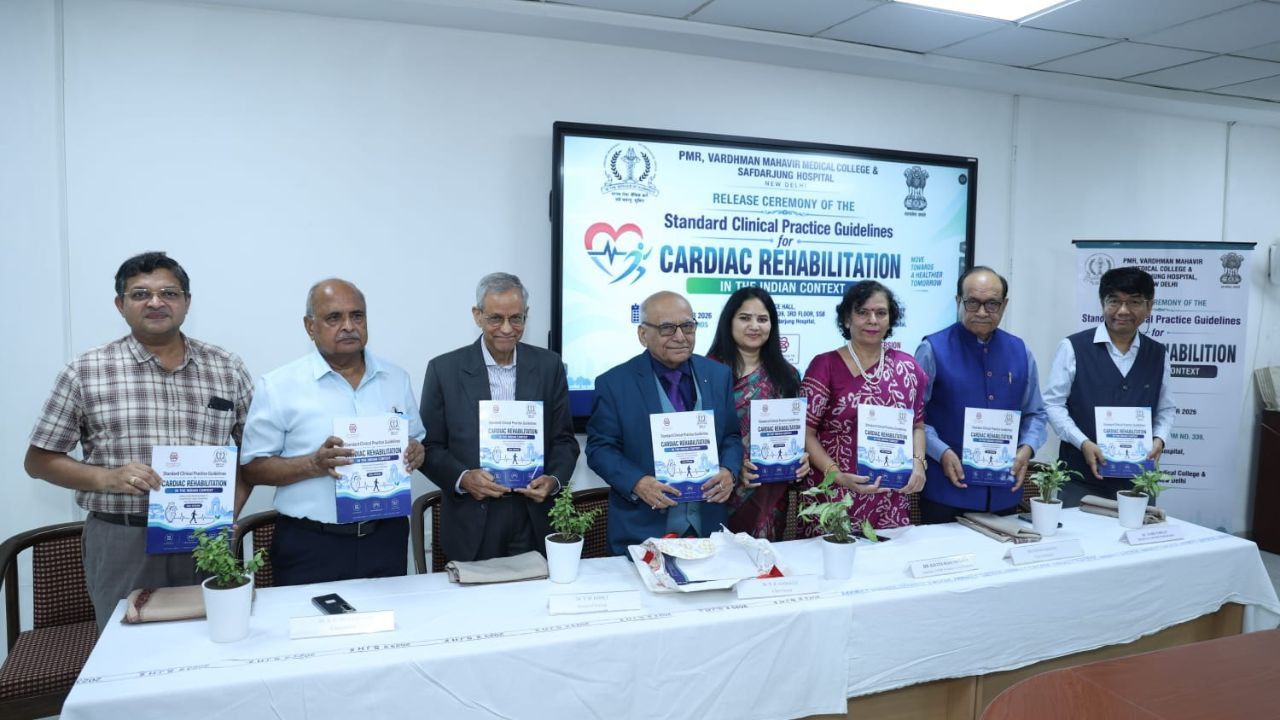
New Delhi:The battle against heart disease is not fought only in the operation theatre. The real story begins after treatment. To give a new twist to this story, Vardhman Mahaveer Medical College (VMMC) and Safdarjung Hospital, keeping in mind the Indian conditions, issued Standard Medical Practice Guidelines-2026 for Cardiac Rehabilitation in the Indian context. This initiative is being considered an important step towards creating a scientifically systematic and in line with India's health system framework for the rehabilitation of heart patients in the country.
Prominent experts of the country gathered in the ceremony
The function organized on Saturday witnessed the gathering of the country's leading cardiologists, physicians, academicians, rehabilitation specialists and public health experts. Renowned scientist and public health expert Dr. Nirmal Kumar Ganguly was the chief guest in the program. Dr. Harsh Vardhan and Dr. Vijay Mohan Kohli were present as special guests. Dr. Rakesh Kumar Srivastava, Chairman of the Guideline Development Committee, Dr. Kavita Rani Sharma, Director of VMMC and Safdarjung Hospital and Dr. Tashi Tobge, Regional Advisor, South-East Asia Regional Office of the World Health Organization and many senior experts participated in the program.
New initiative started with lighting of lamp
The ceremony started with traditional lamp lighting and welcome address. After this, in the scientific discussion, experts expressed the need to make rehabilitation an important part of the medical system along with the treatment of heart disease. According to experts, bringing the patient back to a healthy lifestyle after successful treatment is also an important part of the medical process. Dr. Tashi Tobgay, representative of the World Health Organization, stressed on strengthening rehabilitation services in the health system. He said that systematic rehabilitation services can play an important role in improving the long-term health outcomes of patients.
Rehabilitation of the whole life, not just the body
Dr. Ajay Gupta, Professor and Head of the Department of Physical Medicine and Rehabilitation, VMMC and Safdarjung Hospital, highlighted the evolution of cardiac rehabilitation and its importance. He clarified that comprehensive cardiac rehabilitation is not limited to just regaining physical capacity. Under this, the focus is also on restoring the patient's functionality, permanently adopting a better lifestyle and increasing the quality of life.
Blueprint prepared according to the needs of India
The development process and key features of the guideline were presented by Dr. Suman Badal, Professor and lead guideline developer. He said that while preparing the guidelines, the variations in health facilities, medical human resources, infrastructure, patient awareness and access to services in the country have been kept in mind. The guidelines emphasize the joint role of cardiologists along with physical medicine and rehabilitation specialists, physiotherapists, dieticians, psychologists, nurses and other health workers. Risk assessment, exercise plan according to the patient, changes in eating habits and lifestyle, psycho-social support and prevention of recurrence of the disease have been made important parts of it.
Standard guidelines will bring uniformity in treatment
Dr. Rakesh Kumar Srivastava, Chairman of the Guideline Development Committee, said that there is a need for a systematic and comprehensive cardiac rehabilitation system suited to Indian conditions. Standardized guidelines will bring uniformity to rehabilitation services and help them to be better integrated into the mainstream cardiovascular care system.
Dr. Kavita Rani Sharma, Director, VMMC and Safdarjung Hospital, welcomed the initiative and said that the real objective of scientific progress should be to bring concrete improvements in patient care. He reiterated his commitment to promote evidence-based and patient-centric medical systems.
Chief guest's message and conclusion of the program
Chief Guest Dr. Nirmal Kumar Ganguly stressed the need for accessible and systematic cardiac rehabilitation services amid the increasing burden of cardiovascular diseases in the country. He appreciated the guidelines prepared keeping in mind the actual needs of the Indian health system and the available resources. Senior doctors, cardiologists, academicians, physiatrists and rehabilitation specialists from across the country including representatives of DGHS and ICMR were present at the event. The message of the new guidelines is clear—defeating heart disease is just the first step, the real goal is to get the patient back on track to a healthy, active and better life.