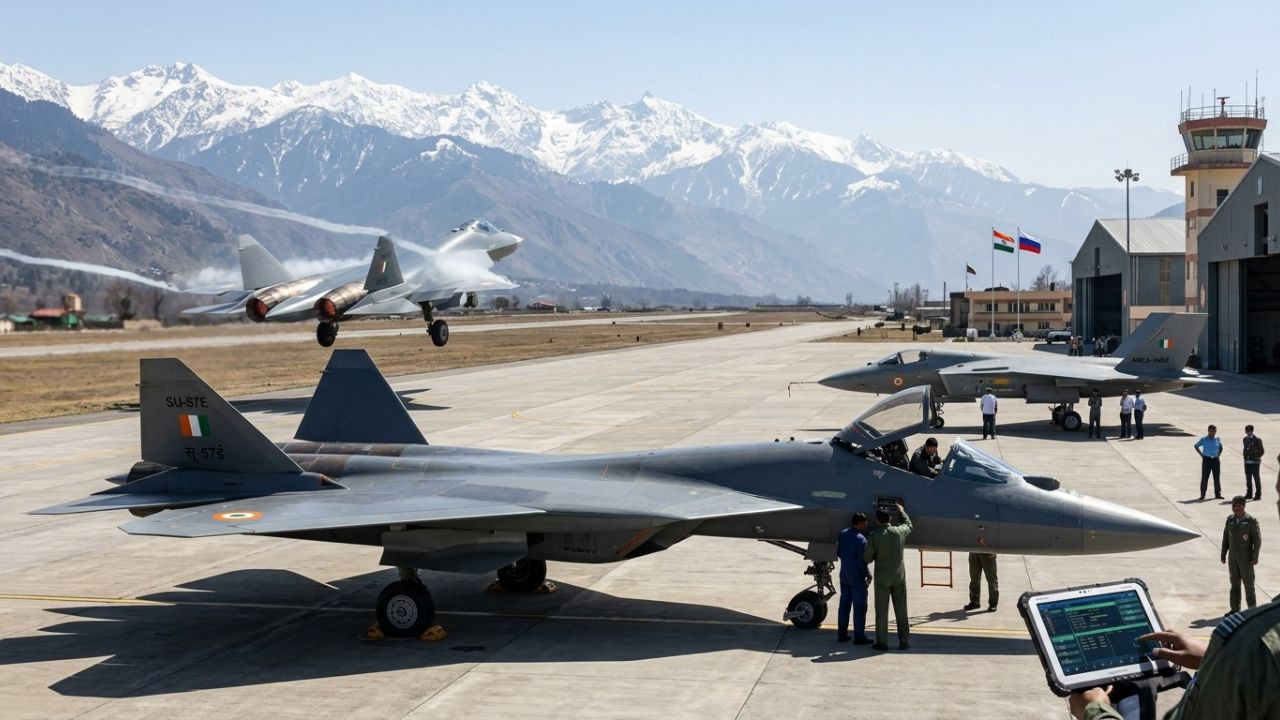
New Delhi: Defense cooperation once again took center stage in bilateral talks between Prime Minister Narendra Modi and Russian President Vladimir Putin on the sidelines of the BRICS summit. Keeping in view the immediate needs of the Indian Air Force, Russia has offered its 5th Generation Stealth Fighter Jet Su-57E with very attractive terms. Moscow is not only in the mood for a deal for this aircraft, but is also playing a big gamble on technology transfer, joint production in India and access to critical source code. The indigenous Advanced Medium Combat Aircraft (AMCA) is expected to be fully deployed by around 2035. In such a situation, this Russian fighter aircraft can play the role of a bridge for the Air Force till the arrival of AMCA.
double front challenge
The Indian Air Force is currently facing two-way pressure. Compared to the sanctioned 42 squadrons, the country has only 29 squadrons left and old aircraft like MiG-21 are being phased out rapidly. On the other hand, the strategic balance in the neighborhood is deteriorating.
China has deployed several J-20 stealth fighter aircraft at forward bases in Tibet, while Pakistan is trying to acquire J-35A. India has advanced 4th and 4.5th generation jets like Rafale, Sukhoi-30MKI and Tejas, but their strategic edge in modern warfare may be limited against 5th generation stealth aircraft.
Features of Su-57E
The Russian Su-57E aircraft is equipped with frontal stealth, exceptional super-maneuverability due to thrust vectoring and advanced sensor fusion capabilities. It is adept at carrying out precise attacks in deep areas and carrying out both air-to-air and air-to-ground operations while avoiding enemy radar sightings. Defense experts estimate that the Air Force may need an initial purchase of 36 to 60 aircraft or two to four squadrons.
The emergency procurement of two squadrons will provide Indian pilots and technicians with practical knowledge of 5th-Gen stealth maintenance and network-centric warfare. At the same time, four squadrons will create such a resistance structure on the border that will keep the security cycle unbroken till the arrival of AMCA in 2035.
Future of Domestic Defense Industry
With this deal, India will immediately gain parity in stealth capability. If Russia gives access to engine technology, avionics, stealth coating and source code, Indian defense scientists will be able to easily integrate their indigenous missiles (like Astra) into it. Most importantly, this knowledge will directly contribute to the rapid growth of AMCA. Due to the long experience of Sukhoi-30MKI, it will not be too challenging for the Air Force to adapt its logistics and training structure.
Challenges and a balanced path
This path is not without obstacles. Many aspects dominate this, such as the Western sanctions imposed on Russia, the impact on its own production capacity and the huge financial costs (billions of dollars). There is also a concern among defense analysts that the big purchase of foreign jets might divert the budget and focus of India's ambitious AMCA project. It would be wise for India to acquire and undertake limited manufacturing of a limited number of Su-57Es to meet the current shortfall in the Air Force. The most balanced and far-sighted decision of India would be to take advantage of the technology received from Russia to make its indigenous AMCA more powerful while maintaining strategic autonomy.