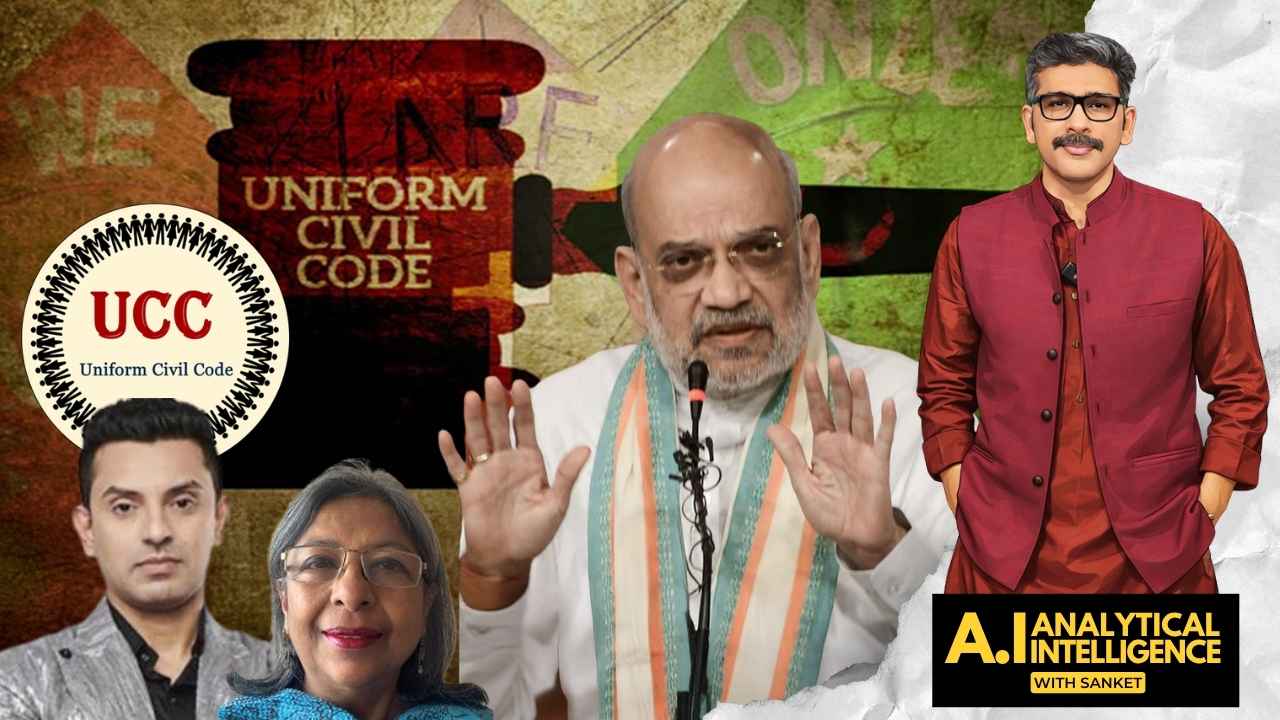
The BJP can no longer set the political narrative as it once did, believes political analyst Tahseen Poonawalla, as the party returns to its Uniform Civil Code (UCC) pitch ahead of the 2029 Lok Sabha elections.
The BJP’s UCC push gained fresh momentum after Union Home Minister Amit Shah said that nearly 21 BJP-ruled states would implement the UCC before the 2029 general elections. The renewed focus comes at a time when the party, in the wake of the Cockroach Janta Party (CJP)-led Gen Z protests, is struggling to control the conversation it had seamlessly navigated over the years, when its appeal among young voters faces a crisis and when questions are being raised on the electoral feasibility of its traditional political issues.
Will UCC push have takers?
Poonawalla described Shah’s pitch as an example of how political issues can be revived even after they appear to have lost momentum. “Nothing’s ever dead in politics,” he said, arguing that the BJP was attempting to bring back an old issue because it currently had less to offer in terms of governance, development and narrative-setting.
According to Poonawalla, the BJP had been particularly effective at setting the political narrative since the early 2010s. This, however has changed over the past weeks and months, with the party now struggling to control the conversation in the way it once did.
Also read: How BJP plans to weaponise UCC to gain edge in poll-bound UP, break Oppn unity
He described the UCC push as almost a “remix version” of the BJP’s older political strategy, but questioned whether the approach would work in 2026 and ahead of 2029, particularly after voters had experienced years of BJP governments at the Centre and in several states.
Poonawala made the observation during a discussion in The Federal on the timing and political implications of Shah’s announcement.
An old formula
Senior journalist Seema Gupta, who also participated in the discussion, linked the renewed focus on the UCC to the political challenge posed by the recent Cockroach Janata Party (CJP) movement, which she said had cut across traditional religious, caste and class divisions.
Unlike earlier protests, which she described as being identified with particular sections of society, Gupta said the CJP movement had brought together people across these barriers. She argued that this had created a challenge for the BJP because the party’s “reliable or tried and tested formula” has been Hindu-Muslim polarisation.
Gupta recalled that the BJP had three major issues on its agenda: the construction of the Ram Temple, the abrogation of Article 370 and the Uniform Civil Code. With the first two already dealt with, she said, the UCC remained the issue that could potentially become the next major political focus.
According to Gupta, the timing of Shah’s announcement could therefore be understood in the context of the 2029 elections. She argued that a contentious UCC debate could bring Muslims and liberal groups into the political conversation and potentially create the kind of polarisation that the BJP has benefited from in the past.
Youth disconnect
Gupta also questioned whether such a strategy would address the concerns of young Indians. She pointed to education and unemployment as the two major issues facing the youth and argued that political messaging aimed at appearing youthful would not substitute for addressing those problems.
She referred to Prime Minister Narendra Modi’s outreach to students at institutions including Shri Ram College of Commerce and IIT Delhi, including the use of language and music associated with younger audiences.
Also read: One nation, many codes: The contradiction inside Amit Shah’s 2029 UCC promise
She, however, noted that young people did not necessarily want older political leaders to imitate their culture. Her point was that voters wanted those in power to solve their problems rather than speak or behave like them.
She also said there had been a shift even among sections of the BJP’s core supporters. Gupta linked this partly to what she described as the “Ram temple scam”, arguing that the issue could have damaged faith among some traditional supporters. She also suggested that the CJP movement had further weakened that support.
‘Voters may not wait for competent Oppn’
Gupta agreed that something had changed among sections of the BJP’s traditional support base. She said the shift could be seen in the way people were questioning issues that had earlier formed the core of the party’s political appeal.
She also highlighted the role of social media in accelerating political movements. Referring to conversations with people who had participated in student movements during the era of Jayaprakash Narayan, Gupta said earlier movements had required activists to physically travel to villages to spread their message.
Today, she said, young people in villages can receive political messages instantly through their mobile phones. That, according to Gupta, can allow a movement to spread much faster than earlier.
Also read: No choice, no voice: Indian Muslims driven to both accept UCC and lose franchise
She suggested that the political mood could increasingly become less about whether the opposition is fully prepared to govern and more about dissatisfaction with the incumbent government. In her assessment, some voters may simply reach a point where they want a change before deciding who should replace the existing government.
Will UCC work?
Poonawalla drew a distinction between winning elections and controlling political mind space. He said the BJP could still win if elections were held immediately, but argued that this did not necessarily mean the party retained the same influence over public discourse that it had a decade ago.
He predicted that a UCC debate could follow a familiar political script, with Muslim religious voices opposing the measure, television debates amplifying the disagreement and the Opposition responding in ways that could ultimately help the BJP.
Poonawalla also questioned the very idea of a single nationwide UCC when different states were implementing different civil codes. He pointed to the Special Marriage Act as an existing law that, in his view, already provides a common framework for marriage, divorce and inheritance across India.
He further questioned the exclusion of tribal communities from some state-level civil-code frameworks, arguing that a genuinely uniform law should apply consistently rather than vary across states.
‘Oppn should avoid Hindu-Muslim debate’
The discussion eventually turned to the Opposition and whether it could challenge the BJP’s strategy without falling into the political script the BJP allegedly wants.
Poonawalla argued that the Opposition could make a stronger argument by focusing on the differences between state-specific civil codes rather than reducing the debate to a Hindu-Muslim confrontation. In his view, an Opposition campaign centred primarily on Muslim concerns would allow the BJP to return the discussion to religious polarisation.
Also read: Uttarakhand’s UCC is neither uniform nor truly civil to citizens
He also alleged that the BJP and Opposition were locked into a political system in which both sides benefit from continued confrontation. He described this as a form of “match fixing”, suggesting that the political contest often remains focused on the same parties and issues rather than broader questions of governance.
The discussion left open the central question: whether the UCC can restore the BJP’s ability to shape political discourse, or whether voters—particularly younger voters and sections of its traditional support base—are now asking a different set of questions.