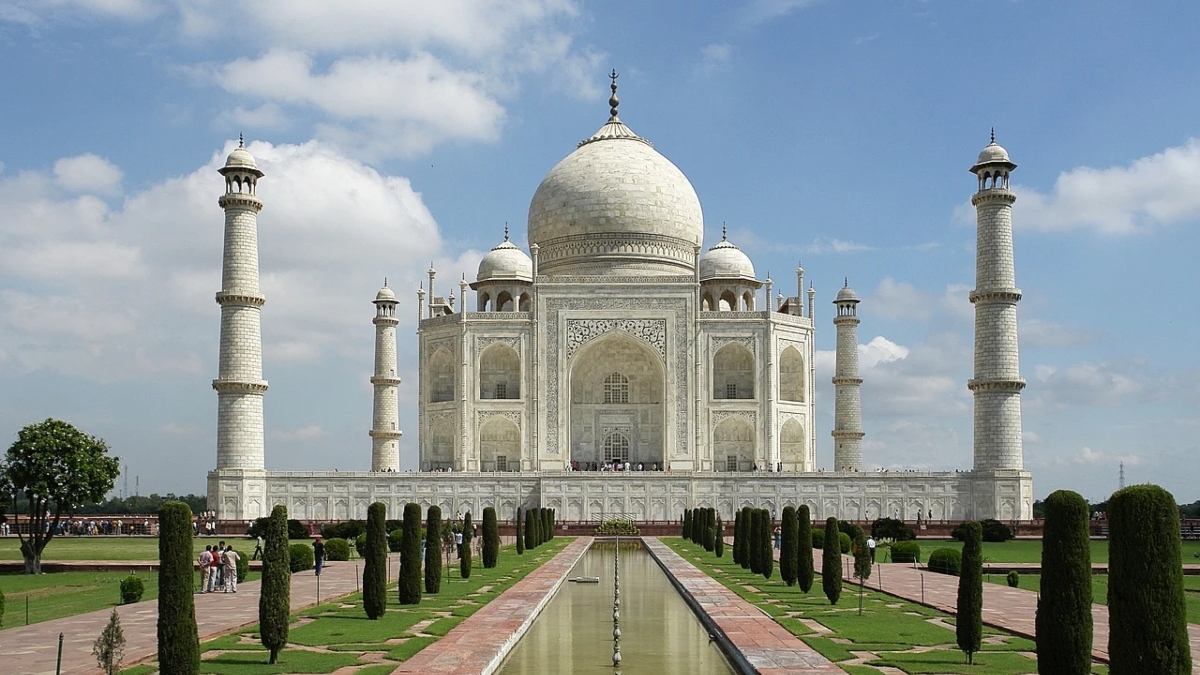
The ‘TAJ MAHAL’ History: Taj Mahal, included among the seven wonders of the world, is not only a symbol of the love of Shahjahan and Mumtaz. Rather, it is a building that attracts more than 65 lakh tourists every year and that is why Taj Mahal is the most visited tourist destination in India. Built with the hard work of 200 Hajj artisans invited from across the country and abroad, the walls of this mausoleum located in Agra are studded with 28 types of precious gems which shine so much on the Poonam night that people keep looking at this building.
The price of this beautiful Taj Mahal, built in 1653, comes to Rs 53 billion as of today. The carving techniques done on its walls were learned from Italian artisans. Marble carving artisans were called from Bukhara, Uzbekistan. Artisans from Balochistan were called to carve the stones and experts in calligraphy were called from Iran. There are many mysteries associated with the Taj Mahal. People are surprised to know about them even today, like the secret of the closed rooms below it.
In this article, I am going to give you all the information related to Taj Mahal, one of the most unique buildings in the world, its history, architecture and secrets. Taj Mahal is located in Agra city of Uttar Pradesh and after reaching Agra, you can easily reach here by bus, autorickshaw cab or your personal vehicle. So I reached the Taj Mahal complex from the West Gate parking side in my personal vehicle and I completed the journey of about 1 kilometer on foot till the ticket counter. If you want, you can also reach the ticket counter through electric card by taking a ticket of ₹ per person.
I would like to tell that the ticket to enter Taj Mahal can be taken from the counter. So it is 50 and West Gate means the western door and this is that gate. Through which Shahjahan used to enter the premises of Taj Mahal, Meena Bazaar was established here during the time of Shahjahan. And the special thing is that only women used to run the shops in this market. Even till 20-25 years ago, there used to be a market here. But the government closed it completely. At that time, Agra's ghagra blouses and bangles, studded with marble and items made from different types of stones, etc. were available here. This place is called the four gate area of Taj Mahal. That means from here, all four doors and gardens located outside the main complex of Taj Mahal can be seen.

The first door is the West Gate. There is another door. The South Gate on the right side from here was built for the artisans of Shahjahan. So the artisans who came to build the Taj Mahal and their families used to enter the complex through this gate. Even today, there is a colony behind this gate where people have been living for many generations. The third gate is the East Gate, built in the straight direction from here, which is also known as the VIP Gate.
All the special people of Shahjahan used to be there. He used to enter through this East Gate and the special thing is that even today whenever any VIP comes to visit Taj Mahal. So he brings his car inside through this gate. There is a fourth door. This Royal Gate, located on the left side, built to enter the main complex, i.e. the Royal Gate, above this royal door, you will see that there are 11 white colored domes, similar domes will be seen on the inside as well. It took a total of 22 years to build the Taj Mahal.
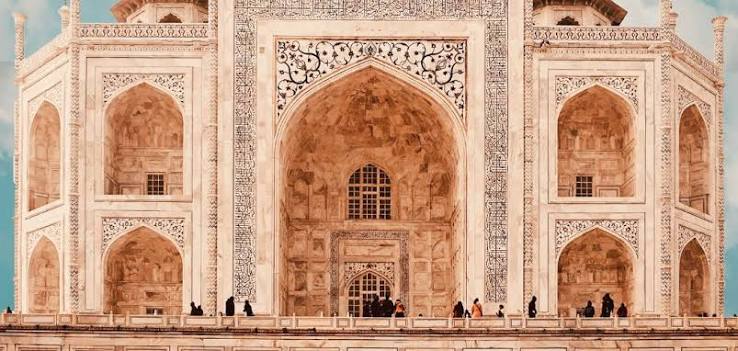
That is why a total of 22 domes were built here. According to a survey conducted in 2019, Taj Mahal is the most visited building in India. More than 65 lakh people from India and abroad come every year to see it. Not only this, Taj Mahal is the eighth most visited building in the world. The most popularity of Taj Mahal is due to the love story related to its construction. Shahjahan built this building in the memory of his wife Mumtaz Mahal. Taj's real name was Arjamand Banu Begum and Shah Jahan named her Mumtaz Mahal which means.
The most precious jewel of the palace, Mumtaz died in Burhanpur while giving birth to her 14th child at the age of just 38. On hearing the news of the death of his beloved Begum, the emperor became sad as if his life was destroyed and after some time, the emperor issued an order to build the Taj Mahal in her memory. The plan of the Taj Mahal was prepared by the famous Persian architect Ustad Ahmed Lahauri along with a team of 37 people. These architects were called from different corners of the world. For your information, let me tell you that like the Taj Mahal, the architect of the Red Fort of Delhi was also Ustad Ahmed Lahauri.
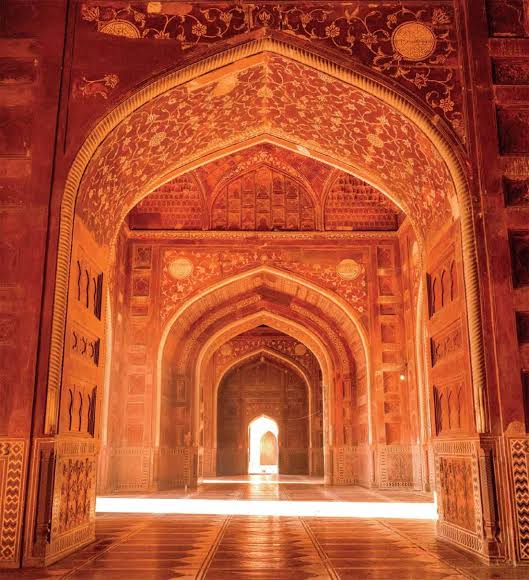
The design of Taj Mahal seems to be inspired by Humayun's Tomb located in Delhi. Humayun was the great grandfather of Shahjahan and his tomb became the inspiration for many Mughal buildings to be built in India. The rooms you see all around here are made of red stone. There are a total of 210 rooms which were specially built as rest rooms for the artisans who came to build the Taj Mahal, so all these rooms belong to the same time and were created whenever the artisans got tired after working. So after having food here, we used to rest for two-four hours and then started working again. So Taj Mahal is 300 meters away from the royal gate. You can see this line in the middle, if you follow this line and go towards the Taj Mahal, then you will feel as if the Taj Mahal is going away.
Which is also called deception of eyes or optical illusion. The time lag has made a lot of difference in determining the price of Taj Mahal. Still, it is estimated that today its value is 33 billion rupees. Here you will see this red building built on two sides, which is known as Drum House, whenever Shahjahan used to enter inside the Taj Mahal. So to welcome him, drums were played in these drum houses. It is said that Shahjahan had cut off the hands of the workers who built the Taj Mahal.
But there is no evidence of this and many historians believe that Shahjahan had made the laborers and artisans write agreements by paying them their lifetime wages. That he would not build any other such building. The tank you are seeing made of white marble is known as the Badshahi Tank. Sitting at this very place, Shahjahan used to watch the construction of Taj Mahal and he felt there was no shortage anywhere. So he used to get one stone removed and another one installed.
I would like to tell you that the white marble has been used to build the Taj Mahal. It was brought from Makrana in Rajasthan and it has lots of red sand stone. It was brought from Fatehpur Sea Creek. Jade and crystal were imported from China. Lapis lazuli came from Afghanistan. Duro was brought from Tibet, jasper from Punjab, sapphire from Sri Lanka and carnelian from Arabia. In total, it is said that 28 types of precious gems were embedded in white marble.
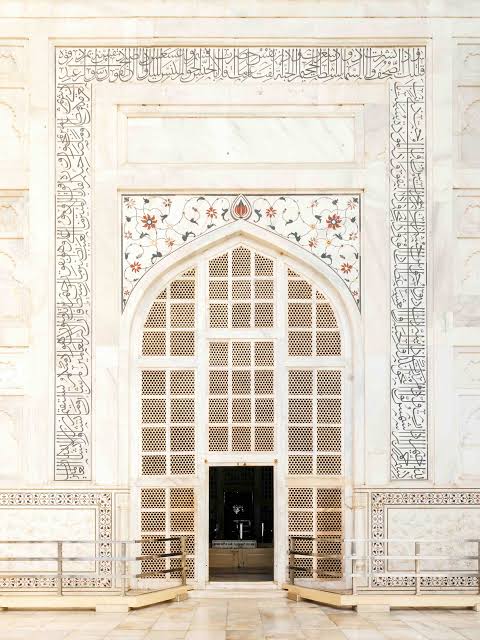
That more than 1000 elephants were used to bring all these things from other countries to Agra. Whatever black writing you see on the Taj Mahal. It is the first chapter of the Quran written in Arabic language. So no ink has been used to write this. Rather, black colored stones have been cut and placed inside these marbles with great effort. It is said that whatever artisans used to cut these stones. By rubbing his fingers, blood would come out, that is why this work was very difficult.
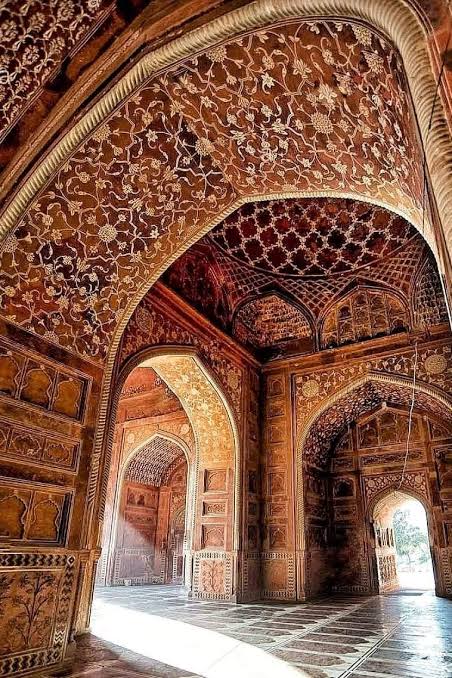
The name of the person who designed this calligraphy was Abdul Haq. Which was brought from Iran and is described. That Shahjahan named him Amanat Khan as a title considering his astonishing art. The construction of Taj Mahal started in 1631, about 400 years ago. And it was completed after 22 years in 1653. Behind which the hard work of 200 Hajj artisans and laborers was involved. To build the Taj Mahal, every thing was carefully selected like a diamond, right down to the carvings on its walls.
Its technology was learned from Italian artisans. Artisans who carved Sange marble were called from Bukhara, Uzbekistan. And the artisans from Balochistan were called to carve the stones which are made of red flowers. This is not a painting, rather these flowers have been made from different types of precious stones. Which shine in the moonlight night i.e. on the night of Poonam. When the full moon rises. So the Taj Mahal looks completely white when the moonlight falls on these red flowers. So it also lights up, making the atmosphere here worth seeing.
So if you also want to see the Taj Mahal shining on the night of Poonam. So you will have to take a ticket of Rs 1000 for that, a special thing is that after taking this ticket you get only 30 minutes to see the Taj Mahal. And you can stand near the royal gate and see the Taj Mahal from a distance. This is also a special thing related to Taj Mahal. That during the Second World War, the government had prepared a protective shield by making a bamboo circle around the main tomb. So that airplanes could be confused and this special circle could provide protection from German and Japanese air attacks.
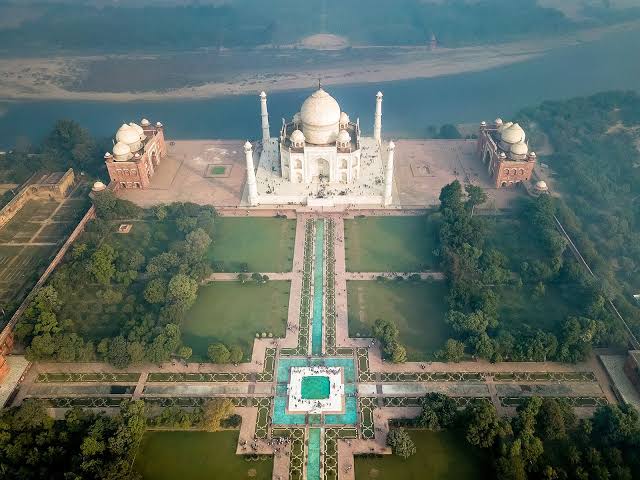
The same was done during the India-Pakistan wars of 1965 and 1971. You will see a red stone building on both sides of the Taj Mahal. The building on the left is the mosque. Where every Friday our Muslim brothers come to offer Namaz and on that day Taj Mahal is kept closed for tourists but it is opened for two hours for Muslims.
Perhaps you will be surprised to know that there are four minarets of Taj Mahal. These are not standing absolutely straight, rather all four are slightly inclined outwards. These were deliberately made so that even if they fall in case of a disaster like an earthquake, they would fall outwards and there would be no damage to the main mausoleum, so for the last few years, a ticket of Rs 50 only allows access to the lower part of this platform. And if you want to go to the upper part, then you will have to take a ticket of Rs 50 in total. The tomb of Shahjahan and Mumtaz is present in the upper part. If you want to see this, you can spend more rupees.
While building the foundation of Taj Mahal, many wells were dug around it and in these wells along with bricks and stones, logs of anus and mahogany wood were put. These wells make the foundation of Taj Mahal strong. The specialty of ebony and mahogany woods is that the more moisture they get, the more they will become steely and strong and these woods get moisture from the water of Yamuna river flowing near the Taj. One special thing is that the water level of Yamuna river is decreasing every year and the moisture in the wood is decreasing.
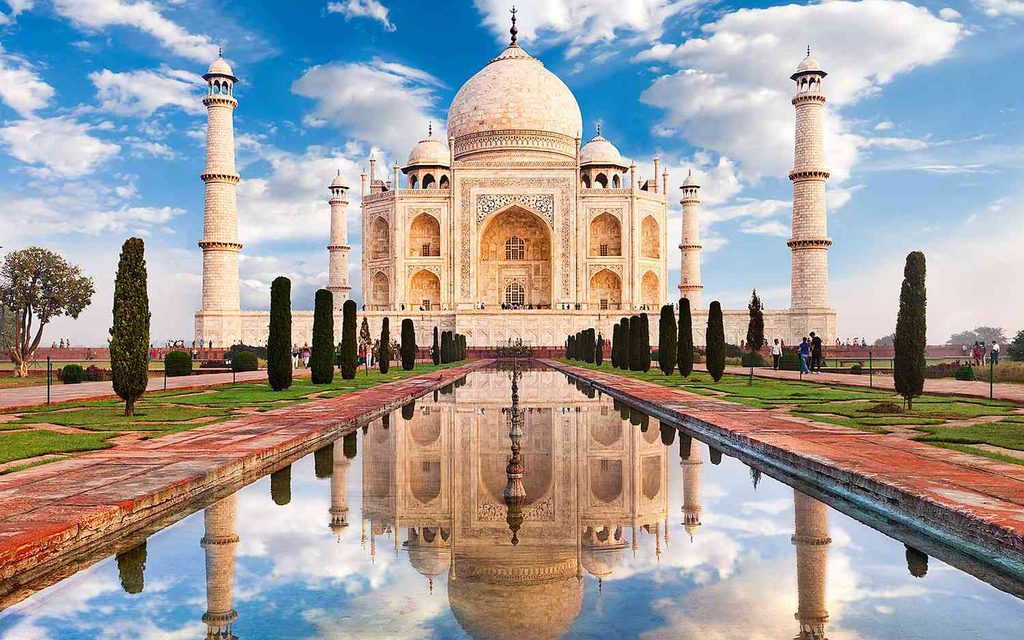
If you come to Agra on Friday, you will not get to enter the Taj Mahal complex, but if you want, you can see the Taj Mahal from Mahtab Bagh and from Mahtab Bagh you will see something like this, here you will also see this secret tunnel which used to open directly into the Agra Fort through the basement of the Taj Mahal, so this is the place in the Agra Fort where this secret path used to open. After the death of Shahjahan, his daughters Roshan Ara and Jahan Ara took his dead body to the Taj Mahal through this secret route. There are 22 such rooms below the Taj Mahal which remain a secret even today. Everyone wants to know what is there in these rooms, but they have remained closed like this for many decades. Now let us go to the upper part.
In 1989, Indian writer PN Oak had written a book named Taj Mahal The True Story. In this book, he had made this claim with many arguments. That before the Taj Mahal mausoleum was built, there was a Shiva temple and its name used to be Tejo Mahalaya. In 2000, PN Oak had applied to the Supreme Court to dig the side of the Taj to prove his point, which was canceled by the Supreme Court. According to the Archaeological Survey of India, Taj Mahal was once a Shiva temple and its name used to be Tejo Mahalaya. There is no concrete evidence for this but Shahjahan had built the Taj. Evidence of this is found in the pages of history, so this was the interesting history related to the Taj Mahal located in Agra.