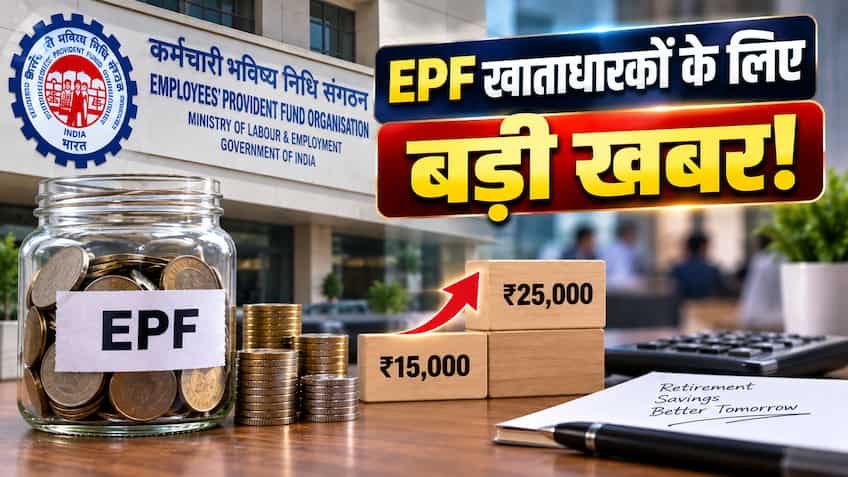
There has been a major change on the social security front for crores of salaried employees in the organized sector and the youth who have entered new jobs. The approval process has progressed towards increasing the statutory wage ceiling for mandatory contribution under the Employees' Provident Fund Organization (EPFO) from ₹ 15,000 to ₹ 25,000 per month. This amendment is being implemented after the year 2014 i.e. after a long gap of about 12 years, when the then government had increased this limit from ₹6,500 to ₹15,000. In view of rising inflation, cost of living and increased minimum pay scales in the private sector, revision of this limit was being recommended by the Ministry of Labor and Employment and the Central Board of Trustees (CBT) for a long time. With this policy decision, lakhs of new employees of the formal workforce across the country will be able to directly join the social security ambit of EPFO, who till now were left out of the mandatory PF coverage due to their basic salary being more than ₹ 15,000. New mathematics of EPF and EPS contribution: How will ₹25,000 be divided? Under the Employees Provident Fund rules, a contribution of 12-12 percent of the basic salary and dearness allowance (DA) is deposited by each employee and his employer company. Due to increase in the salary limit, the base of this mandatory calculation will become ₹ 25,000 instead of ₹ 15,000. The direct monthly changes in each account under this new slab will be as follows: Employee's EPF contribution: The entire 12% of the employee's contribution is deposited directly into the Employee Provident Fund (EPF) account. It was a maximum of ₹1,800 per month at the limit of ₹15,000, which will now increase to ₹3,000 per month at the limit of ₹25,000. Company (employer) contribution: 12% employer's share is divided into two parts: 8.33% share (Employee Pension Scheme – EPS): Earlier the maximum deduction was ₹1,250, which will now increase to ₹2,083 per month. 3.67% share (EPF account): Earlier it was ₹550, which will now increase to ₹917 per month. Monthly contribution to the total PF fund: The total amount of money going into the PF account of the employee and the employer will directly increase from ₹3,600 to ₹6,000 per month. Will take-home salary decrease or increase? Understand the actual impact of the pay slip. This increase in the salary limit will have a mixed impact on the take-home pay of every employee. For employees whose cost-to-company (CTC) model is fixed, the structure of deduction in their salary slips will change. Employees whose basic salary is more than ₹ 15,000 (e.g. ₹ 25,000 or more), but their company used to deduct PF only at the minimum ceiling of ₹ 15,000, will now have an additional ₹ 1,200 deducted from their pockets every month towards PF. Additionally, the employer's additional contribution of ₹1,200 can also be adjusted from the gross pay if it is part of CTC. This will result in an immediate reduction of approximately ₹1,200 to ₹2,400 in the employee's monthly in-hand salary. However, this deduction is not a loss, rather this money will be compounded by being safely deposited in a provident fund account with an interest rate of 8.25% guaranteed by the government. 66.6% straight jump in EPS pension: Secure monthly income on retirement The most revolutionary and far-reaching impact of this decision will be visible on the monthly pension received under the Employees' Pension Scheme 1995 (EPS-95). EPS pension is determined by a fixed formula based on pensionable salary and total service years: $$\text{Monthly pension} = \frac{\text{Pensionable salary} \times \text{service years}}{70}$$ Till now this formula had a cap on the maximum pensionable salary at ₹15,000, due to which even after completing the maximum service of 35 years, an employee could not get a monthly pension of more than ₹7,500. Now as soon as the base salary becomes ₹25,000, the range of pensionable salary will increase by 66.67%. The direct result of this will be that the maximum monthly pension of employees who have completed 35 years of service will directly increase from ₹7,500 to ₹12,500 per month. Lakhs of employees who have completed 20 to 30 years of service will also get the benefit of additional guaranteed monthly pension of ₹3,000 to ₹4,500 for life in proportion to their service period. What will be the impact on new employees and companies? This limit revision will change the rules for both industries and employees: Mandatory coverage for new employees: It will now be legally mandatory for every new employee with a basic salary up to ₹25,000 to become a member of EPFO, in any establishment with more than 20 employees. Increase in EDLI life insurance: The maximum life insurance cover available under the Employees Deposit Linked Insurance (EDLI) scheme available with EPF is also decided on the basis of salary limit. Increasing the salary limit will also increase the amount of insurance protection provided to the employee's dependents in case of any untoward incident. Companies' liabilities will increase: The financial burden on small and medium enterprises (MSMEs) towards their employees' statutory PF contributions will increase as employers may have to bear an additional monthly contribution of ₹1,200 per eligible employee. The move to raise the EPFO salary limit to ₹25,000 may reduce cash flows a bit in the short term, but in the long run, it will prove to be an unprecedented boost to the retirement fund, pension security and social empowerment of the Indian workforce.