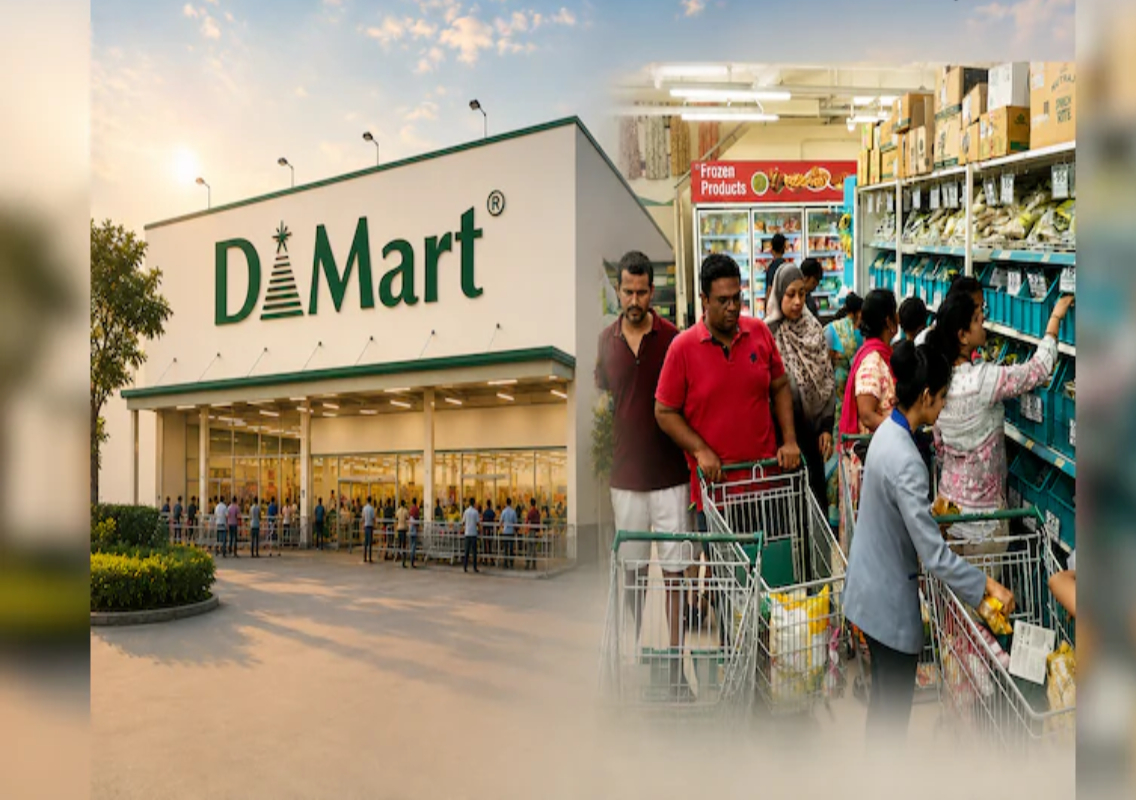
Mumbai: Avenue Supermarts, which operates the DMart retail chain, is facing growing competition as its store expansion increasingly shifts towards smaller cities, according to HSBC Global Research. The brokerage has raised concerns over the productivity of new stores and warned that DMart’s pricing advantage may not be strong enough to significantly improve its competitive position.
HSBC has maintained its Reduce rating on Avenue Supermarts and marginally lowered its target price to Rs 3,520 from Rs 3,530. The revised target was based on a reference price of Rs 3,720 cited in the brokerage report.
The brokerage’s assessment comes as DMart continues to expand its store network beyond major metropolitan and urban markets. HSBC believes this shift could weigh on store productivity, particularly because DMart’s existing stores have historically performed better in larger markets.
Smaller cities raise store productivity concerns
One of HSBC’s key concerns is the increasing proportion of new DMart stores being opened in areas with populations of less than one million.
DMart has historically recorded stronger store productivity in metros and larger urban markets. HSBC believes newer stores in smaller locations could generate lower productivity compared with the existing store base.
The brokerage expects new DMart stores to achieve around 50% of the productivity of the existing store base, compared with approximately 65% based on the FY23-25 average.
If the productivity of newer stores remains lower, simply increasing the number of outlets may not result in a proportional improvement in overall productivity.
HSBC expects DMart’s revenue per square foot to remain broadly flat during FY26-FY29, reflecting its concerns about the productivity of the retailer’s expansion strategy.
Pricing remains central to DMart’s strategy
HSBC also examined DMart’s pricing position against online competitors.
According to the brokerage, the pricing differential is around 5% for DMart Ready and 10% for physical DMart stores compared with online peers. HSBC said the relative pricing position has improved marginally, but not enough to materially strengthen DMart’s competitive position.
The brokerage considers pricing to be DMart’s key competitive advantage in the organised retail market.
This makes the sustainability of its price advantage particularly important as competition from online retailers and quick-commerce companies increases.
HSBC’s assessment indicates that maintaining lower prices relative to competitors could remain central to DMart’s ability to defend its customer base and store economics.
Competition from quick commerce intensifies
DMart’s competitive environment has changed significantly with the rapid expansion of e-commerce and quick-commerce platforms.
Quick-commerce companies have increasingly expanded their delivery networks and product offerings, particularly in urban markets. These platforms compete with traditional retailers through convenience, fast delivery and increasingly broad product assortments.
HSBC has flagged e-commerce and quick commerce as risks for DMart, along with competition from new retail formats and private-label products.
The growing competition could put pressure on DMart’s pricing advantage and make it more difficult for the retailer to maintain the same level of differentiation it has historically enjoyed.
For DMart, the challenge is therefore not only to expand its physical store network but also to ensure that its pricing and overall value proposition remain competitive across different channels.
Store expansion strategy under scrutiny
HSBC has described DMart’s current strategic approach as disappointing and said it will closely monitor whether the company changes its approach to store additions.
The brokerage’s concern centres on whether opening more stores in smaller cities can generate sufficient sales and productivity to justify the expansion.
The strategy could still provide DMart with access to markets where organised retail has room to grow. However, HSBC’s estimates suggest that the productivity of these newer stores may initially remain significantly below that of the company’s established outlets.
This difference matters because store productivity is an important factor in determining the efficiency of a large-format retail network.
DMart’s pricing moat faces a test
HSBC’s analysis places considerable emphasis on DMart’s pricing advantage.
The brokerage said DMart’s pricing is its only major competitive moat against other retailers, making any erosion of this advantage an important consideration for the company.
If competitors narrow the price gap while offering greater convenience through online ordering and rapid delivery, DMart could face increased pressure to balance prices, margins and store expansion.
At the same time, DMart’s physical store network remains central to its retail model. The company’s ability to maintain competitive prices while expanding into new territories will therefore be closely watched.
New CEO’s strategy remains important
The assessment also comes as Avenue Supermarts operates under CEO Anshul Asawa, who took over the role in January 2026.
The company’s future strategy could include decisions around store additions, e-commerce, private-label products and the performance of newer territories. These areas are expected to remain important for investors assessing how DMart responds to changes in India’s retail market.
HSBC’s latest report suggests that investors will be watching whether the company modifies its expansion strategy or continues to increase its presence in smaller cities.
The performance of recently opened stores could provide an important indication of whether DMart can replicate its established store economics outside major urban markets.
What HSBC’s assessment means for DMart
HSBC’s latest assessment highlights two closely connected issues for Avenue Supermarts: where DMart opens stores and how strongly it can defend its pricing advantage.
The brokerage expects newer stores to operate at lower productivity levels than the existing network and sees limited improvement in revenue per square foot through FY29. At the same time, it believes DMart’s pricing differential against online competitors remains relatively modest.
Competition from quick-commerce platforms, e-commerce companies, new store formats and private labels could add further pressure.
For DMart, the next phase of expansion will therefore involve balancing geographical growth with store productivity and maintaining its value proposition for customers.
The company’s ability to demonstrate stronger productivity from smaller-city stores and preserve its pricing advantage could remain key areas of focus as competition across India’s organised retail sector intensifies.