Nearly all of the savings came from avoided gas imports, according to a report published in late August by the Finland-based Centre for Research on Energy and Clean Air (CREA), as reported by Channel News Asia.
Despite those savings, the independent research organization found that Singapore’s dependence on imported fossil fuels resulted in $8.1 billion in additional gross fossil fuel costs during the six months following the outbreak of the U.S.-Iran war.
Singapore ranked 13th among 171 territories for additional fossil fuel import costs during the period, said Isaac Levi, CREA’s Europe-Russia policy and energy analysis team lead. China, India and the U.S. faced the largest financial burdens.
|
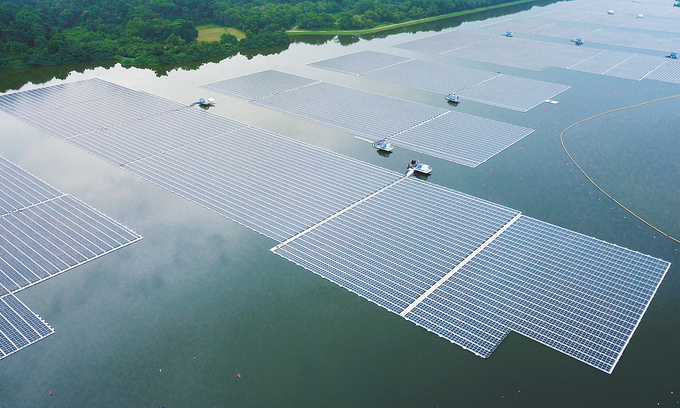
An aerial view of Sembcorb energy company’s floating solar power farm at Tengeh reservoir in Singapore. Photo couresty of Singapore’s National Water Agency PUB via AFP |
Levi said the savings resulted from the country’s reduced need to import fossil fuels for electricity generation following its solar expansion since 2020.
More than 95% of Singapore’s electricity is generated from imported natural gas, whose prices surged amid the U.S.-Iran war.
Strikes during the conflict disrupted shipments through the Strait of Hormuz, a critical maritime chokepoint that previously carried about 20% of the world’s oil and liquefied natural gas.
Singapore has been expanding its use of solar energy, the most viable form of renewable energy for the country.
In February, Singapore increased its solar deployment target from 2 gigawatt-peak to 3 GWp by 2030, after reaching its original target in 2025 through the installation of solar panels on rooftops, reservoirs and other surfaces.
However, Levi noted that solar still accounts for a relatively small portion of Singapore’s power mix. Solar energy currently meets only about 2% of the country’s electricity needs.
Fuel prices in Singapore, however, have been climbing over the past week. Chinese state-owned Sinopec raised its prices for the fifth straight day on Sunday, AsiaOne reported.
Following the latest round of price increase, the price of the more popular 95-octane petrol now ranges from $3.48 at SPC to $3.49 at Caltex, Esso, Shell and Sinopec.