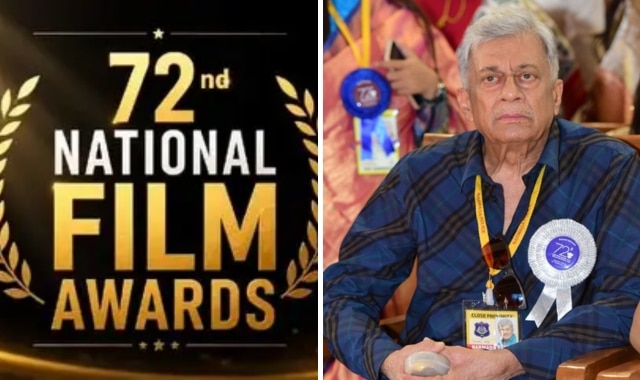
President Droupadi Murmu presented the 72nd National Film Awards at Ekta Nagar in Kevadia, Gujarat — the first time the country’s most prestigious film honours have been conferred outside New Delhi on Tuesday.
The evening’s defining moment belonged to veteran Kannada actor Anant Nag. After more than five decades and over 300 films, Nag received the Dadasaheb Phalke Award for 2024, India’s highest cinematic honour. The government cited his “illustrious cinematic journey that has inspired generations,” especially his lasting imprint on Kannada cinema. He becomes only the second Kannada actor after Dr Rajkumar to receive the Phalke. Prime Minister Narendra Modi had earlier hailed Nag’s “rare depth and authenticity.”
The ceremony, held near the Statue of Unity, honoured films certified in 2024. Article 370directed by Aditya Suhas Jambhale and produced by Jio Studios and B62 Studios, won Best Feature Film. Its lead, Yami Gautam, took Best Actress — her first National Award — for a taut political drama built around the abrogation of Article 370.
Best Actor was shared. Malayalam icon Mammootty won for Rahul Sadasivan's Brahmayugamadding a fourth National Award for acting. Kartik Aaryan claimed his first for Kabir Khan’s Chandu Championin which he portrayed Paralympic gold medallist Murlikant Petkar. Two very different performances, one shared golden lotus.
Non-feature cinema was not overlooked. Bhangaardirected by Sumira Roy, won Best Non-Feature Film. Ram-Namidirected by Bharatbala Ganapathy, was named Best Documentary. Actor-turned-filmmaker Randeep Hooda received Best Debut Director for Swatantrya Veer Savarkara film he also starred in and co-wrote. Hooda later said the project “asked more of me than anything I’ve ever done.”
The venue itself was the other headline. For decades the awards were presented at Vigyan Bhavan in Delhi. This year a specially built dome near the 182-metre Statue of Unity hosted stars, technicians and juries from across languages. Officials framed the shift as an effort to take national recognition closer to the country’s many film cultures. Gujarat Governor Acharya Devvrat and Chief Minister Bhupendra Patel attended with the President.
Other major winners included Rajkumar Periasamy (Best Director, Warning) and Kalki 2898 AD (Best Popular Film Providing Wholesome Entertainment). Together, the list stretched from mainstream spectacles to regional and documentary work — a reminder that the National Awards still try to measure Indian cinema in more than one language and one market.
For Anant Nag, the night completed a late-career arc that already included the Padma Bhushan in 2025. For Yami Gautam, Kartik Aaryan and Hooda, it marked firsts. For Mammootty, it added another chapter to a long record. And for the awards themselves, Kevadia offered a new picture: India’s film honours standing, quite literally, at the feet of a monument to unity.