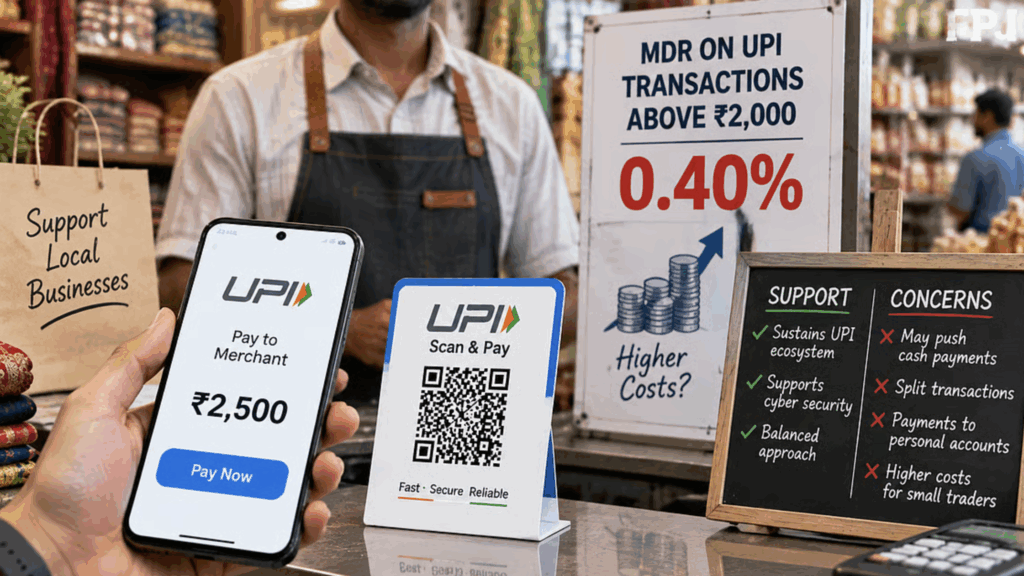
The government’s decision to introduce a Merchant Discount Rate on certain UPI transactions has triggered concerns that India’s rapid shift towards digital payments could face a setback.
Former NITI Aayog vice-chairman Rajiv Kumar has urged the government to continue keeping UPI transactions free for at least a few more years. He warned that even a small charge could encourage merchants and users to return to cash.
0.4% MDR To Apply From October 15
From October 15, a 0.4% Merchant Discount Rate will apply to certain person-to-merchant UPI transactions above Rs 2,000.
The charge will be paid within the merchant payment ecosystem rather than directly by consumers. Transactions between individuals will remain free, while most small-value merchant payments will also continue without an MDR.
The charge will be capped at Rs 300 for transactions of Rs 75,000 or more.
Rajiv Kumar Says UPI Should Remain Free
Rajiv Kumar has argued that UPI should be treated as a public good because its broader economic benefits outweigh the cost of maintaining the infrastructure.
He has urged the government to maintain zero-fee UPI transactions until there is a sustained decline in India’s currency-to-GDP ratio.
According to Kumar, the government should continue supporting the payment ecosystem rather than introducing charges that could change consumer and merchant behaviour.
Why High-Value UPI Transactions Matter
While most UPI transactions are relatively small, high-value transactions account for a significant portion of the total value moving through the system.
Kumar pointed out that around 96% of UPI transactions by volume are below Rs 2,000, while nearly 66% of transactions by value are above that threshold.
This means the number of transactions affected by the MDR will be relatively small, but they represent a substantial share of the money moving through UPI.
Could Merchants Return To Cash?
Kumar’s concern is that merchants facing additional transaction costs could start preferring cash for larger purchases.
This could be particularly relevant for businesses operating on narrow margins. If accepting UPI becomes more expensive while accepting cash does not carry an equivalent transaction charge, some merchants could encourage customers to pay in cash.
Retail industry representatives have raised a similar concern, arguing that MDR could create an incentive for some small retailers to shift higher-value transactions back to cash.
RBI Has A Different View
The concern about a possible return to cash is not universally shared.
RBI Deputy Governor Shirish Chandra Murmu has said that the introduction of MDR is unlikely to result in a significant shift back to cash. He described the concern as an initial apprehension and said the new fee would help the payments ecosystem recover its operating costs.
The Finance Ministry has also indicated that it does not expect cash transactions to increase significantly because only a relatively small share of UPI transactions will be affected.
Most Everyday UPI Payments Will Remain Free
For ordinary consumers, the new rules will not mean that UPI becomes a paid service.
Person-to-person transfers will remain free, and more than 95% of merchant UPI transactions by volume are below Rs 2,000.
The impact will therefore be concentrated on higher-value purchases, including some retail, business and service transactions.
The Real Test Begins In October
The actual impact of the MDR will become clearer after October 15, when the new system takes effect.
Changes in high-value UPI usage, cash withdrawals and other payment methods could indicate whether merchants and consumers are actually switching away from digital payments.
For now, the debate is centred on two competing considerations: creating a sustainable revenue model for India’s enormous digital payment infrastructure while preserving the rapid adoption of UPI.
Summary
Former NITI Aayog vice-chairman Rajiv Kumar has warned that introducing a 0.4% MDR on certain UPI transactions above Rs 2,000 could encourage some merchants and users to return to cash. He has urged the government to keep UPI free for several more years. RBI officials and the Finance Ministry, however, have said they do not expect a significant shift back to cash.