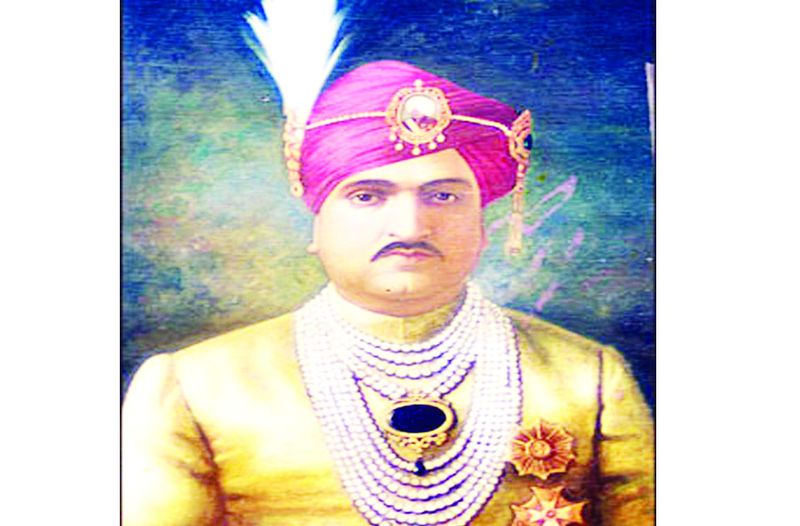
Today is a very important day for every Dogra and, indeed, for every Indian who wishes to understand the history of Jammu and Kashmir. It is the Birth Anniversary of Maharaja Hari Singh Ji, the last Dogra ruler of the princely state of Jammu and Kashmir. Maharaja Hari Singh was born on 23 September 1895. Today, as we remember him, we must remember not merely a Maharaja, but the sovereign who stood at one of the most critical crossroads in the history of the Indian subcontinent. The Jammu and Kashmir over which he ruled was unlike any other princely state in India. It was an enormous Himalayan state, stretching across approximately 84,000 square miles, occupying a position of extraordinary geographical and strategic importance. Its frontiers reached towards China, Afghanistan and the territories that later became Pakistan, while its wider geographical neighbourhood brought it close to Tibet, Russia, Nepal and the Indian heartland. What other princely state possessed such a geography, such a history and such strategic importance?
This extraordinary state was the creation of generations of Dogra statesmen, administrators and soldiers. Beginning with Maharaja Gulab Singh and the remarkable military achievements of General Zorawar Singh, the Dogras extended and consolidated their authority across some of the most difficult terrain in the world. Men such as Mehta Baste Ram, General Mohammad Khan and countless other soldiers and administrators helped build and defend this great state. We must remember that history was not made only in palaces. It was made on the battlefield, on mountain passes, in deserts and valleys, by men who marched where armies could scarcely move. Maharaja Hari Singh inherited that legacy. Yet, sadly, the man who inherited and defended this extraordinary Dogra state has too often been remembered only through the prism of the political controversies surrounding 1947. I believe it is time to look at Maharaja Hari Singh again. Not as a symbol to be used for political argument, but as a historical personality whose decisions must be understood in the extraordinarily difficult circumstances in which he lived.
The year 1947 was not an ordinary year. British paramountcy over the princely states ended with independence, leaving the rulers facing an unprecedented constitutional and political situation. Jammu and Kashmir, because of its geography, religious composition, borders and strategic importance, was particularly vulnerable. Maharaja Hari Singh did not wish to surrender his state casually to either side. But there is an important point that is often forgotten: his personal preference was not, in my understanding, for Pakistan. He wished ultimately to accede to India. I came to understand something of Maharaja Hari Singh’s thinking personally when I spent a month with him in Bombay in 1954. I had already been commissioned by him on 10 September 1947, only weeks before the great events that changed the history of Jammu and Kashmir forever. I had two interviews with him, and as an officer of the J&K State Forces, I was able to see something of the man and the principles by which he governed. Indeed, the political circumstances were made by the British more complicated.
When the Maharaja sent his Deputy Prime Minister, Mr Batra, to meet Jawaharlal Nehru on 18 July 1947 regarding accession, Nehru did not engage with the Maharaja directly and directed him towards Sheikh Abdullah, who was then imprisoned. Whatever one’s view of the politics of that period, this episode demonstrates how difficult the relationship between the Maharaja and the emerging Indian leadership had become even before independence or perhaps Nehru was doing what he had been told to do by the British who were all there to ensure the Accession of J&K to Pakistan.
At the same time, Lord Mountbatten was pressing the princely rulers to make decisions about accession. The pressure on Maharaja Hari Singh was particularly intense because of the strategic importance of Jammu and Kashmir. I have always believed that Maharaja Hari Singh understood the implications of joining Pakistan and that is what the British wanted him to do and that is what created the J&K problem, it is as simple as that.
He was a Dogra ruler. He knew his state. He knew its history, its people and its strategic position. He also knew that accession was not simply a political document. It could determine the future of generations. The Maharaja was forced to delay his decision. It was all planned. History may debate whether that was the correct strategy. But we should not confuse a difficult decision with treachery or indifference.
The tragedy was that while political negotiations continued, forces hostile to the State were already moving. The invasion of Jammu and Kashmir in October 1947 transformed the situation completely. Pakistani forces under the garb of tribal forces entered the State from the west. The Maharaja’s government suddenly faced an armed invasion across an enormous frontier and an internal revolt. Here again, we must understand the extraordinary disadvantage under which the State Forces operated.
In 1947, Maharaja Hari Singh had only about 7,000 troops in roughly eight battalions to defend a frontier eight hundreds of kilometres, extending from the Lakhanpur to Ladakh. These troops were scattered in small detachments because the territory was so vast. It was an impossible military problem, yet these men fought and saved the State. They fought at Muzaffarabad, Uri, Domel, Naushera, Poonch and elsewhere. The most celebrated among them was Brigadier Rajinder Singh, the Chief of Staff of the J&K State Forces, who was ordered to delay the invading forces at all costs and to the last man. With a small force, Rajinder Singh and his men stood between the advancing invasion and the Valley. That resistance bought precious time.
It is worth remembering what that time meant. Without that resistance, Srinagar could have fallen before Indian troops arrived. The Dogra soldiers therefore did something far greater than merely defend a princely state. They bought time for the accession and for the subsequent Indian military intervention. When the situation became untenable, Maharaja Hari Singh signed the Instrument of Accession to India on 26 October 1947, and Indian troops were subsequently airlifted to Srinagar.
I have always believed that the sacrifice of the State Forces in those crucial days deserves far greater recognition. The tragedy is that the Maharaja himself did not receive the historical understanding he deserved. He was eventually removed from effective power and spent the rest of his life away from Jammu and Kashmir. In my view, this remains one of the great tragedies of modern Dogra history: a ruler was separated from the state of which he was the sovereign at the very moment when that state was passing through the greatest crisis in its history.
But there is another side of Maharaja Hari Singh that is equally important and is often forgotten. He was not merely a ruler concerned with territory and power. He introduced and supported significant social reforms. His period saw measures affecting education, the position of women, access to public institutions and the status of historically disadvantaged communities. One example particularly stays with me. In Kashmir, Maharaja Hari Singh took measures to encourage girls’ education, including arrangements to provide security for girls travelling to schools. In those days, social conventions often prevented parents from sending their daughters to school. The State had to take active steps to make education possible. These were not small matters in the social conditions of that period. His approach to his subjects was also not based upon religious discrimination. I knew this personally. Even among his closest attendants, cooks and servants, Muslims served him until his final days.
The Maharaja’s conception of kingship was rooted in the old Dogra understanding of the ruler as the head of a larger family, responsible for all his subjects. Hindu, Muslim, Sikh or Christian, the ruler’s duty was to protect them. That aspect of Maharaja Hari Singh’s life deserves to be remembered alongside the political controversies.
We must also understand the larger British context. Walter Reid’s book Fighting Retreat: Churchill and India, published in 2024, has renewed discussion about Winston Churchill’s long opposition to Indian self-government and the British handling of India’s transfer of power. Reid, a historian educated at Oxford and Edinburgh and a Fellow of the Royal Historical Society, examines Churchill’s relationship with India from his early years there through the struggle over Indian independence. The fact cannot be disputed: the British withdrawal left behind a deeply divided subcontinent, unresolved territorial questions and a Kashmir crisis that has continued for generations with serious consequences.
India and Pakistan fought wars. Jammu and Kashmir became one of the most dangerous flashpoints in the world. And, decades later, the people of the region continued to suffer. Among the deepest tragedies was the forced displacement of the Kashmiri Pandit community from the Valley in the late twentieth century. This is why remembering Maharaja Hari Singh is not an exercise in nostalgia. It is about understanding history. It is about understanding what the Dogras built, what they defended and what was lost. The Dogras created a state of extraordinary strategic importance. Their soldiers defended it with extraordinary courage. Maharaja Hari Singh inherited that state at a moment when the old order was collapsing around him.
Today, on his birth anniversary, I therefore wish to pay my respectful tribute to Maharaja Hari Singh Ji. I do so not merely as a Dogra, but as one who had the privilege of being commissioned by him and of seeing something of the man behind the history.
Maharaja Hari Singh was a great Dogra ruler who inherited an extraordinary legacy and faced an extraordinary crisis. If he had been born in another age, perhaps history would have remembered him as Vikramaditya of Jammu and Kashmir. But he was born into one of the most turbulent periods in Indian history, and he found himself standing at the crossroads of empire, partition, invasion and the birth of two new dominions. We owe it to ourselves, and especially to the younger generation, to study that history without fear and without prejudice.
Let us remember Maharaja Gulab Singh, General Zorawar Singh, Col Mehta Baste Ram, Gen Mohd. Khan, Gen Baj Singh and Brigadier Rajinder Singh and the thousands of Dogra soldiers who built the largest and the most strategic state of India. Let us remember Maharaja Hari Singh not merely as the ruler who signed the Instrument of Accession, but as the last Dogra sovereign who carried the responsibility of a vast Himalayan state through one of the most dangerous moments in South Asian history.
Let us remember the central truth of his legacy: The Dogras built this state. The Dogras defended it and the sacrifices made in its defence must never be forgotten.
On this sacred day, I bow my head before the memory of Maharaja Hari Singh Ji. May his contribution to Jammu, Kashmir and India be studied honestly, remembered with dignity and given its rightful place in our national history. Jai Dogra.