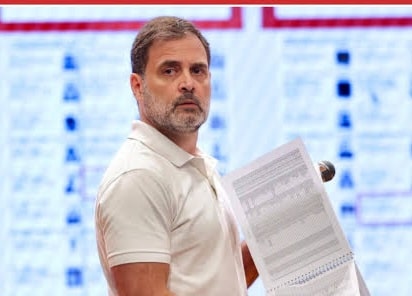
Congress leader and Leader of Opposition in the Lok Sabha Rahul Gandhi on Thursday renewed his allegations of “vote chori” and called for the resignation of Chief Election Commissioner Gyanesh Kumar.
Gandhi referred to electoral developments in states including Haryana, Maharashtra and Uttar Pradesh, questioning how what he described as anti-incumbency had “disappeared”.
His remarks came amid a political row over a report by The Indian Express that Election Commissioners Sukhbir Singh Sandhu and Vivek Joshi had recorded objections at least 14 times over 10 months regarding decisions taken in the name of the Election Commission.
What is the Election Commission dissent row?
According to the Indian Express investigation, Sandhu and Joshi raised concerns on several issues linked to electoral rolls and the Commission’s systems, including changes to Form 6, centralisation of electoral-roll database controls and voter-deletion appeals.
The report said the two Election Commissioners recorded four objections on a single day, adding to questions raised by Opposition parties about the functioning of the three-member poll panel.
However, Election Commission officials have rejected the suggestion that the reported objections reflected a breakdown or split within the Commission.
EC officials said all decisions, including those concerning the Special Intensive Revision (SIR) of electoral rolls, had the approval of all three Election Commissioners. The Commission has also said that differing views and observations are a normal part of institutional deliberations.
Rahul Gandhi says ECs should ‘think seriously’
Gandhi said Sandhu and Joshi had “done a wise thing” by recording their objections.
He also called on CEC Gyanesh Kumar to “think seriously and turn approver”, according to his remarks cited in the report.
Gandhi’s comments followed his earlier criticism of the Election Commission over the electoral-roll revision process. On September 23, he also described his “vote chori” allegation as a serious issue concerning the electoral process.
The allegations remain contested, with the Election Commission maintaining that its decisions were taken unanimously.
Gandhi recalls dissent over CEC appointment
Gandhi also referred to the process through which Gyanesh Kumar was appointed Chief Election Commissioner.
He said he had submitted a dissent note during the appointment process, arguing that the selection mechanism should be independent and free from executive control. Gandhi said his note was “junked”.
Under the Chief Election Commissioner and Other Election Commissioners Act, 2023, the selection committee recommends candidates for appointment to the President. The law provides for a three-member selection committee comprising the Prime Minister, the Leader of Opposition in the Lok Sabha and a Union Cabinet minister nominated by the Prime Minister.
The Act also provides that the Chief Election Commissioner can be removed only in the same manner and on the same grounds as a Supreme Court judge.
Political row intensifies over ECI functioning
The reported objections by Sandhu and Joshi have triggered criticism from Opposition parties, while the BJP and the Election Commission have defended the functioning of the poll panel.
The Election Commission’s position is that differences or observations during internal deliberations do not necessarily mean that final decisions lacked consensus. The row therefore centres on how the reported objections should be interpreted alongside the Commission’s assertion that its decisions were unanimous.