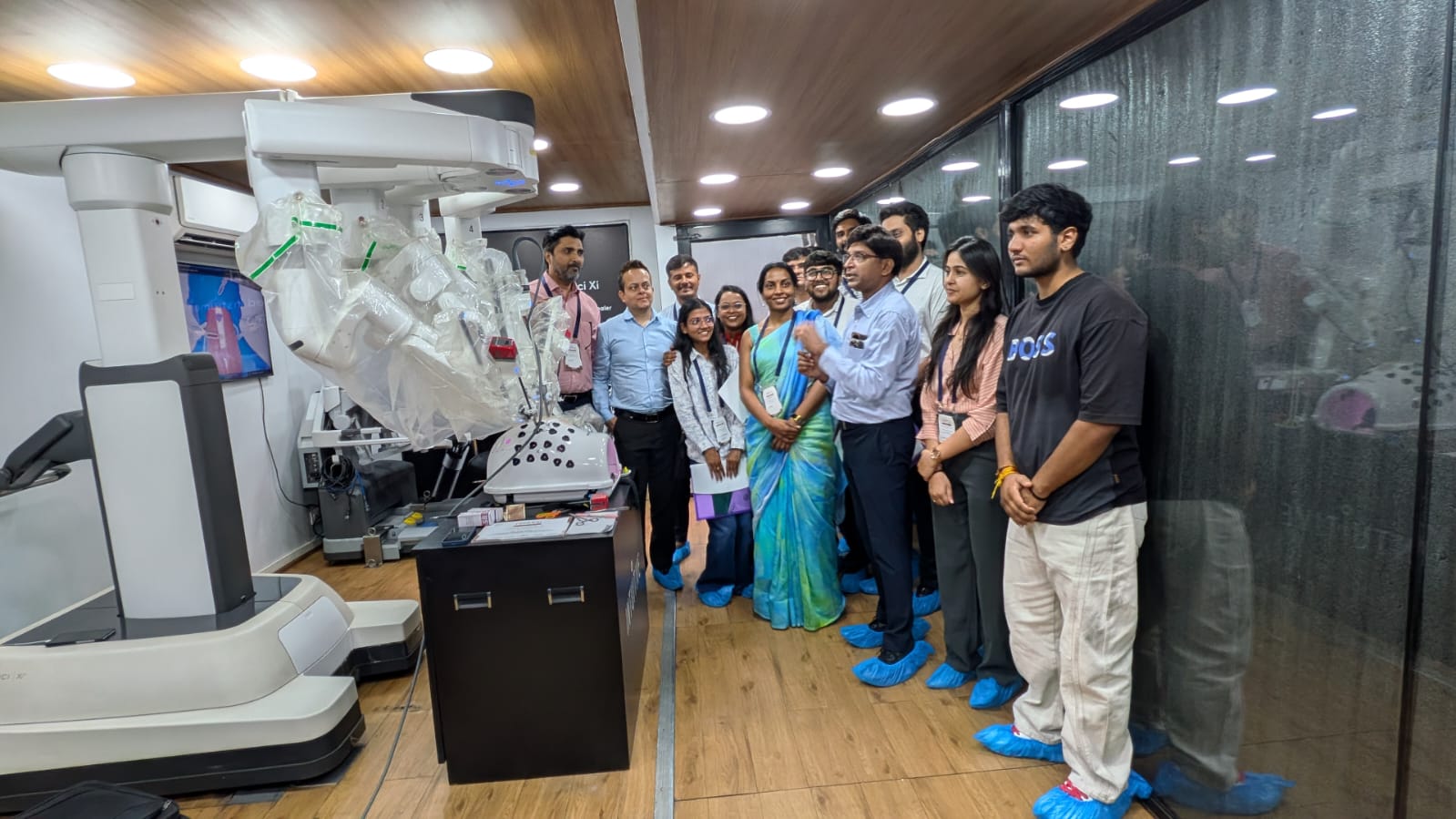
Jaipur. The 12th National Conference of the Indian Academy of Otolaryngology and Head-Neck Surgery (IAOHNS) began with hands-on robotic surgery training at the Academic Building of Sawai Mansingh Hospital on Thursday. In the pre-conference workshop of this national conference being organized from 24 to 27 September, the doctors and students were given practical training in various modern techniques of ENT and Head-Neck surgery including robotic surgery.
During the workshop, Dr. Satish Jain and Dr. Sampat Chand Prasad Rao demonstrated the techniques of anterior skull base and lateral skull base surgery on cadaver. Apart from this, the participants also did hands-on practice of nerve monitoring system. According to the organisers, around 150 students and around 50 consultants participated in the workshop.
Also training on checking Eustachian tube, allergies and dizziness
In the pre-conference workshop, training was given on balloon dilation technique, laser methods and use of 3D CT Scan and CBCT Scan for the treatment of Eustachian tube related disorders.
Along with this, doctors were also trained on skin prick test for allergy detection and techniques of testing and treatment related to the problem of dizziness. The participants were also given information about the technical aspects of various instruments used in ENT.
Robotic technology still limited in ENT and Head-Neck surgery
Dr. Pawan Singhal, senior professor of the Department of Ear, Nose and Throat of SMS Hospital and scientific chairman of the conference, said that the training in robotic surgery in conferences related to ENT and head-neck surgery is still relatively limited.
He said that the use of robotic surgery in the treatment of diseases related to ear, nose, throat and head, mouth and throat in India is still less as compared to foreign countries. According to Dr. Singhal, the number of operations performed using robotic technology is still very less compared to the large number of thyroid surgeries being performed at present.
Emphasis on better visibility and movement of equipment
Explaining the usefulness of robotic surgery, Dr. Singhal said that in traditional surgery the surgeon has to work on the basis of his hands and normal vision. There are some parts of the body where it can be challenging to reach and turn the equipment at the proper angle.
He told that the robotic system has many arms, one of which is for the camera. With the help of other arms, tasks like catching, cutting and coagulation can be done. With the help of the camera, the surgeon can view the operation area as per requirement and from different angles, which helps in working in sensitive areas.
Training given on movement capability of robotic arm
According to Dr. Singhal, dexterity i.e. the ability to operate instruments precisely is important in robotic surgery. He explained that the robotic arm can be operated in different directions and angles, helping to reach areas where movement of traditional instruments may be limited.
He also pointed out that slight vibration in the hands during manual surgery can pose a challenge in surgery around sensitive areas, blood vessels or nerves. In robotic systems the surgeon controls the instruments through a console, allowing precise hand movements to occur in a more controlled manner.
Limited availability and cost are major challenges
Dr. Singhal cited better visibility, precise movement of instruments and control during operations as the major potential benefits of robotic surgery. However, he cited its limited availability and high cost as major challenges.
He said that robotic systems available in a single institution can be used by multiple departments to reduce the cost challenge. Departments where the use of robotic surgery is appropriate, including urology, gynecology and ENT, can share the same system.
Hands-on training will increase practical experience
Dr. Singhal said that it is important to give practical training to doctors in the technology for robotic surgery. For this, cadaver and simulation based workshops are being organized in which doctors are made to practice the operation of robotic systems and surgical techniques.
This pre-conference workshop of IAOHNS also gave an opportunity to the physicians and students for practical training with modern surgical techniques. According to the organizers, the objective of such training is to enhance the understanding of emerging technologies in ENT and Head-Neck surgery and to acquaint the physicians with modern surgical procedures.