Canada has recruited 48 senior academics based in the U.S. to join its leading universities, highlighting the government’s efforts to attract research talent as American higher education faces increased pressure under President Donald Trump’s administration.
The academics are among 64 researchers from selected 13 countries. Together, they will receive more than C$541 million (US$382.57 million) in funding over eight years to work in Canada’s strategic priority areas, according to a government’s announcement.
Among them, 48 come from top U.S. institutions such as Harvard, MIT, Yale, Carnegie Mellon University, the University of Massachusetts and the University of California, Berkeley.
Their work spans fields where funding has been cut by the Trump administration, including sustainability, climate and the environment, the Financial Times reported.
“At a time when parts of the world are turning away from science, Canada is doubling down. Attracting top talent will deliver breakthroughs that improve Canadians’ lives and advance Canada’s position as a global leader in science and innovation,” Mélanie Joly, Minister of Industry and Minister responsible for Canada Economic Development for Quebec Regions, was quoted as saying in the government’s announcement.
|
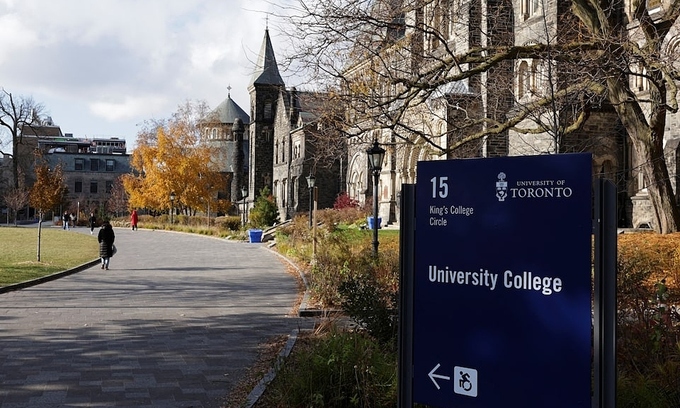
Students walk at the St. George campus of the University of Toronto, in Toronto, Canada, Nov. 20, 2025. Photo by Reuters |
The recruitment is part of Canada’s C$1.7 billion (US$1.2 billion) Global Impact+ Research Talent Initiative, which was launched last year to recruit world-leading researchers.
The initiative comes amid growing uncertainty over U.S. government support for scientific research and strained relations between the Trump administration and several leading American universities, according to Forbes.
The administration has used federal funding to pressure several leading U.S. universities, including Harvard and Columbia.
In April 2025, Reuters reported that it had frozen $2.3 billion in research funding to Harvard after the university rejected government demands, while Columbia faced the termination of $400 million in grants and contracts. Scientists and university officials warned that such measures could undermine research and innovation, while researchers also expressed concern about greater government control over scientific funding.
Receiving universities jointly welcomed the incoming faculty.
The president of the University of British Columbia, which is welcoming nine researchers, said the institution is “delighted to welcome these nine exceptional researchers, whose work will have important and meaningful impact,” CNN reported.
The president of the University of Toronto, where six researchers will work, said government support would help build a solid research foundation amid an increasingly volatile international landscape.
Many scientists said concerns over declining academic freedom in the U.S. were a primary driver of their departure. For more than a year, the U.S. government has cut funding at several prestigious universities while taking measures to increase oversight.
Researchers have also expressed unease about government intervention in science funding decisions, which they say has disrupted their work.
Phillip Zamore, an RNA biology researcher at the University of Massachusetts, told WBUR that his reason for leaving was encountering too many obstacles in recruitment.
“I cannot do my best work in America. I can’t recruit the best people to help me do that, and I can’t promise them an environment where they’ll be safe,” Zamore said. He has since joined McGill University in Montreal, Quebec.
WBUR also reported that Zamore said funding cuts and delays prevented him from replacing two of his 14 lab members, while he dismissed two other staff members and stopped taking graduate students.
He is receiving at least C$12 million over eight years, plus several million dollars for equipment, to establish his new lab at McGill.