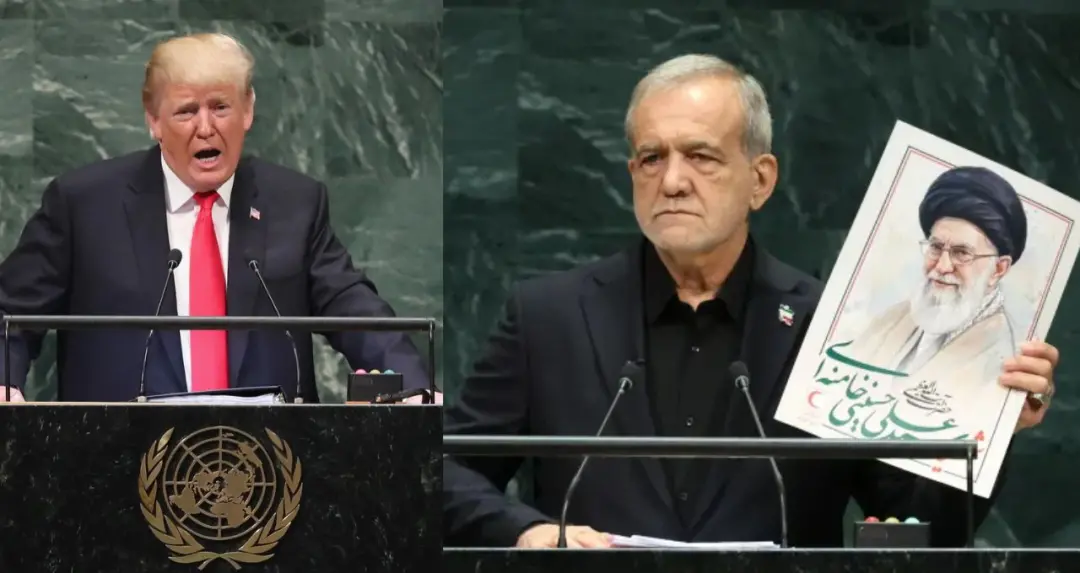
Iran has proposed a seven-day ceasefire roadmap to the US. This includes a plan to first stop military action and give relief in sanctions, then open the Strait of Hormuz on the seventh day and start new talks on the nuclear program.
Iran/US talks: Iran has proposed a seven-day roadmap to America to end the conflict. According to Iranian Foreign Minister Abbas Araghchi, the plan stipulates first stopping military action and providing relief from American pressure and oil sanctions. After this, there is a proposal to reopen the Strait of Hormuz on the seventh day and start comprehensive talks on Iran's nuclear program. This initiative has come at a time when diplomatic efforts have intensified amid the conflict between America and Iran that has been going on for almost seven months.
What's in the seven day plan?
Iranian Foreign Minister Abbas Araghchi told the UN General Assembly that Tehran has sent a proposal to the US through mediators. Under this, if certain conditions are fulfilled, it has been said that the Strait of Hormuz will be opened on the seventh day and talks on nuclear program will be resumed.
This proposal is said to be similar to the framework of the agreement prepared between America and Iran in June, but its deadline has been kept much shorter. The previously proposed arrangement had provided for lengthy negotiations to reach a final agreement, while the new roadmap seeks to speed up the process within seven days.
Iran has also said that the further process can be accelerated after relief from American military pressure and economic sanctions. However, whether the US administration has accepted this seven-day roadmap or not has not been confirmed in the available reports.
President Pazhakian said- Iran does not want war
Iranian President Masoud Pazhakian said in an interview with American media that his country does not want war and is ready for talks. Speaking to Fox News, he said that the basis for an agreement between the two countries had been prepared in June and Iran was ready to take that process forward.
Pazhakian claimed that at that time the Strait of Hormuz was open and negotiations were ongoing, but after this there were attacks on Iran. He accused America of disrupting the diplomatic process with military action. These are Pazashkian's statements and details from the Iranian side.
According to Fox News, Pazhakian also said that Iran is willing to allow international inspections over its nuclear program, but that it would not accept military and economic pressure. He reiterated that Tehran is not trying to acquire nuclear weapons.
Diplomatic stir increases after Trump's warning of 'disaster'
Iran's seven-day proposal comes after US President Donald Trump's recent warning. During his speech at the United Nations General Assembly on September 22, Trump had said that the US could “annihilate” Iran if a peace deal is not reached. Accusing Iran of trying to acquire nuclear weapons, he also called on other countries to isolate Tehran economically.
The next day, Pazhakian said in the UN General Assembly that Iran would not bow to American pressure. However, he did not completely close the door to diplomacy and reiterated Iran's readiness for talks.
In this way, a tough stance is maintained in the public statements of both the countries, but ways of dialogue are being explored in parallel.
Why has Hormuz become the biggest issue?
The Strait of Hormuz is one of the world's most important energy and maritime trade routes. This waterway has become a major strategic and economic issue in the current conflict between Iran and America.
Iran first tightened controls on maritime traffic in Hormuz, while the US increased naval pressure around Iranian ports. As tensions escalated in September, maritime attacks also took place between the two sides. According to Reuters, the conflict has affected global oil supplies and maritime transportation.
Iran's new proposal to open the Strait of Hormuz on the seventh day is important because the restoration of safe movement of the waterway can reduce the pressure on global transportation of oil and other commodities. However, to actually open the waterway, both sides will need to agree on security and military activities.
American attack on five Iranian oil tankers on September 8
In the latest round of conflict, the incident of September 8 had further increased the tension. The US Central Command i.e. CENTCOM had said that the US military destroyed five ships carrying Iranian crude oil. According to the US military, the action came after the Iranian Revolutionary Guards Corps (IRGC) tried to target a US Navy warship twice with ballistic missiles.
According to CENTCOM, the ships targeted included M/T Kaviz, M/T Charminar, M/T Horizon 1, M/T Riesco and M/T Derya. The U.S. military said the ships' crews were instructed to abandon ship before actions were taken against them.
In response, Iran fired ballistic missiles towards the American base in Jordan. According to the Jordanian military, 18 of the 20 missiles were intercepted by its air defense system, while two fell in remote areas. No casualties were reported.
After this, Iran also claimed to target American ships and oil tankers in the Hormuz area. Not all details of these claims were independently verified.
America-Iran conflict continues since February 28
America and Israel started military action against Iran on 28 February 2026. According to initial reports by Reuters, the US launched strikes on several targets in Iran, while Israel also attacked on the same day. After this the struggle progressed in several phases.
The US says that the main purpose of its military action is to reduce the threat related to Iran's nuclear and military capabilities. Iran has consistently maintained that its nuclear program is for peaceful purposes and that it wants to maintain the right to peaceful uses of nuclear technology.
Why was the June agreement broken?
Pazashkian described the agreement reached in June as the basis for current diplomatic efforts. According to Reuters report, the interim agreement reached in June was a framework towards a comprehensive peace agreement, but differences arose between the two sides over its implementation and the agreement did not move forward.
The Iranian President has said that under the agreement, a team was to be formed to coordinate and resolve misunderstandings, but this process could not be completed. He says that such incidents could have been prevented if there was a communication system between the armies of the two countries.
Now let's look at America's answer
The seven-day roadmap will now depend on America's response. Iran's plan includes stopping military activities, reducing economic pressure, reopening of Hormuz and resuming talks on the nuclear issue.
At present it is not clear in what form Washington will accept these conditions. There are serious differences between America and Iran regarding nuclear program, sanctions, maritime traffic and regional security.
This proposal of Iran has come as an attempt to reactivate the diplomatic channel amid the conflict. The US response in the coming days and the status of maritime activities in Hormuz will be crucial in determining whether this seven-day roadmap translates into actual negotiations.