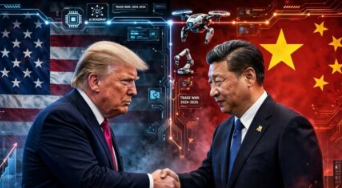
In geopolitics, the eyes of the world are fixed on the UN General Assembly and the meeting between Xi Jinping and Donald Trump. This is because competition is not a new thing in the relations between China and America, but the latest meeting of President Donald Trump and Chinese President Xi Jinping in Washington has indicated progress towards controlling this competition. According to the Global Times report, there are serious differences between the two countries, from trade, tariffs to artificial intelligence, Taiwan to the global economy, but this time the tone of the conversation seems to be focused on handling differences instead of escalating conflict.
Did Trump-Xi write a new language of relations?
During his meeting with Trump at the White House, Xi Jinping said that the two countries should not limit the active and creative relationship of strategic stability to mere vision, but should convert it into action. His emphasis was on the fact that China and America have to understand what would be a fair way for two big countries to live and compete with each other.
According to Xi, US-China relations should be based on cooperation, competition should be kept within healthy limits, differences should be managed appropriately, and peace and stability should be promoted through mutual trust.
Xi’s stance accepts the reality that China and the US are each other’s economic and technological rivals, but they also have to communicate with each other on many global issues.
Is there an effort to prevent the trade war from becoming a permanent conflict?
The new round of talks between the economic and business representatives of the two countries is also important in this context. Xi said the two sides have reached a new joint arrangement, which he described as positive for the industries, peoples and global economy of both countries.
Trade relations between the US and China have long been tense over tariffs, market access, supply chains and strategic goods. In May, the two countries had agreed on several economic understandings to stabilize trade relations and a relationship with strategic stability.
Xi’s latest message is that for stable economic relations, it is necessary to expand areas of cooperation and limit areas of disputes. According to him, solutions to problems can be found on the basis of equality, mutual respect and mutual benefit. That is, instead of making trade merely an arena of competition, an effort is seen to make it a medium of communication between the two countries.
Is AI the next big frontier?
The next big competition between China and America is in the field of Artificial Intelligence. Both countries see this technology as linked to economic development, national security and future industrial power. This is why artificial intelligence also got an important place in the Trump-Xi talks.
Xi said China and the US are competing in artificial intelligence, but they also have reasons to cooperate. His argument was that instead of creating distance from each other, both the countries should continue dialogue using their respective strengths.
He stressed the need to exchange views on the risks and potential benefits of AI, prevent its misuse, and maintain human control over the technology. Trump also talked about continuing dialogue and cooperation in this area. He described artificial intelligence as a subject related to the future of humanity.
Is this an attempt to keep the competition under control?
This meeting does not indicate the end of competition between China and America. On the contrary, fundamental differences still exist between the two countries on issues such as trade, technology, Taiwan and security. The importance of the latest talks lies in the fact that despite these differences, both sides want to keep the path of dialogue open.
That is why it will not be enough to look at this relationship only from the perspective of cooperation or only conflict. Cooperation and competition are going on simultaneously between the two countries. While efforts are being made to compromise in business, competition continues in technology; While there are differences on Taiwan, there is also the possibility of dialogue on the risks of artificial intelligence.
This is the position Xi presented as a combination of healthy competition, management of differences and cooperation.
Is there a strategic message in the warm welcome?
The formal and warm welcome of Xi Jinping to the White House was also an important aspect of this meeting. The US President described Xi’s visit as wonderful and talked about deep communication between the two leaders.
Such state functions are not just a formality. They also give political signals to the international community about the direction of relations. This time the message was that despite the intense competition, the world’s two biggest powers want to maintain dialogue at the highest level.
However, a warm diplomatic environment cannot be considered synonymous with genuine policy solutions. Many difficult questions are still on the negotiating table.
Will dialogue continue despite differences on Taiwan?
However, Taiwan remains the most sensitive question in China-US relations. This issue also came up in the latest talks. China considers Taiwan as part of its territory and connects this question to its core interests, while America views its relations and regional security with Taiwan from a different perspective.
This is why, despite the possibilities of cooperation in trade or artificial intelligence, Taiwan is a topic where distance may remain between the strategic priorities of the two countries.
It is too early to see the latest developments as a permanent agreement between China and America. Efforts for further dialogue and stability in trade relations are certainly visible, but questions like artificial intelligence, Taiwan and broader strategic competition are not yet over.
Therefore, the main indication of the Trump-Xi meeting is that both the countries are looking for a way to manage the competition instead of ending it. How concrete this effort to reduce trade conflicts, maintain technical dialogue and manage political differences becomes will be determined by the upcoming agreements and their implementation.