Vietnam scored 4.15 points out of 10 in the biennial ranking released on Friday by the World Economic Forum.
The index measures the factors and policies that enable sustainable and resilient development of tourism like business environment, safety and health conditions, price competitiveness, air transport infrastructure, ground and port infrastructure, tourist services and infrastructure, natural resources, and cultural resources.
In Southeast Asia, Vietnam ranked behind Singapore, which placed 13th globally, Indonesia at 23rd, Malaysia at 26th and Thailand at 38th.
|
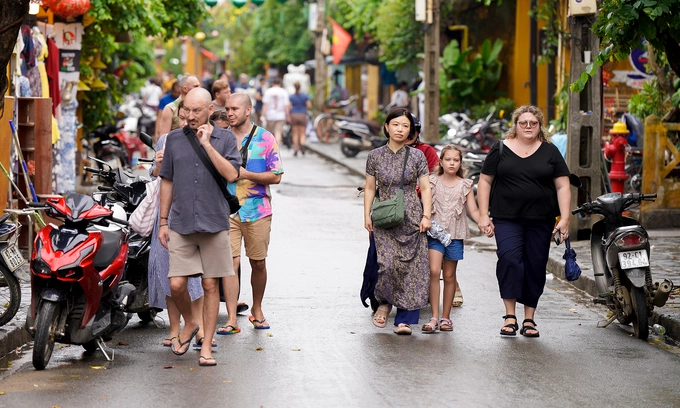
Foreign tourists walk in Hoi An ancient town, November 2025. Photo by Read/Nguyen Dong |
In terms of improvement, Vietnam’s score rose 6.1 percentage points from 2024, outpacing regional revials such as Indonesia at 2.2 percentage points, Malaysia and Thailand at 5.8 each, and Singapore at 3.3.
Vietnam performed well in price competitiveness, safety and security, air transport, port infrastructure, and natural resources.
Thanks to political stability and a high level of safety, Vietnam has become a favorite destination for foreign tourists.
The ranking reflects the World Economic Forum’s assessment of Vietnam’s stable, safe and secure socio-political environment amid global volatility and instability, according to the Vietnam National Authority of Tourism.
Vietnam’s air transport infrastructure also recorded major improvements.
Tan Son Nhat International Airport in Ho Chi Minh City last year opened its VND11-trillion (US$430 million) domestic Terminal 3, which is designed to serve up to 20 million passengers annually.
The country is also getting Long Thanh International Airport in Dong Nai Province, next door to HCMC.
During its first phase, slated for commercial operation later this year, the airport will have one runway, a passenger terminal and supporting infrastructure, and a capacity of 25 million passengers a year.
It will replace Tan Son Nhat as Vietnam’s largest aviation hub.
Despite the gains, several areas remained relatively weak.
Vietnam faces a number of challenges such as tourism infrastructure and services, prioritization of travel and tourism, and the socioeconomic impact of the sector.
This provides a crucial foundation for Vietnam to strengthen its competitiveness, address existing gaps and pursue more sustainable, high-quality and effective tourism development, the tourism administration added.
Japan reclaimed the top spot in this year’s tourism development ranking.
The U.S. ranked second, followed by Spain in third, Australia in fourth and France in fifth, according to the report.