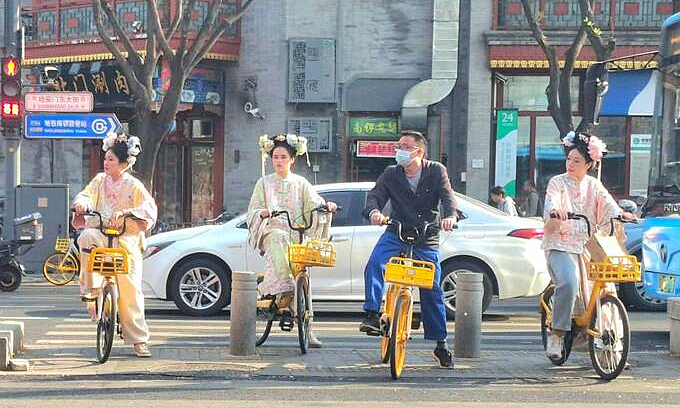
The trend, known as “disposable clothing,” emerged on Chinese social media this summer with related hashtags generating 6.8 million views and 135,000 discussions on a single platform.
The outfits, typically priced at 10-50 yuan (US$1.40-7), are mainly chosen for travel photos.
One female tourist said she bought five outfits for a seven-day trip for less than 200 yuan with no plans to keep them afterward, the South China Morning Post reported.
|
Tourists, some in ancient Chinese costumes, ride bicycles on a street in Beijing, China, April 2025. Photo by Read/Hoang Phong |
“Disposable clothing” refers to inexpensive outfits bought specifically for travel and worn only once or twice before being discarded or resold. The clothes often feature distinctive designs, from ethnic-style long dresses and capes suited to beaches and forests to brightly colored fluorescent windbreakers, China’s News Pedaily reported.
These outfits are ideal for photoshoots but can appear too formal or elaborate for everyday wear.
As a result, many people choose cheaper “disposable clothing,” reasoning that they can simply discard it after the shoot.
Discussions about the trend become particularly active during peak travel seasons.
The trend has sparked online debate. Some argued that buying disposable outfits is more economical than spending more on clothes that are rarely worn.
“It’s a good idea that could help save money,” a netizen wrote.
However, others have criticized the trend, raising concerns about textile waste and its environmental impact.
Another netizen wrote: “The more people throw away, the more waste is created.”
The United Nations Environment Programme estimates that around 92 million tons of textile waste are generated globally each year. Textile production doubled between 2000 and 2015, while the average lifespan of garments fell by 36%.
Only 8% of textile fibers were made from recycled materials in 2023, while clothing and textiles accounted for around 11% of plastic waste.