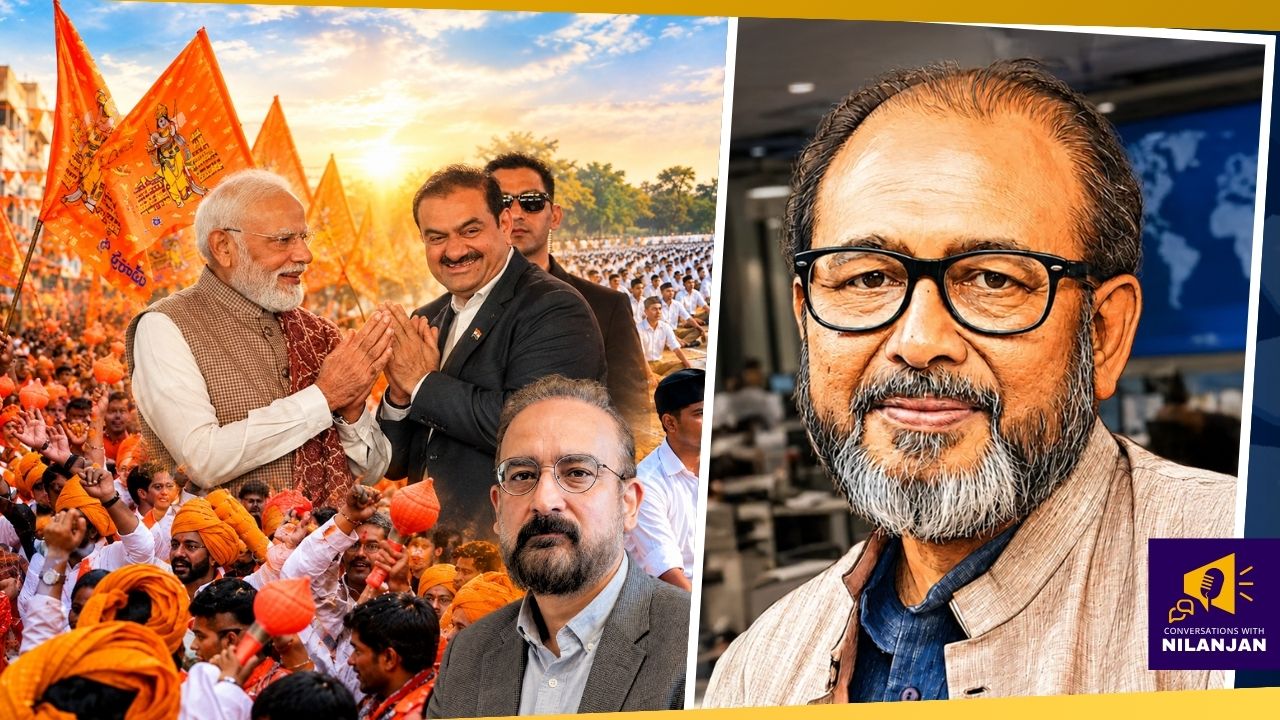
Fascism is not a loose insult but the precise analytical term for India’s current political order — a “communal-corporate nexus” where a majoritarian Hindutva state and a handful of consolidated corporations now function as mutually-reinforcing partners, with no operating tension between the two, according to political scientist Rohit Varman.
The framing comes as India’s billionaire wealth has surged even as its liberal-democratic institutions have visibly weakened. In an episode of Conversations with Nilanjan, The Federal spoke to Prof. Varman, editor of the new book The Politics of Corporations in ‘New’ Indiaon this deepening alignment between big business and majoritarian politics.
Edited excerpts from the interview:
What has really changed in the relationship between big capital and government over the last two decades — and more specifically since 2014, when the BJP came to power with an outright majority of its own?
Ties between big capital and government are essential to any capitalist state, and India is no exception. Various Indian governments since 1947 have had close ties with big capital, so what we see today is, to that extent, a continuation. After the Bombay Plan was finalised in 1944, Nehru, in effect, implemented it, creating a division of labour between what big capital would do through its own accumulation processes and what the state would do.
I’d like to step back to the book’s central concept and return to the relationship between big capital and the Modi government. The key term we use is fascism. For us, this is not just a pejorative label but a concrete analytical category to understand the regime in power and the far right in India and elsewhere.
Also read: RSS at 100: How Italian fascism influenced Hindu nationalist politics
If you go back to the birth of the RSS in 1925, it can be seen as a communal or cultural project. But there was another central tendency: it was reacting to changes India was beginning to witness. There were anti-caste mobilisations, growing awareness of class-based exploitation, the Bolshevik Revolution, the Communist Party, socialist forces, and working-class mobilisations. And there was the challenge to patriarchy.
The birth of the RSS was therefore a reaction to these tendencies — a project to counter the forces of equality. We don’t see much of this in Hedgewar’s writings, but it is sharper in Golwalkar’s. In Bunch of Thoughtshe devotes a chapter to communism, dismissing it as an anti-national force. Akshaya Mukul’s account of Gita Press and Poddar’s first editorial for Kalyan also show how socialism and communism were portrayed as dangerous. That thread runs through the ideological development of the RSS, the Sangh Parivar, and Hindutva.
The latest version is Prime Minister Modi’s phrase “Naxali dimag”, following “urban Naxals”. The message is that anyone with any flirtation with Marxism or communism must be kept away.
I want to step back from the RSS and Hindutva and talk about interwar European fascism — Mussolini from 1922 and Hitler after 1933. What forces backed them? In Italy, it was big landlords and big capital. In Hitler’s case, almost the entire corporate establishment of Germany funded his rise. This happened amid a rising threat of communism and a deep crisis, with the possibility of people mobilising against elite interests.
So you need a counter-force that can divert that anger, mobilise it as storm troopers or vigilantes, and direct violence at “the other”. You aestheticise politics, turning it into spectacles of violence, so working people don’t ask questions about property relations, disempowerment, or exploitation.
Also read: RSS at 100: How Hindu nationalism drew from Mussolini’s fascist model
We see this in India now. Eighty crore people are being given free food, while India produces a billionaire every thirteenth day. Adani’s wealth rose 1,534 per cent between 2014 and 2024, from USD 7.1 billion to around USD 116 billion. Mukesh Ambani’s wealth rose 406 per cent, from USD 23.6 billion to nearly USD 120 billion.
How do you sustain such an unequal order? You need a repressive state. But capitalism also needs mass participation — people have to work and consume. So repression alone is not enough. Alongside repression, you need a mass movement. That’s what we saw in interwar Europe, and that’s what we see in contemporary India — the mass movement of Hindutva constantly targeting “the other” while the loot continues.
Would you say the Indian business class has adapted to — or actively been part of — this hollowing-out of India’s democratic institutions?
You can read Aakar Patel’s Price of the Modi Years to see how, on almost every parameter, there has been a decline. But who is gaining from it? A handful of the largest corporations are clearly making gains. That doesn’t mean the economy or every business is gaining. Over the last twelve years, we’ve seen a decline of the informal sector and medium and small enterprises. Big capital is the force that is gaining and supporting the government’s political strategies.
By defining India through what many would consider a European lens — fascism — are we missing indigenous factors, like caste, patronage, and informal labour?
What we see in India is not an exact replica of Europe. That’s not the point. An analytical category doesn’t have to be identical across countries. What matters is whether there are common fundamentals.
Authoritarianism and fascism are fundamentally different. In authoritarianism, a dictator tries to make the population passive. In fascism, you have a strong state that tries to arouse the population against “the other”. In Italy it was non-Italians; in Germany, Jews; in our context, minorities — Muslims, Christians, and others.
Also read: Hindutva is not just ideology, it is a performance: Cultural theorist Brahma Prakash
On the question of crony capitalism – capitalism has always dished out favours, from the 19th-century robber barons in the United States to Elon Musk today. That tendency isn’t unique to Modi’s India.
Indian fascism also has local aspects, including caste. The birth of the RSS in 1925 was a reaction to Dalit and anti-caste mobilisation. It is essentially status-quoist, safeguarding elite interests in gender, caste, race, or class. There is nothing inherent to fascism that excludes caste.
Our organised sector employs less than 10 per cent of working people, with 90 per cent in the informal sector. But that doesn’t change the employer-employee relationship or the class relationship.
Your book brings together political science, economics, critical management, and culture studies. What unique insights emerge from analysing corporate power across these fields?
The idea was to look at the relationship from different vantage points. Rohit Chopra’s chapter on Bollywood examines how films normalise Hindutva and propagate a message aligned with the dominant ideology.
That’s important, because if fascism is a mass movement, it has to manufacture consent. Films can be important to that project. We saw that with Goebbels in Nazi Germany. Anand Patwardhan’s piece looks at the demolition of the Babri Masjid, a significant moment that enabled the BJP to acquire power eventually.
The poor embrace Hindutva even though, economically, they’re at their worst, especially post-Covid. Are we misreading the situation?
Travelling across India, poverty is visible, and inequality is unprecedented. Poverty is about the absence of wealth, income, and food, but it is also relational — you feel poorer given the conspicuous consumption around you. So yes, there is a contradiction. But we should be careful about overstating the success of the Hindutva project.
At its peak, the BJP gets around 39 to 41 per cent of the vote, nowhere close to 50 per cent. They don’t have the dominance among the masses that their parliamentary numbers suggest because of the first-past-the-post system.
Why are there attempts to fix the electoral system? If there was so much consent, there’d be no need to fix the electoral rolls or for big capital to pump in so much money. People are not convinced to the extent they would like to project. There are still serious material contradictions. The Ram Temple and Hindutva identity projects have their place, but people finally need food, jobs, and education.
Also read: Khairlanji to Dangwas: What our numbness says about Hindutva-led neo-casteism
I’d also add that when the poor supported the BJP, it came after a betrayal by more liberal forces. I’m talking about the larger neoliberal project introduced in the 1980s and more sharply after 1991, which transferred wealth from the poor to the rich.
How has the state evolved from a mediator of development into an enforcer of corporate land and resource extraction?
That has been integral to it — through access to land, taxation, environmental law, and labour law. At its core is the idea that a repressive state can let corporations have their way, doing away with the pretence of a democratic process. The BJP doesn’t have the same constraints as the Congress, which still had to appear more liberal and inclusive.
The idea of overcoming past humiliations is central to every fascist project, and Hindutva is no exception. How do you manufacture consent? Partly through propaganda — a cultural project over a hundred years old that instils the idea that Muslims or Mughal rule are responsible for people not getting their due. It has succeeded partly because of the betrayal by liberal forces and the absence of wealth redistribution.
Do you see any alternative frameworks or resistance emerging?
I see resistance almost everywhere. Despite all their might, they’re not able to go beyond 40 to 45 per cent — the collective strength of the ruling coalition. That tells us there’s still a large section unwilling to be part of their project.
There are concrete material conditions that will always check the advance of this force. As long as 80 to 90 per cent of people have next to nothing, there’s no way to convince them to be part of this identity project.
We saw resistance in the youth movement and the farmers’ protest. South India is also clearly different and not as integrated into the Hindutva project. So there are geographical zones of resistance. They may not always be organised or on the streets, but they are present and likely to sharpen as inequality and repression increase.