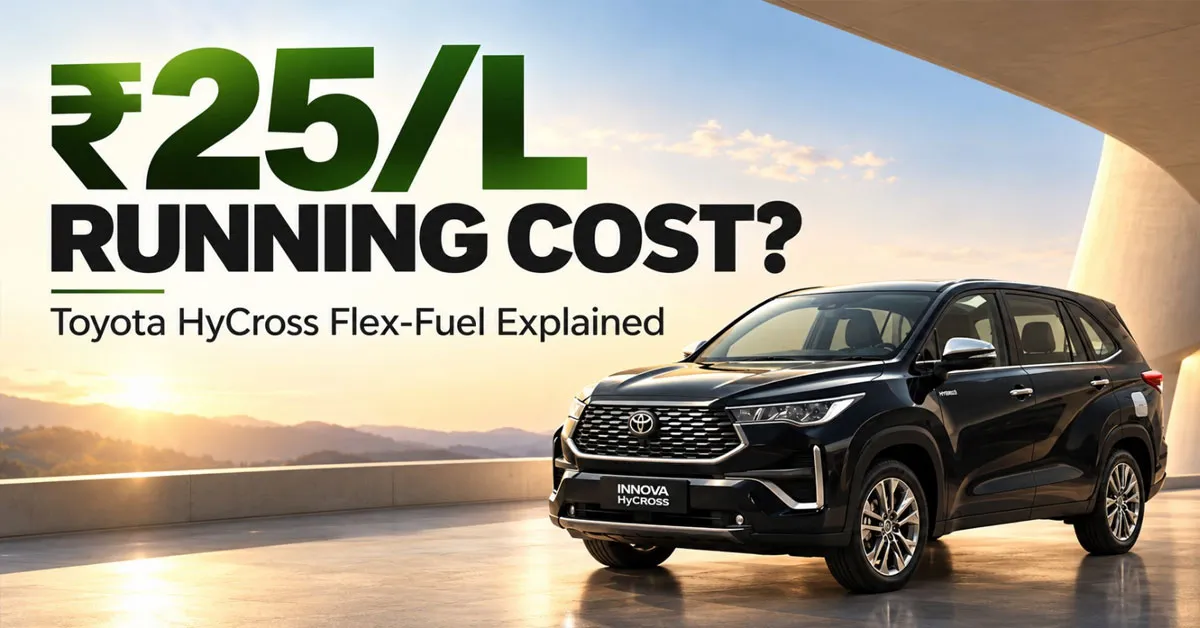
Toyota is preparing to bring a new version of the Innova HyCross that can run on very high ethanol blends, potentially up to 100% ethanol.
Union Minister for Road Transport and Highways Nitin Gadkari has said the vehicle could offer running costs equivalent to a petrol car running on petrol priced at just ₹25 per litre.
That sounds surprising when petrol currently costs around ₹100 per litre.
So what exactly does this mean?
It is not saying ethanol will cost ₹25 per litre. This is the first thing to understand.
Gadkari is not saying that ethanol will be sold at ₹25 per litre. He is talking about the cost of running the car.
For example, imagine a petrol car that gives 10 km for every litre.
At today’s petrol price of ₹100 per litre:
- 10 km costs ₹100
- 1 km costs ₹10
Gadkari’s claim is that the ethanol-hybrid Innova could cost roughly the same to run as a petrol car if petrol cost only ₹25 per litre.
Using the same 10 km/l example:
- 10 km would cost ₹25
- 1 km would cost ₹2.50
So the comparison would look like this:
Running cost of Petrol car at today’s price: ₹10 per km
Running cost of Ethanol-hybrid: roughly ₹2.50 per km
So an ethanol hybrid Innova Hycross can in theory cost just 1/4th as much as a petrol Hycross to run.
This is why Gadkari uses the ₹25-per-litre figure. It is an equivalent running-cost figure, not the actual price of ethanol.
The proposed Innova HyCross Flex Fuel is designed to run on high concentrations of ethanol. The technology is expected to allow the engine to use fuel containing much more ethanol than the E20 petrol available today.
The ultimate goal is to make the vehicle capable of running on E100which is essentially 100% ethanol.
This is what makes it different from a normal petrol Innova HyCross.
But it is still a hybrid. The car does not simply burn ethanol and send all that power directly to the wheels. It uses a strong-hybrid system.
In simple terms, there are three important parts:
Ethanol engine + electric motor + battery
The engine can produce power, while the electric motor can also drive the wheels. The battery stores electricity used by the electric motor. The car can also recover some energy when it slows down or brakes and use that energy to recharge the battery. So the vehicle can run using the engine, the electric motor, or both, depending on the driving conditions.
There is an important reason for this. Ethanol contains less energy per litre than petrol. That means a car generally needs more ethanol than petrol to travel the same distance.
The hybrid system can help reduce fuel consumption by allowing the electric motor to take over some of the work. For example, during some low-speed driving, the electric motor can move the car while the engine remains switched off. The engine can then start when more power is needed. This helps make better use of the fuel.
The Innova HyCross Flex Fuel is not a full electric car. You do not have to plug it into a charging point every night. It is a self-charging hybrid. The battery gets electricity from the hybrid system and from energy recovered during braking. So you would fill the car with ethanol-based fuel just as you fill a normal car with petrol.
India is currently moving towards higher ethanol blending in petrol. For example, E20 petrol contains up to 20% ethanol. An E100 vehicle would be capable of running on fuel containing essentially 100% ethanol. This requires changes to the engine and fuel system because ethanol behaves differently from petrol. Toyota has already demonstrated an Innova HyCross Flex Fuel prototype using this technology.
This could be more important to buyers than the technology itself. Making a car capable of running on E100 is one thing. Having enough E100 fuel stations is another.
If E100 is not easily available, owners cannot depend on it for their daily driving. The success of the technology will therefore depend not only on Toyota producing the vehicle, but also on the availability of high-ethanol fuels across India.
We don’t know yet. The ₹25-per-litre figure is a claim about equivalent running cost. It is not the confirmed price of ethanol. It is also not an official mileage figure for the production car.
Until Toyota reveals the final vehicle, its fuel economy and the actual price and availability of ethanol, the real cost per kilometre cannot be confirmed. And government also has to tell as the price of ethanol flex fuel at the launch time.
Actual savings will depend on the car’s real-world fuel economy, the price of ethanol and, importantly, how easily drivers can find high-ethanol fuel.