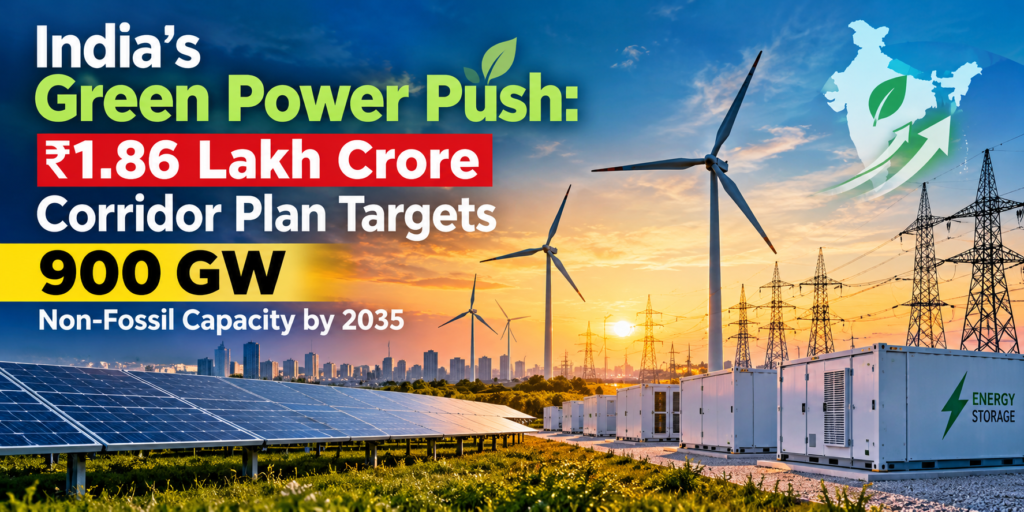
India is stepping up its clean energy ambitions with a major investment in electricity transmission and storage infrastructure, marking a significant development in its journey towards a low-carbon energy future. The government’s Green Energy Corridor Phase-III (GEC-III) is designed to strengthen the country’s power network and support the integration of renewable energy on a much larger scale. The initiative is aligned with India’s long-term ambition of achieving 900 GW of installed non-fossil fuel-based power capacity by 2035, placing grid infrastructure at the centre of the country’s energy transition.
With a proposed investment of ₹1,86,405 crore, the programme focuses on expanding transmission capacity, improving electricity evacuation and developing large-scale battery storage infrastructure. The initiative recognises that adding solar and wind generation capacity alone will not be sufficient to meet future energy requirements. A stronger electricity network is essential to transport power from renewable energy-producing regions to industrial centres, cities and households where demand continues to grow.
A substantial portion of the investment, amounting to ₹1,36,378 crore, has been earmarked for intra-state transmission infrastructure. The development of new transmission lines, substations and associated facilities is expected to facilitate the evacuation of approximately 135 GW of renewable energy. These improvements will help address grid congestion and connectivity constraints that can limit the utilisation of electricity generated from renewable sources.
The programme also places considerable emphasis on energy storage, with ₹50,000 crore allocated for the development of 50 GWh of Battery Energy Storage Systems. Battery storage is increasingly important as India’s renewable energy portfolio expands. Solar generation is concentrated during daylight hours, while electricity consumption continues into the evening. Storage systems can retain surplus electricity and release it when generation falls or demand increases, helping maintain a more balanced power supply.
The Central Government will provide financial assistance of ₹54,082 crore under the scheme. This support is intended to reduce the financial burden associated with transmission infrastructure and help contain the impact of additional transmission charges on consumers. The funding arrangement is expected to encourage states to strengthen their electricity networks while supporting the wider integration of renewable power into the national grid.
The implementation framework combines competitive bidding with targeted upgrades to existing infrastructure. Greenfield transmission projects will be developed through Tariff-Based Competitive Bidding, while brownfield projects involving the strengthening and modernisation of existing networks will follow a cost-plus approach. State Transmission Utilities will coordinate implementation, with transmission service providers responsible for developing and maintaining infrastructure under the prescribed framework.
The initiative comes at a time when India’s electricity demand is being reshaped by rapid industrialisation, urban development, digital infrastructure, electric mobility and expanding commercial activity. Reliable and affordable electricity will be critical to sustaining economic growth. Increasing the share of non-fossil energy in the power mix, supported by adequate transmission and storage facilities, is expected to help meet these requirements while advancing the country’s energy transition objectives.
Renewable energy resources are not evenly distributed across India. Several regions with strong solar and wind potential are located far from major electricity consumption centres. Improved transmission connectivity can help bridge this geographical divide by enabling power generated in resource-rich areas to reach demand centres more efficiently. The proposed corridor expansion is therefore expected to strengthen coordination between renewable energy developers, transmission utilities and electricity distribution companies.
The investment is also expected to generate opportunities across India’s infrastructure and manufacturing sectors. Construction of transmission lines, substations and battery storage installations will require engineering services, electrical equipment, skilled technicians and project management capabilities. The growing demand for transformers, conductors, switchgear, power electronics and energy storage technologies could provide additional business opportunities for domestic manufacturers and engineering companies.
From an environmental standpoint, improved grid connectivity can reduce the curtailment of renewable electricity and increase the utilisation of clean power. As renewable generation becomes more deeply integrated into the electricity system, it can contribute to reducing dependence on fossil fuel-based generation and lowering emissions from the power sector. Battery storage will further support this transition by improving the availability of renewable electricity during periods when solar and wind generation are limited.
Despite the scale of the proposed investment, timely execution will remain a critical factor. Land acquisition, right-of-way permissions, equipment availability, financing and coordination among state agencies can influence infrastructure development timelines. The successful deployment of battery storage will also require effective grid management and appropriate operating arrangements. Addressing these challenges will be important to ensure that the additional infrastructure delivers its intended benefits.
Green Energy Corridor Phase-III represents a shift in India’s renewable energy strategy from capacity addition alone towards building a comprehensive ecosystem for clean power generation, transmission and storage. With its ₹1.86 lakh crore investment framework, 135 GW renewable energy evacuation objective and 50 GWh storage component, the initiative is expected to strengthen the foundations of India’s future electricity system. As the country moves towards its 900 GW non-fossil capacity ambition by 2035, the programme could emerge as a major enabler of energy security, industrial development and sustainable economic growth.