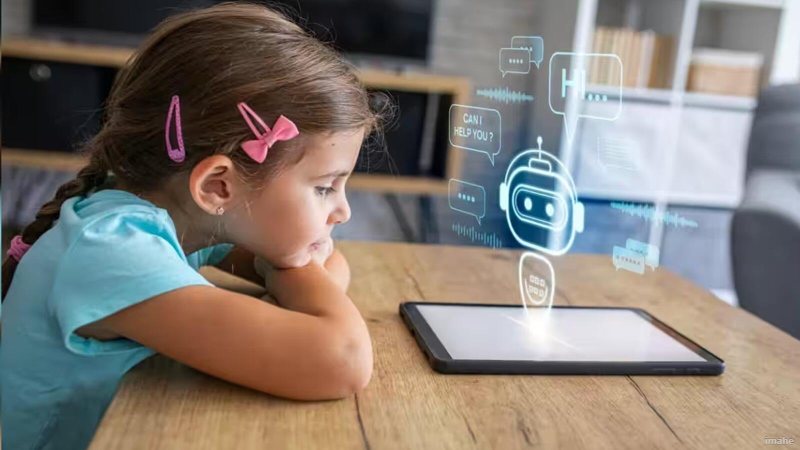
In today's digital and high-tech era, Artificial Intelligence (AI) has deeply influenced every aspect of our lives, but along with it some serious psychological dangers are also emerging which have given sleepless nights to parents and child experts around the world. Recently, many shocking reports related to child psychology and digital well-being have come out, warning that today's children and teenagers have started moving away from real human relationships and making AI chatbots and virtual assistants their best friends. There is a huge mental trap hidden behind this artificial and always agreeable comfort found on the screen, which is gradually making children socially cowardly, lonely and mentally weak. When a child becomes dependent on a code based algorithm instead of a live human being or friend to share his/her feelings, it severely hampers his/her true social development journey. Seeing the dangerous consequences of this growing trend, psychiatrists have appealed to the parents to keep a close watch on this digital habit of their children in time, otherwise this problem can take the form of a major mental crisis in the future. Increasing scope of virtual world and growing addiction of AI friendship in children. In today's modern era, smartphones, tablets and AI based apps have become an essential part of children's life, where they get an always available virtual companion to answer their every question. Parents are often unable to give time to their children due to their busy schedule, due to which children feeling lonely start taking the help of AI chatbots to solve their curiosities and emotional problems. The specialty of AI is that it never gets tired, never gets angry and always agrees with everything the child says, due to which the child becomes addicted to it very quickly. Children begin to see this as a safe and fair friend who will never judge them, and this is where this artificial friendship begins. However, this virtual friendship is completely one-sided and imaginary, as AI neither has any real sentience nor can it teach a child the correct human lesson of right or wrong. When children become accustomed to living in this virtual world, they start getting scared of small conflicts and interactions in real life, which hinders the natural mental development of their childhood. Deep impact on mental balance and rapid decline of social skills. Psychologists believe that when a child or teenager considers AI as his best friend, then the social skills within him gradually start deteriorating. In real life, friendship does not just mean getting one's point of view, but it also includes qualities like mutual debate, compromise, appreciating feelings and empathy, which can be learned only through interaction between humans. In contrast, AI chatbots always respond according to the user's preferences, leaving children with no tolerance for failure or accepting a different opinion. Additionally, children increasingly develop anxiety, depression, and sleep-related problems due to constant time spent in front of screens and talking to virtual friends. Many times children consider the advice given by AI as the final truth, which in many cases can prove to be misleading and dangerous for them. When they return to school or to their families, they find the real world quite boring and complicated, as a result of which they become more withdrawn and do not like to talk to anyone. Dangerous consequences of parental neglect and excessive dependence on technology. A major reason behind this serious problem is the modern lifestyle of parents and lack of communication with their children, where they become free from their responsibilities by placing gadgets in the hands of children. Children do not realize that the software they are talking to is not a human being but merely a computer program, and many times children become so emotionally attached that they even become worried about the fear of losing it. Child development experts clearly suggest that parents should ensure that their children use technology only as a tool or for the purpose of learning and not adopt it as an emotional companion of their life. If parents at home communicate openly with children, spend time with them and understand their feelings, then children will never need to look for a virtual AI friend. To break this growing empire of loneliness in children's rooms, it is very important to involve them in outdoor games, sports, arts and other social activities, so that they can utilize their energy positively and feel the warmth of human relationships. Parents will have to take concrete steps for solution and future security. To deal with this increasing digital mental problem, now the time has come that society and family should together adopt a strong and conscious approach. Workshops on digital literacy as well as mental health should also be organized in schools and educational institutions so that children can be made to understand that technology can never be a substitute for human relationships. Parents should keep strict controls on their children's screen time and monitor what types of AI apps or chatbots they are interacting with. If symptoms like excessive loneliness, irritability or speaking less suddenly appear in a child's behavior, then instead of ignoring it, one should immediately seek the help of a professional counselor or psychiatrist. Technology is created for the convenience of humans, not to make humans slaves of their emotions; Therefore, it is the collective responsibility of all of us to inspire our future generation to live in a healthy, balanced and real world, where love, friendship and emotions are not dependent on any algorithm.