Pham Ha, CEO of a cruise company, got the chance to explore the world’s largest cave at the last minute after another person had canceled due to health issues.
Ha was the 10th member of a group that was to go exploring from Aug. 3 to 8.
Before the trip, organizers required participants to complete a medical questionnaire to verify their fitness. Ha faced no difficulties despite the last-minute opportunity, since daily walking and cycling, past forest treks, and a climb to Fansipan had helped build his endurance.
Son Doong is the most challenging tour by the operator Oxalis. The route covers 16 kilometers of mountain forests, nine kilometers of caving, 20 river crossings, an 800-meter elevation gain, and two 90-meter climbs.
“Numbers like these only become real once your feet are on slippery rock and mud,” Ha said.
|
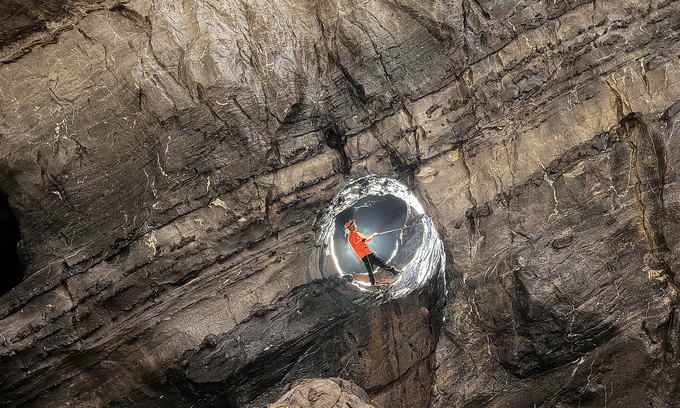
Pham Ha poses at the “James Bond” pit, a circular rock hollow inside Son Doong Cave, August 2026. Photo courtesy of Pham Ha |
On Aug. 4, following orientation in Phong Nha Cave, the group headed into the Truong Son Forest.
Walking under the trees felt like forest “bathing” to Ha, and with no phone signal, the outside world faded away.
The group waded through streams and passed a village of the Bru-Van Kieu, an ethnic minority group in central Vietnam, on their way to En Cave. After climbing over boulders and descending into the cave, they set up their first campsite on a stretch beside an underground lake.
For Ha, after a trek, swimming in the lake and sleeping inside the cave felt like luxury. Sipping coffee in the stillness, he listened to the stream, falling rain, and chirping swallows while watching starlight filter through the cave’s opening.
Without spas, pools, or bedding, luxury was simple: cool water and deep sleep underground.
 |
|
The group on the stretch from En Cave to Son Doong entrance. Photo courtesy of Pham Ha |
On day three, the group moved through En Cave and the Rao Thuong River valley toward Son Doong entrance. The river, the primary architect of the Ke Bang limestone system, rushes along the valley before disappearing into a cliff face.
At a rest stop near the entrance, guides checked each member’s safety harness and technical gear. Cold air and mist drifted from the cave’s mouth as natural light gave way to headlamps. Using ropes, the group rappelled 90 meters down the rock face into the abyss, where those ahead shrank into tiny specks of light.
Ha said: “In everyday life, people crave things bigger than themselves. In Son Doong, nature brings you back to your true self.”
After crossing a river and sand dune, and passing the stalagmite formation known as “hand of dog,” the group reached the first campsite beside Doline 1, one of two sinkholes inside Son Doong, ending day three.
On day four, the route wound through rock crevices and along cliff faces toward Doline 1, also known as “watch out for dinosaurs”.
There, the “wedding cake” stalagmite emerged from the shadows. As shafts of sunlight pierced the sinkhole and illuminated the mist, everyone stopped in awe. Sunlight, something so ordinary on the surface, became a spectacular sight.
The group continued across limestone terrain toward Doline 2, known as the “Garden of Eden”.
Emerging from darkness, a primeval forest ecosystem appeared before them, complete with greenery, birdsong, drifting clouds, and natural light.
Watching creatures adapted to survive in the darkness, like crickets losing their eyes but growing longer antennae to sense their surroundings, Ha reflected on the nature of survival.
Life endures not by resisting its circumstances, but through the flexibility to adapt.
“What I remember most about Ha is his determination and passion for nature,” Le Thanh Dat, a senior guide with Oxalis, said.
He added that Ha relished the moments without phone signal inside the cave.
On day five, the group prepared to face the biggest challenge: the Great Wall of Vietnam, a 90-meter limestone cliff.
Standing before the wall, exhaustion from days of trekking can shake one’s resolve. To scale it, visitors climb an 18-meter steel ladder followed by a 72-meter rock slope, relying on harnesses, ropes, and guidance.
Rather than take in the entire cliff face at once, Ha chose to narrow his focus to just the next step. He gripped his safety harness, climbed one rung at a time, as he kept reminding himself he could do it.
When he reached the top and saw light streaming down from the cave’s exit, he felt no sense of conquest. What stayed with him instead was gratitude, for his body’s resilience, the support of his team, and the embrace of the landscape.
Reflecting on the journey, Ha observed that Son Doong existed long before humans arrived and will remain long after they are gone. Nature, he realized, teaches through scale, using its vastness to instill profound humility.
“Son Doong hasn’t changed; I’m the one who has,” he said.