Increasing distance too quickly
Many beginners lace up their sneakers with immense enthusiasm, only to hike their mileage or workout duration too fast right from the start.
Brian Eckenrode, an associate professor of physical therapy at Arcadia University, pointed out that rushing progress often triggers joint irritation and overuse trauma. “Individuals should consider building up time and distance slowly. Pain and injury can result if the progression is too much, too fast,” Eckenrode explained to Yahoo! Health.
To protect vulnerable joints, Eckenrode advised walkers to avoid expanding total weekly distance by more than 10%, while utilizing smartwatch trackers and smartphone apps to monitor movement volumes carefully.
Taking overly long strides
When walkers attempt to speed up their pace, they frequently make the mistake of overreaching with their lead leg, reported by Performance Therapy Institute.
Karena Wu, physical therapist and clinical director at ActiveCare Physical Therapy in New York City, explained that overextended steps cause the foot to strike the ground far ahead of the body’s center of mass. “Walking with too large a stride can increase knee pains due to the higher loading forces of your leg being out in front of your center of mass,” Wu explained.
A longitudinal study tracking roughly 2,300 older adults found that individuals displaying longer strides were noticeably more prone to worsening knee pain after two years, according to Multicenter Osteoarthritis Study.
Experts recommend keeping steps natural and smooth, swinging the leg comfortably forward, landing on the heel, rolling across the sole, and pushing off cleanly through the toes.
|
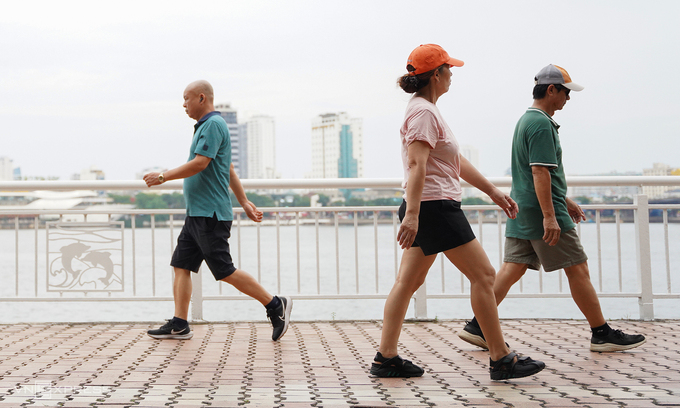
A visual guide illustrates walking as a simple exercise that supports both cardiovascular wellness and skeletal health. Photo by Nguyen Dong. |
Walking with an uneven gait
Distributing body weight unevenly between limbs or leaning too heavily onto the front of the foot can create chronic joint imbalances over time.
Dr. Rodante Saballa, a board-certified chiropractic sports physician in Los Angeles, noted that walking with a dragging shuffle or tipping onto the forefoot overloads the lower leg’s anterior chain, funneling intense pressure directly into the knee joint. Inherent limb-length discrepancies or chronic postural shifts can similarly skew overall alignment, Saballa noted.
Walkers can identify gait abnormalities by checking their shoe outsoles for lopsided wear or excessive erosion near the toe box.
Physical therapists also recommend walking in front of a full-length mirror or recording a short video from multiple angles to catch subtle limps, unequal steps, or ankles rolling inward.
To correct these alignment deficits, specialists suggest performing banded side steps three times weekly to build hip abductor strength and stabilize the knees during forward movement.
Using poor technique downhill
Descending slopes forces the body to drop deeper with every step, compelling the quadriceps muscles to work 2.5 to 3 times harder than on flat ground to absorb impact. This eccentric braking strain causes compressive pressures on knee cartilage and joints to spike dramatically.
Walkers can safeguard their knees by deliberately shortening their stride and slowing down, which shortens the downward drop distance on each pace.
Rather than leaning backward to brake—a common habit that strains the legs—descending walkers should lean slightly forward from the hips to shorten the quadriceps lever arm and reduce joint forces.
Employing trekking poles also provides valuable mechanical relief, with clinical research demonstrating that hiking poles diminish impact forces on knee joints by 12% to 25%, according to research published by Journal of Sports Sciences.
Inappropriate footwear
No single walking shoe suits every individual, and selecting the wrong model can aggravate joint distress.
Shoes with excessive foam cushioning undermine ankle stability, forcing the knee joint to overwork to keep the body balanced, while ultra-thin minimalist shoes fail to absorb road shock and transmit impact up the leg, Saballa explained.
Shoppers should match their footwear to their planned terrain, choosing supportive grip shoes for outdoor trails and lighter, flexible alternatives for treadmill walking, physical therapist James Bruder told Yahoo! Health. Bruder also recommended trying footwear on in person and buying from retailers with flexible exchange policies.
Physical therapy assistant Kim Dallara reminded walkers in Yahoo! Health that footwear adjustments cannot replace professional medical care. “Don’t try to out-shoe a problem,” Dallara warned, urging walkers to seek medical evaluation if joint discomfort persists beyond one week, exceeds a 5 out of 10 pain rating, or prevents daily activity.