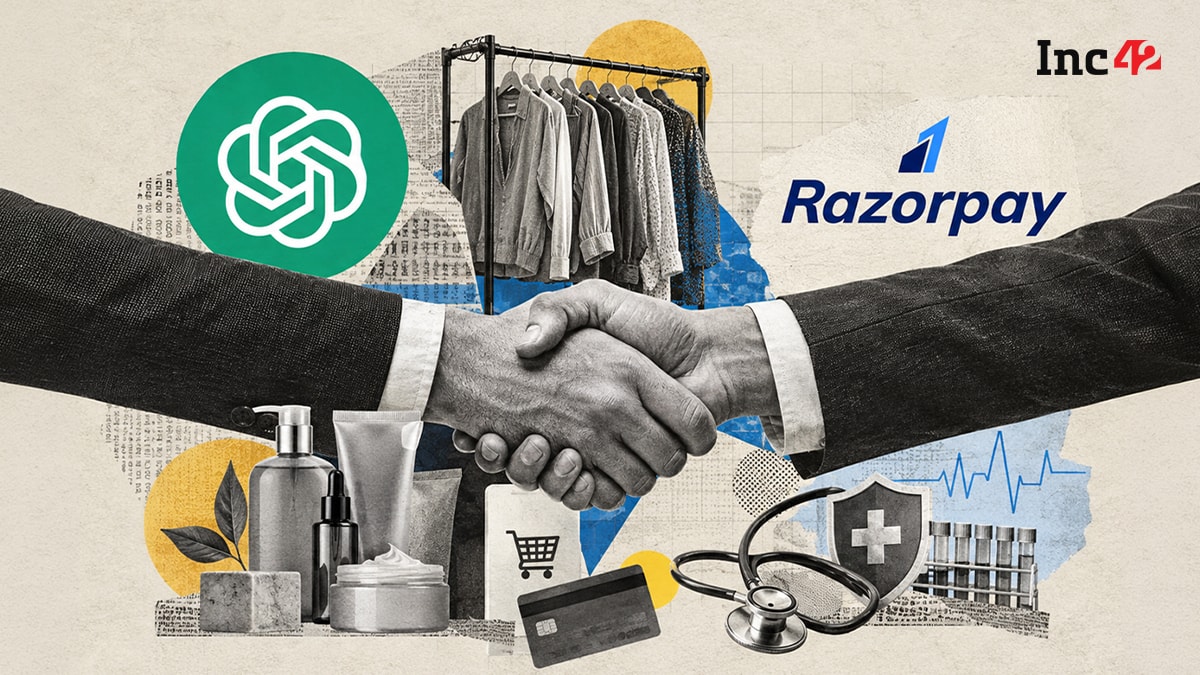
IPO-bound Razorpay announced today that it has deepened its partnership with AI major OpenAI to help Indian brands advertise on ChatGPT
The fintech company has been working with OpenAI and NPCI on infrastructure that allows merchants to create ChatGPT-native storefronts, sync product catalogues and eventually complete purchases within the chat interface
Under the partnership, Razorpay Engage will enable brands to prepare product catalogues, launch and manage campaigns on ChatGPT Ads
IPO-bound Razorpay announced today that it has deepened its partnership with AI major OpenAI to help Indian brands advertise on ChatGPT.
Under the partnership, the company’s growth marketing platform, Razorpay Engage, will enable brands to prepare product catalogues, launch and manage campaigns on ChatGPT Ads.
Brands onboarded by Razorpay include Tanishq, Fastrack, Traya, Tata Neu, Rivaah by Tanishq, Shaadi.com, Axis Max Life, Palmonas and Narsee Monjee Institute of Management Studies (NMIMS).
Razorpay Engage To Become ChatGPT Ads Layer
Razorpay Engage will provide the technology and operational infrastructure for businesses looking to get started with ChatGPT Ads.
Its offering will include assessing catalogue readiness, improving and structuring product feeds, creating and managing campaigns, and measuring and optimising campaign performance.
The platform will also use an AI agent built around ChatGPT Ads best practices to help create and manage campaigns across different contexts where consumers may encounter a brand’s products.
The agent will monitor campaign performance and make ongoing adjustments, while Razorpay’s team will provide human oversight where required.


“The way people discover products is changing. The next customer may not search for a product or scroll through an ad; they may simply ask an AI assistant for help deciding what to buy. For businesses, we believe that opens up an entirely new moment to be discovered,” Razorpay COO Rahul Kothari said.
The Broader Context Behind OpenAI-Razorpay Partnership
The partnership comes as consumer discovery of brands is shifting from traditional keyword-based searches on engines to conversational interactions with AI chatbots. An early trend of users describing what they are looking for to an AI bot, comparing options and refine their choices via subsequent conversations is emerging at the moment.
As this trend gains more footing, ChatGPT started rolling out ads on ChatGPT in Indiawith the initial rollout covering logged-in adults on the Free and Go plans at the end of August. Ad agencies WPP and Omnicom are OpenAI’s first agency partners in India.
For brands, this creates a new channel where products need to be structured and represented with sufficient information and context to surface across different consumer queries. Razorpay said managing this process manually at scale can be challenging.
The advertising push builds on Razorpay’s earlier efforts to turn ChatGPT into a commerce channel. The fintech company has been working with OpenAI and NPCI on infrastructure that allows merchants to create ChatGPT-native storefronts, sync product catalogues and eventually complete purchases within the chat interface. In August, Razorpay said it was working with around 50 brands and several ecommerce marketplaces on agentic-commerce pilots.
The company has also earlier said that its technology can reduce the time required for a Shopify merchant to set up a ChatGPT storefront from around eight to 10 weeks to roughly 30 minutes by automating catalogue syncing and the submission process.
The broader proposition is that merchants need more than visibility on AI platforms: they also need structured catalogues, storefronts and payment infrastructure that can work inside conversational interfaces. Razorpay has been building these layers as it seeks to establish itself as an infrastructure provider for AI-led commerce.
This also marks a continuation of Razorpay’s partnership with OpenAI and NPCI around agentic payments. The company has been experimenting with UPI Circle and UPI Reserve Pay to enable purchases within ChatGPT, while keeping payment credentials away from the AI model and requiring user consent for transactions.
Razorpay’s push comes as other payment companies, including Cashfree and Pine Labs, are also building infrastructure for agentic commerce, suggesting that payment providers see the AI interface as a potential new layer between consumers and merchants rather than simply another checkout channel.
The partnership also marks another step in Razorpay’s expansion beyond its core payments business.
Razorpay was founded in 2014 by IIT Roorkee alumni Shashank Kumar and Harshil Mathur and has expanded from payments into a broader suite of business and banking solutions.
Razorpay launched Engage in 2023 as a full-stack growth marketing platform, offering businesses customer acquisition, retention and engagement tools. The platform provides personalised incentives, gift cards and targeted rewards across an inventory of more than 5,000 options.
Its AI push, meanwhile, extends beyond commerce and advertising. In August, Razorpay launched Vulcana proprietary AI foundation model designed to improve payment success, fraud detection and transaction routing, underlining the company’s broader attempt to build AI into its payments infrastructure.
Razorpay has also been developing Agent Studio, its platform for deploying task-specific AI agents for businesses. Around 200 businesses were using the platform in beta as of August, with use cases including reconciliation, abandoned-cart recovery, subscription recovery and finance operations.
The company has previously described this as a broader “distribution layer” across different agentic touchpoints, including merchant websites, independent agent platforms and large language model platforms, rather than a bet solely on ChatGPT.
The startup, which has raised over $800 M from investors like Tiger Global, Y Combinator, Lightspeed, is gearing up for a public markets debut soon.