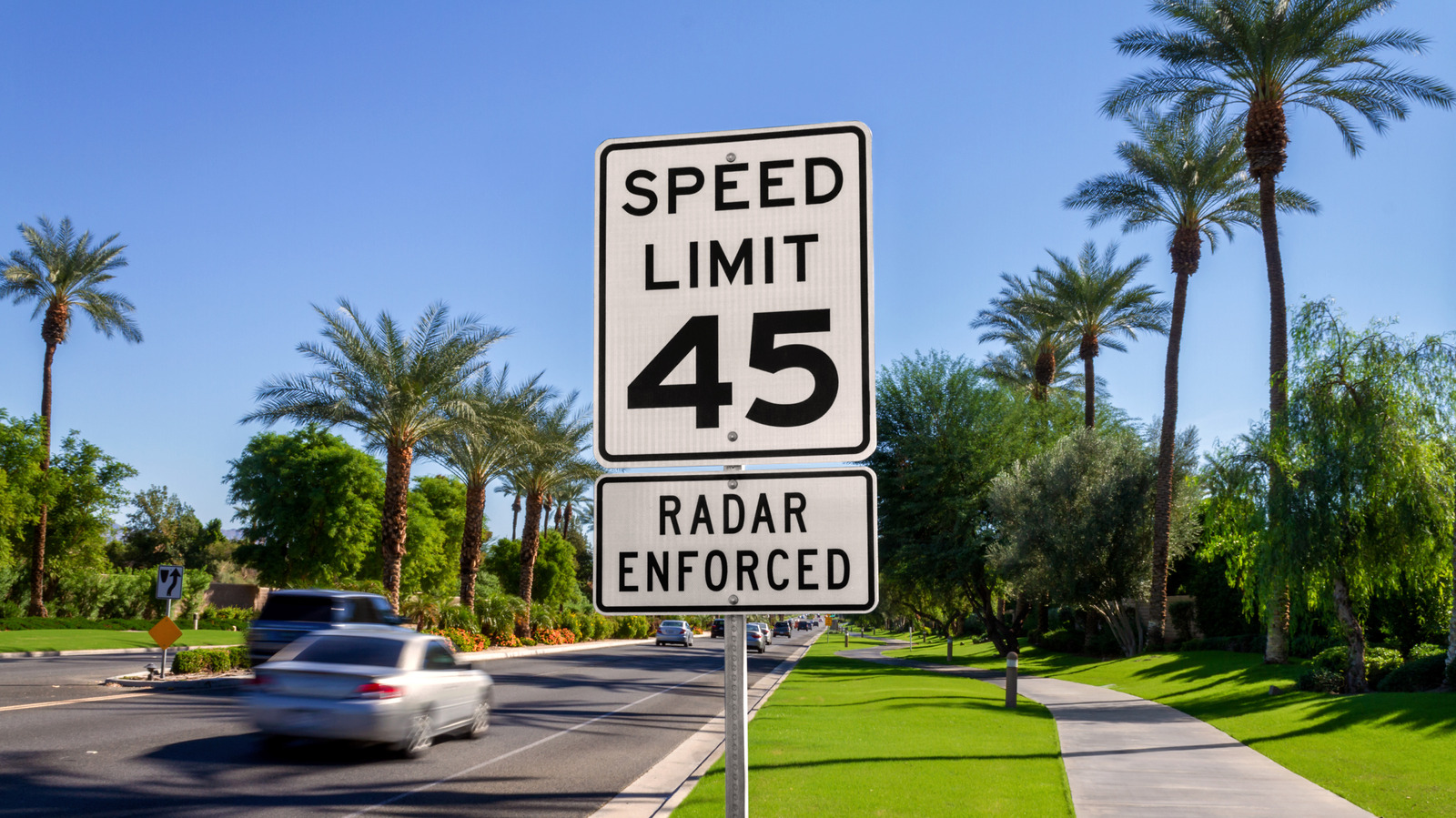
Back in the 1970s, America (temporarily) capped the national speed limit at 55 MPH due to an ongoing oil crisis. The mandate required new signs on roads with previously higher limits, begging the question: How far apart do speed limit signs need to be placed?
The answer is that there is no federally mandated distance between standard speed limit signs. According to the Federal Highway Administration’s current version of the Manual on Uniform Traffic Control Devices (MUTCD), there are some locations where speed limit signs are mandatory, but placement is left to the discretion of the state or local jurisdiction installing the signs.
This can lead to stretches of road, especially after turns, where there’s no visible speed limit sign and you may be uncertain what the posted speed limit is. However, the MUTCD does explicitly state that a sign needs to indicate anytime a speed limit changes, and anywhere specific regulations apply (like school zones). There are some recommendations, like dropping signs after major intersections or where needed to remind drivers of the limit, but they’re suggestions rather than firm rules.
What affects the placement
Speed limits are put in place by state legislators and local officials, meaning there can be a broad variance in different parts of the country, with some places having really high speed limit signs. Limits can also vary widely at the local level, which is why you’ll often see signs at an intersection to update drivers who never passed the previous sign. The same logic is applied at state borders or around the “jurisdictional boundaries” of towns and cities, as the MUTCD specifically requires signs at those entry points.
The type of road on which a sign appears is also a factor, though the MUTCD’s guidance is more about size than placement. For instance, on a standard single-lane road, 24 inch by 30 inch signs are the mandatory minimum, while on an expressway that jumps to 36 by 48, or 48 by 60 on the freeway.
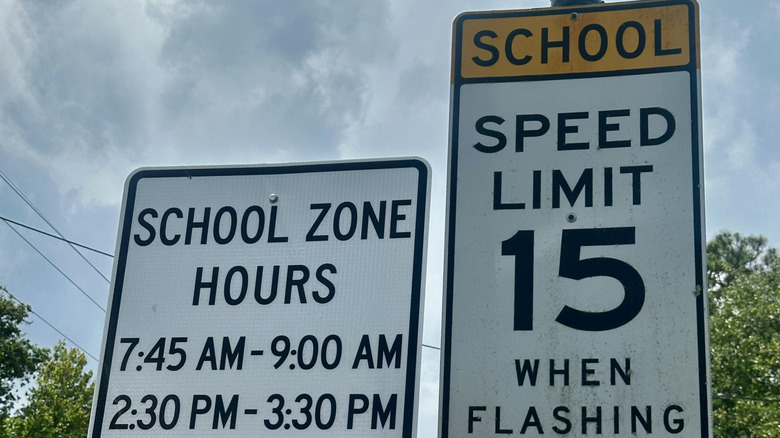
Special zones, like the aforementioned school zones, have their rules, too. A sign has to be placed to indicate the start of a school zone, and another one at its downstream end. The MUTCD advises that signs should live at least 200 yards before a crossing or the border of a school’s campus, though usually no more than 500 yards in advance.
The same rule applies for variable speed limit zones, or zones that only apply to specific vehicles, like trucks. Signs need to appear at both the beginning and end of such zones to alert drivers that they’re entering a specially-regulated stretch of road.