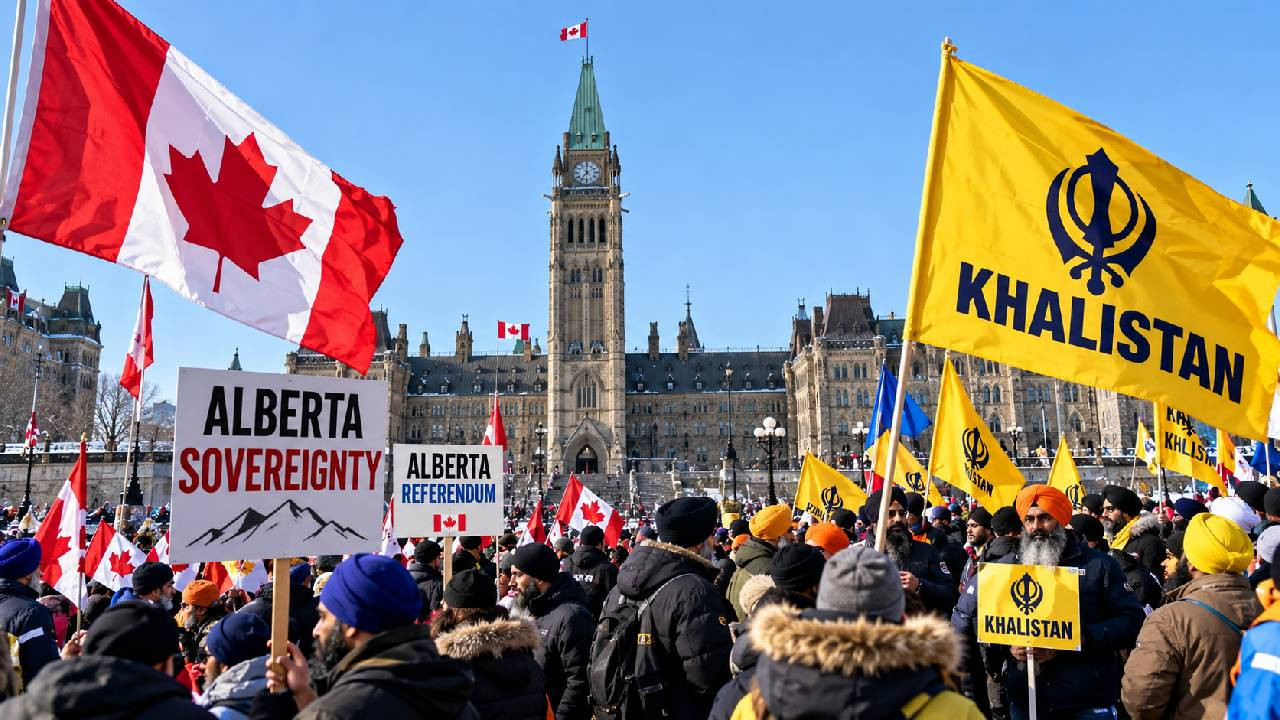
The dates of two separate incidents related to separatism in Canada this month have come very close to each other. Alberta is scheduled to hold a provincial referendum on Oct. 19, asking voters whether the government should initiate a constitutional process to hold a future binding referendum on separation from Canada. This does not mean immediate Alberta independence, but rather a question of taking the next constitutional step toward separation. Just a day before this, on October 18, a pro-Khalistan program associated with Sikhs for Justice is proposed in Edmonton, in which a claim is being made to vote in support of creating a separate Khalistan from India.
The legal and political status of the two incidents is completely different, but the same city and two consecutive dates have certainly put the separatism debate in Canada in the spotlight. The Oct. 19 vote is being held with several questions related to the province’s constitutional and economic powers, according to official Alberta government documents.
What real questions will be asked in Alberta
Alberta’s upcoming vote will not directly decide whether the province will secede from Canada. The question facing voters is whether the government should initiate the constitutional process necessary to hold a binding referendum on separation from Canada in the future. This means that even if the pro-secession stance gets support, there will still be several constitutional and political steps left.
Alberta Premier Danielle Smith has stated in her stance that her government is in favor of strengthening Alberta’s rights and autonomy within a united Canada. The government has also included several other questions related to immigration, constitutional powers and the economic condition of the province in the October 19 vote.
Khalistan event in Edmonton on October 18
A day before Alberta’s voting, Sikhs for Justice in Edmonton has announced to organize an alleged referendum related to Khalistan. On its website, the organization describes it as a campaign related to the independence of Punjab. However, this voting is not part of the official election process of the Government of Canada or Alberta.
Because of this, it would not be correct to consider both the incidents as the same kind of referendum. Alberta’s vote is being held under an official provincial process, while the Khalistan-related event is an unofficial campaign. Despite this, their frequent dates have given a new topic to political debate.
Questions are being raised on the politics of separatism
The secession debate in Alberta has its own local background. The province has long been at odds with the federal government over taxation, resources, immigration and constitutional rights. It is in this background that the political campaign on the issue of separation has strengthened. However, available surveys show a clear lead in favor of remaining within Canada.
On the other hand, the pro-Khalistan campaign is part of a separate political and regional dispute related to India. Sikhs for Justice has been claiming to organize such voting programs in many countries. India sees this organization and its campaign as being linked to separatist activities.
Are both the movements linked by one date?
The holding of both the events in the same area on two consecutive days is certainly attracting political attention, but it would not be appropriate to conclude that both the movements are driven by the same organization or with the same political objective. The Alberta issue is related to the Canadian federal structure and provincial rights, while the Khalistan campaign demands a separate state for India’s Punjab.
For now, the dates of October 18 and 19 are bringing together two separate debates on separatism in Canada. On one hand, Alberta voters will have an opinion on the constitutional relationship between their province and Canada, while on the other hand, the proposed Khalistan event in Edmonton will attract attention as a non-governmental campaign. The real political significance will be what direction the debate takes in Canada regarding separatism, provincial rights and foreign political campaigns after these two events.