There have been two so-called “golden eras” for American muscle cars, both of which gave rise to some genuinely iconic vehicles. While the second era, which ended around 2024 or so, easily birthed the better cars — including headline-grabbing vehicles like the 1,025-hp Dodge Challenger SRT Demon 170 and bona-fide drivers’ cars like the Chevy Camaro SS 1LE — we don’t think it’d be controversial to say that the first, and original, muscle car era is the one that still looms large in the gearhead imagination.
Think of it this way: The nameplates that impressed car buyers and reviewers so much in the 2010s and 2020s were almost all revivals of ones that first emerged and made a name for themselves in in the ’60s. It’s a who’s who of motoring legends, really: Challenger, Charger, Camaro, Mustang. One mustn’t forget the nameplates that didn’t make a triumphant return but are still feted to this day, too, like the Road Runner, HEMI ‘Cuda, 442, and GTO.
Depending on who you ask, this original muscle car era may have lasted until as late as 1974 — the GTO’s final year, lending a nice symmetry to the narrative — but we’d argue that 1971 was the final flourish of the muscle car as buyers knew it. Sure, some of these nameplates survived ’71 and even lasted into the Malaise Era years of reduced horsepower, stricter emissions controls, and oil crises, but things were never quite the same after this year.
Dodge Charger R/T and Challenger R/T
1971 was the final year the world would be treated to the Dodge Charger R/T and Challenger R/T, both of which would be discontinued and replaced with Rallye variants in 1972. It wasn’t just the end of the road for the R/T variants, though: The 426 HEMI that powered these cars was also on its way out, and Dodge would drop it by the time ’72 models hit showroom floors.
Both the ’71 Charger R/T and Challenger R/T were part of Dodge’s Scat Pack lineup. While it was primarily a promotional term more than anything, Scat Pack vehicles packed serious hardware from the factory and were all allegedly capable of 14-second quarter-mile ETs. That sounds pedestrian now, but it was on par with other high-performance muscle cars of the era like the 360-hp 1970 Chevy Camaro Z/28 — and nobody would have called a Z/28 “slow” back in the day.
The 1971 Charger R/T had the 370-hp 440-CI Magnum V8 as standard, with the 425-hp 426 HEMI or 385-hp 440 Six Pack available as added-cost options. It also got an uprated suspension, better brakes, and a dual exhaust. The Challenger R/T, meanwhile, shipped with a 383-CI Magnum V8 good for 300 hp and could be specced with a 340, 440 Six Pack, or 426 HEMI. It also received an uprated suspension. Dodge built 3,118 ’71 Charger R/Ts and 4,630 Challenger R/Ts, with HEMI-equipped variants being exceedingly rare.
Ford Mustang 429 Cobra Jet
The Ford Mustang is the only nameplate on this list that never went away, with seven generations in total as of 2026, including the first-gen model that Ford built from 1964 to 1973. The first-gen Mustang is considered one of the best ever, and 1971 offered a potent example of what the Mustang could do in the form of the Mustang 429 Cobra Jet (and Super Cobra Jet).
The 429-CI Cobra Jet engine wasn’t new for 1971; it had debuted a year before, replacing the 428 Cobra Jet engines in mid-1970 or so. It was available in a range of Ford Motor Company vehicles, including the ’70 Ford Ranchero, the Mercury Cougar, and, of course, the Ford Mustang. Note that despite sharing a displacement, the Boss 429 and Cobra Jet 429 are different engines, and one shouldn’t conflate them.
Either way, 1971 would be the final year for the 429 Cobra Jet and Super Cobra Jet in all Ford vehicles, including the first-gen Mustang. The Cobra Jet was rated at 370 hp, although its spec — a 700 cfm carb, an 11.3:1 compression ratio, and beefier internals — suggests that Ford was severely underrating the numbers. The Super Cobra Jet was an even hotter version only available with a so-called Drag Pack. The Drag Pack came with a 3.91:1 axle ratio and several engine mods, including a racy camshaft, an uprated crankshaft, and 780-cfm Holley carburetor. All these upgrades afforded measly 5 hp extra according to Ford, although modern estimates suggest that it made well above 400 hp in reality.
Plymouth HEMI ‘Cuda
There’s no way of mentioning 1970s muscle cars without discussing the ’71 Plymouth HEMI ‘Cuda: the last of the short-lived breed, the end of an era, and now one of the most valuable muscle cars ever. 1971 HEMI ‘Cudas are exceedingly rare and modern-day prices reflect that, with six figures being the norm — one sold for $330,000 at a 2016 RM Sotheby’s auction, for example — and the ultra-rare convertibles selling for millions.
If you’re familiar with muscle cars, you know the drill here: a claimed 425 hp and 490 lb-ft of torque from the 426 HEMI, which propelled the ‘Cuda to 60 mph in 5.2 seconds and a top speed of 140 mph. Not amazing for a 400-plus-hp car now, admittedly, but it was certainly quicker to 60 mph than other hot muscle cars of its era, including the 429 Cobra Jet-equipped Ford Mustang Mach 1 — which Sports Car Graphic timed at 6.3 seconds (via Hemmings) — and the 1970 Chevy Camaro Z/28 that Car and Driver took to 60 mph in 5.8 seconds.
1971 wasn’t just the end of the line for the 426 HEMI, though; the 440 Six-Pack and the 383 would also be gone come the 1972 model year. The Barracuda and ‘Cuda stayed on for 1972, but things just weren’t the same. The 1972 ‘Cuda had a 340 V8 as standard, and a neutered one at that, with compression dropping from 10.3:1 in 1971 (when the engine made 275 hp) to just 8.5:1. Somewhat unsurprisingly, horsepower figures were conspicuously absent from Barracuda brochures of the time.
Pontiac GTO Judge
The iconic 1964 Pontiac GTO, the brainchild of one John Z. DeLorean (yes, that DeLorean) and his team, is often considered the first muscle car. While that alone would be enough to earn the GTO a place in automotive history, Pontiac took things a step further in 1969 with the GTO Judge, a high-performance offering meant to compete with 440-powered Mopars of the time.
The Judge came with a 400-CI Ram Air III V8 under the hood in its first year good for 366 hp. GM lifted its displacement ban — which limited intermediate cars to 400 CI — for the 1970 model year, allowing the Pontiac team to stuff a 455-CI V8 into the engine bay. The engine, available in the Judge mid-way through 1970, had slightly less peak power than the 400 — 360 hp — but made up for it with 500 lb-ft of torque.
GM dropped compression ratios across the board for 1971, bringing power down to 300 and 325 hp for the 400 and 455 V8s, respectively. The Judge didn’t suffer quite as badly, though, thanks to its new standard 455 H.O. engine, which made 335 hp and 480 lb-ft of torque. Even then, performance numbers were somewhat distressing: The ’71 Judge only managed a 7.0-second 0-60 mph time and a 14.9 quarter-mile ET in a Motor Trend test (via Hemmings). Unsurprisingly, the ’71 Judge wasn’t a popular car: Pontiac built only 374 that year, including 17 convertibles. Equally predictably, the latter are now quite sought-after, with one example selling for nearly $300,000 at an RM Sotheby’s auction.
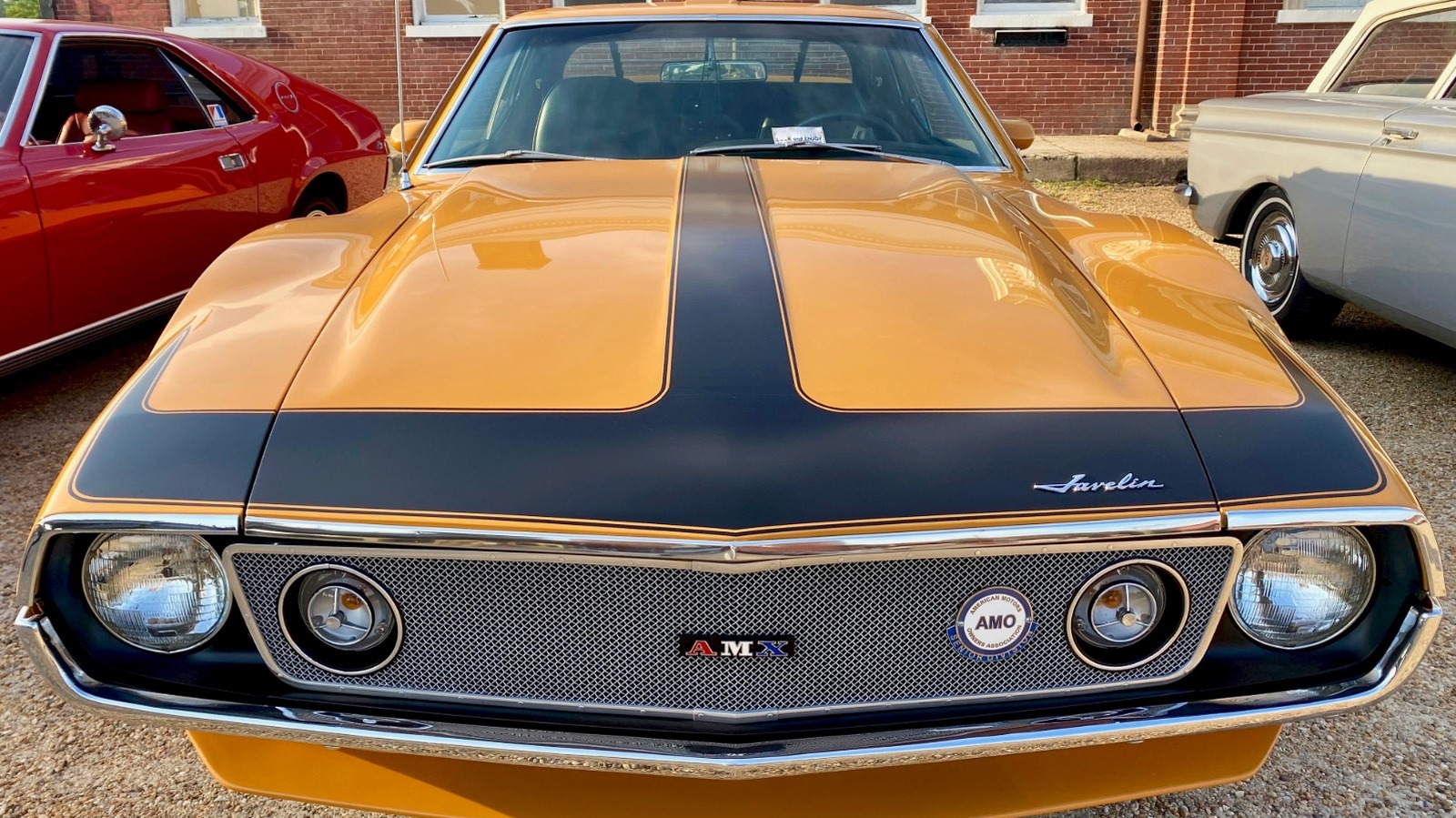
AMC Javelin AMX
The AMC Javelin will never win a popularity contest against more well-known nameplates from Detroit’s Big Three, but that doesn’t mean that it didn’t have anything going for it. That was, in fact, far from the case; the Javelin offered a great combination of performance and style that some have argued makes it one of the most underrated muscle cars ever.
AMC debuted the Javelin for the 1968 model year, with engines ranging from an economical 232-CI inline-6 up to a reasonably beefy 343-CI V8 that made 280 horses. The Javelin eventually birthed the AMX that same year, which was a two-seat, shortened-wheelbase version. Both proved popular with the buying public, and AMC would eventually introduce a couple of stout 300-plus-hp 390-CI V8s under the hood for 1970.
For ’71, AMC dropped the AMX and turned it into a trim level for the redesigned second-gen Javelin. The Javelin AMX had a 245-hp 360 V8 as standard and could be optioned with a “Go” pack that included dual exhausts, improved cooling, and a handling package, among other upgrades. More importantly, buyers could spec it with AMC’s 401 V8 under the hood, which was good for 330 hp and 430 lb-ft of torque, or 255 hp and 345 lb-ft in SAE numbers. That was the beginning of the end, sadly: While the Javelin AMX and 401 survived until 1974, power had dropped to 235 hp by then. AMC pulled the plug sometime in 1975.
Plymouth Road Runner
The Road Runner wasn’t the first muscle (or pony) car, nor was it the longest-lived. But it’s earned its place in the history books for being the first of the low-buck, high-performance muscle cars that American automakers began offering to consumers in the late 1960s. A Road Runner, with its 335-hp 383-CI V8, cost just $2,870 in 1968, $1,000 cheaper than a contemporary GTX, with a 426 HEMI available for an extra $700. Not a bad deal, all things considered.
Plymouth’s budget bruiser did also, of course, benefit from a licensing deal that allowed the automaker to use the Road Runner cartoon character’s imagery and classic “beep beep” horn. Cheap speed and pop culture appeal made for brisk sales in its early years, and Plymouth sold more than 170,000 first-gen Road Runners between 1968 and 1970. In 1971, Plymouth debuted the second-gen Road Runner, ditching the boxy first-gen lines for the curvier, almost cylindrical lines of Chrysler’s “fuselage” styling.
The second-gen Road Runner would stay in production until 1974, with the model itself staying around until 1975, but 1971 was its last truly great year. This was the final hurrah of the 426 HEMI and 440 Six-Pack, barring the three or so ’72 440 Six-Pack cars made before they got cancelled. After that, the Road Runner was never the same again. Sure, the 440 V8 was available until 1973, but a big drop in compression meant that the model’s tire-shredding days were behind it. Come 1976, the Road Runner was nothing more than a trim package for Plymouth’s new Volare.
Oldsmobile 442
The Oldsmobile 442 was Olds’ answer to the Pontiac GTO, and followed much the same template: take an already-existing model (the Cutlass) and hop it up with speed parts. In the 442’s case, it got a four-barrel carb, a four-speed manual, and dual exhausts — the origin of the “442” name — plus other upgrades like a higher-lift cam and uprated suspension.
The result was 310 hp from its 330-CI V8 and a car that, while not necessarily the best handler, was quite rapid for its time. Olds dropped the standard four-speed manual in 1965 but switched to a 400-CI V8 under the hood, allowing it to keep the 442 name. Olds promoted the 442 to a standalone model for its second generation starting in 1968, with a revised 400 V8 under the hood. The 442’s peak likely came in 1970, when it got a 365-hp 455-CI V8 as standard and a ram-air W30 package that added 5 hp. Granted, the 455 was a bit past its peak by then — it made 400 hp in the late ’60s — but it was still good for sub-6-second 0-60 times and 14-second quarter-mile ETs.
1971 was the end of the line for the 442. While it handled and looked as good as ever, GM’s move to the lower compression ratios necessary for unleaded fuel dropped the 455’s power to 340 hp (270 SAE net hp) and 460 lb-ft of torque. For 1972, the 442 reverted back to being an option package for the Cutlass, although the name continued in various forms until Olds discontinued the 442 in 1991.
Chevrolet Chevelle SS
Let’s be clear: 1971 probably wasn’t the best year for the Chevelle SS. That was probably 1970, when buyers could, if they had deep enough pockets, option their Chevelles with GM’s monster 450-hp LS6 V8 under the hood. It was worth it, though: Shelling out nearly $1,000 for the LS6 got a buyer one of the most powerful sports cars of the 1970s and paid dividends on the drag strip, with Motor Trend managing an impressive 13.44-second quarter-mile time. Buyers who couldn’t stretch that far still had a potent engine in the form of the also-454-CI LS5, which made 360 hp.
As great as it was, the LS6 Chevelle SS wasn’t long for this world. Once the 1971 model year rolled around, the most powerful engine a prospective Chevelle SS buyer could get — unconfirmed rumors of ’71 Chevelle LS6s notwithstanding — was the LS5 engine, which was rated at 365 hp (285 net hp). It was still a quick, mind you, with its 14-second quarter-mile times being a suitable send-off for the golden era of muscle cars, but it certainly wasn’t anywhere close to its former glory.
GM kept the 454 LS5 in the engine bay for 1972, but power dropped even further as the reality of stricter emissions regulations kicked in. It was now rated at 270 hp net, and things were only going to get worse. Chevy unveiled the third-gen Chevelle for 1973, with the 454 now making just 245 hp. The Chevelle SS was also gone, replaced by the Malibu SS before Chevy dropped the SS branding entirely for 1974.
Ford Torino Cobra
1971 was a watershed year for the Torino. Not only did it help send off the golden era of muscle cars with Ford’s beefy Cobra Jet and Super Cobra Jet engines under the hood, it was also the final year that Ford would offer the Torino as a unibody car, with ’72 models switching to body-on-frame.
The Torino Cobra debuted in 1969 with the 428 Cobra Jet under the hood as standard and Ram Air version available as an added-cost option. The then-new 429 took the 428’s place starting in 1970, with the Ram Air version once again an option for buyers willing to splash the cash. The move came with a big leap in rated horsepower, going from 335 hp with the 428 to 370 with the 429. The result? A 0-60 mph time of 5.8 seconds and a quarter-mile ET of 13.99 seconds in Motor Trend’s hands — undoubtedly part of the reason why the outlet named it the year’s best car.
Unlike GM’s early-’70s offerings, Ford stuck to its guns and kept the 370-hp Cobra Jet available, with its leaded-friendly 11.3:1 compression ratio, available into 1971. The only big difference was the standard engine, which was now a 285-hp, 351-CI V8, requiring buyers to drop an extra $350 or so to get the Cobra Jet. Ford dropped the Cobra Jet engines come ’72, with the remaining 429-CI a far cry from the racy 429s in the ’71 Torino.
Pontiac Firebird Trans Am
The Firebird lived on for many decades after the end of the muscle era, with its Trans Am package surviving the ’70s and lasting into the early 2000s. Unlike many of its ’60s brethren, then, the Firebird Trans Am survived long enough to some respectability back later in its life, its revival peaking in 2002 with a 325-hp LS1 V8 that could take it to 60 mph in under five seconds.
While these later iterations of the Firebird Trans Am are undoubtedly excellent muscle cars, we would be doing a disservice to the ’71 Trans Am if we were to overlook it. Like GM’s other offerings that year, the 1971 Pontiac Firebird Trans Am was arguably hobbled with an unleaded-friendly engine running a relatively low 8.5:1 compression ratio. However, made up for that by speccing the ’71 Trans Am with a much larger engine than its predecessor.
Where the 1970 Trans Am had a 400-CI V8 that made 345 hp and 430 lb-ft of torque, the ’71 model had a 455 H.O. V8 under the hood making 335 hp (305 net hp) and 480 lb-ft of torque. The ’71 model was also only slightly heavier at 3,695 pounds versus 3,666, so buyers would probably have felt that extra torque, too. The ’72 Firebird kept the 455 H.O. (now down to 300 net hp), but that was essentially it for the Trans Am: Power dropped as low as 255 hp by 1973, making an ignominious end to the Firebird Trans Am’s performance heritage for a long while.