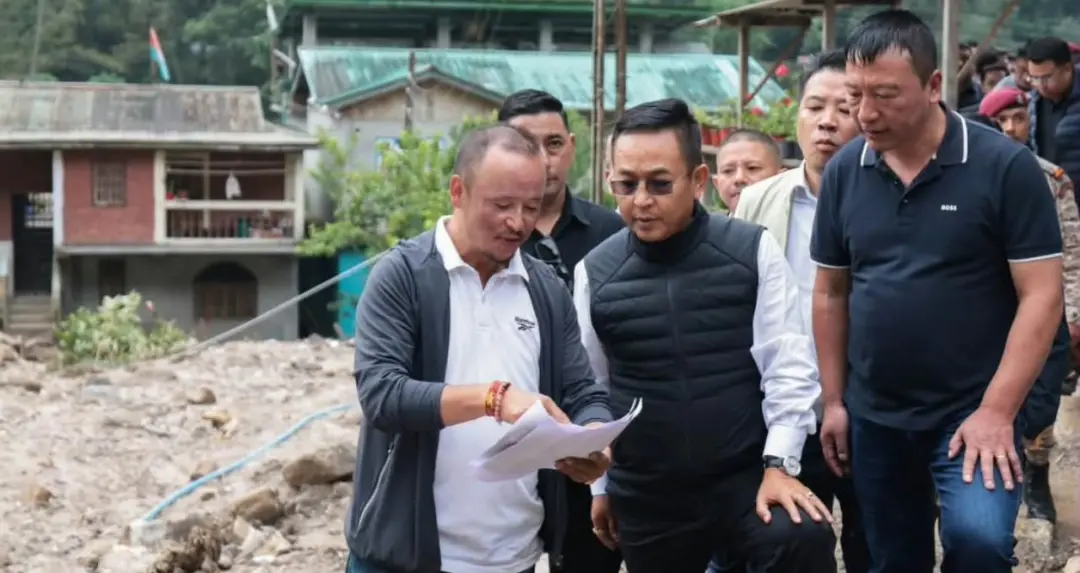
Sikkim Chief Minister Prem Singh Tamang visited landslide affected Rimbi village and took stock of the condition of the families. The government provided relief funds to the affected people and issued land allotment orders for the rehabilitation of families who lost their homes.
Rimbi: Sikkim Chief Minister Prem Singh Tamang visited landslide-hit Rimbi village in Yuksom-Tashiding assembly constituency on Friday. During this, he met the families affected by the natural disaster and took stock of their losses and current conditions. The Chief Minister said that no one died in this incident, it is a matter of relief. However, many families are facing the challenge of surviving and resuming normal life due to damage to their homes and properties.
The state government distributed checks and cash assistance under the Chief Minister's Relief Fund (CMRF) to provide immediate assistance to the affected families. Apart from this, land allotment orders were also given under Sikkim Garib Awas Yojana (SGAY) for long-term rehabilitation of families whose houses were completely destroyed in the landslide. The Chief Minister assured that arrangements will be made for construction of new houses for the families who have lost their homes.
Review of the situation of families affected by landslides
The Chief Minister's visit to Rimbi village was aimed at understanding the needs of the affected people and assessing the status of relief operations. Due to damage to houses and properties due to landslides, many families are facing the problem of safe shelter.
Chief Minister Tamang expressed concern over the difficulties of the affected families. He said that after a natural disaster, it is not only the loss of property that is a challenge, but people's safety, living arrangements and ability to return to normal life is also affected.
The Chief Minister expressed satisfaction that no one died in the incident. However, he acknowledged that conditions are extremely difficult for families whose homes have been damaged or destroyed. Such families will need immediate assistance as well as long-term rehabilitation support.
Financial assistance given from Chief Minister's Relief Fund
To provide immediate relief to the landslide affected families, the state government distributed checks and cash assistance under the Chief Minister's Relief Fund. Assistance was provided keeping in mind the standards set by the authorities and the extent of loss suffered by the families.
Financial assistance following natural disasters can help affected families purchase essential goods, make temporary living arrangements, and meet daily needs. For those who have suffered property damage, initial financial support is an important part of the process of returning to normal life.
However, the available information does not provide details of the total number of families affected and the total amount of assistance distributed. Therefore, detailed data released by the government will be required to assess the overall size of the relief package.
The Chief Minister assured that every effort will be made to provide all possible assistance keeping in mind the needs of the affected people. The objective of the Government is to ensure that no affected family is deprived of assistance in the process of rehabilitation after a disaster.
Land allotment under Sikkim Garib Awas Yojana
Along with immediate relief, the state government has also focused on long-term rehabilitation of the affected families. Under this, land allotment orders were made available under Sikkim Garib Awas Yojana (SGAY).
This step is especially important for those families whose houses have been completely destroyed in landslides. The Chief Minister said that arrangements would be made to build new houses for such families, so that they could re-arrange their lives with secure accommodation.
Rehabilitation after a natural disaster is not limited to just providing houses. It also includes aspects like suitability of land, safety of construction, access to basic facilities and protection from possible future disasters. Considering the risk of landslides in hilly areas, construction of houses at safe places assumes special importance.
However, information regarding the timeline for construction of new houses, the number of proposed houses and detailed conditions regarding land allotment has not been made available. Once these details are revealed, the progress of the rehabilitation plan can be assessed more clearly.
Government said to give priority to safe rehabilitation
Chief Minister Prem Singh Tamang reiterated that the safety, dignity and welfare of the affected people are among the top priorities of the state government. He said that efforts will be made to continuously provide assistance to the families to recover from the disaster and resume normal life.
After natural events like landslides, the affected people have to face many challenges. Families need temporary shelter when their houses are damaged. Apart from this, problems related to household items, livelihood and daily facilities may also arise.
In such a situation, coordination between relief distribution and rehabilitation is necessary. Immediate assistance helps meet people's initial needs, while the restoration of safe housing and other infrastructure is essential for longer-term reconstruction.
The Chief Minister assured that keeping in mind the needs of the affected families, work will be done to provide further assistance.
Appreciation of administration, voluntary organizations and local people
During his visit, the Chief Minister expressed his gratitude to the government officials, non-governmental organizations (NGOs), people helping at individual level and members of various political parties who contributed to the relief and aid work.
He said that it is important for different groups to come together to help the affected families in difficult circumstances. The role of administrative officials is important in implementing the relief system, while voluntary organizations and local people can cooperate in providing assistance to the affected families.
After a natural disaster, community support can also provide mental and social support to the affected people. Along with providing food, essential goods and other assistance, identifying the actual needs of families also helps in making relief efforts effective.
Appreciating this collective effort and solidarity, the Chief Minister said that cooperation of all concerned parties will be important in the rehabilitation of the affected families.
The challenge ahead in Rimbi: safe homes and restoration of normal life
The major challenge now facing the relief and rehabilitation process in Rimbi village is to provide safe accommodation to the affected families and help them return to normal life. The financial assistance given from the Chief Minister's Relief Fund and the land allotment order are initial steps in this direction.
Further progress will depend on when construction of new houses begins, how quickly the land allotment process is completed and how necessary facilities are provided to the affected families.
Given the risk of landslides in hilly states, safe construction and risk assessment are also important. While planning rehabilitation, it is important to take into account the needs of the affected families as well as the security of the land and possible natural hazards in the future.
At present, the Government of Sikkim has assured immediate financial assistance and long-term housing support to the affected families of Rimbi village. The message given by the Chief Minister's visit is that safety and rehabilitation of the affected people will be given priority. Now eyes will be on how quickly and effectively the announced assistance is implemented on the ground.