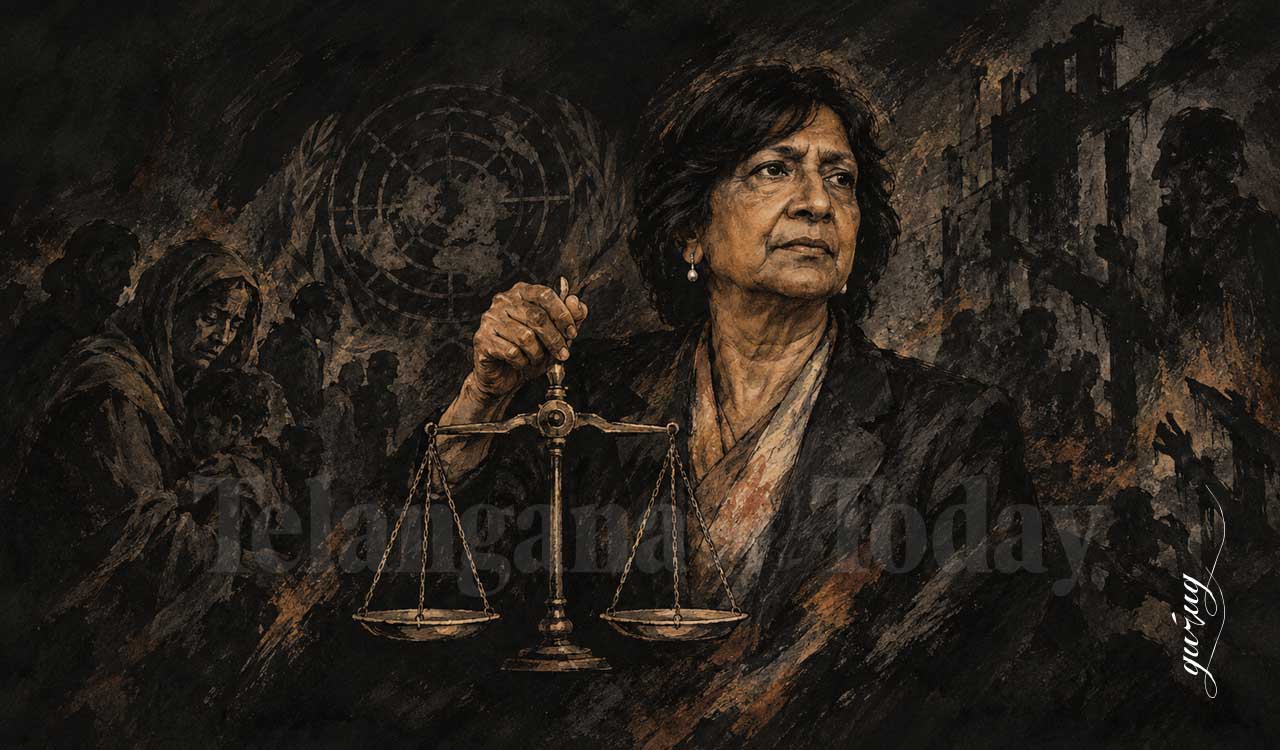
Pillay’s Nobel Peace Prize affirms the conviction that international law, however imperfectly applied, remains the best bet for a peaceful world in which no one should be denied justice because of their identity or nationality
Published Date – 12 October 2026, 10:53 PM
Illustration: GuruG
As a child of Indian descent growing up in apartheid-era South Africa, Navanethem ‘Navi’ Pillay knew what it takes to make a living in a brutally racist environment. Decades later, her achievements as a global campaigner for the rights of the vulnerable came to symbolise the triumph of human spirit over systemic injustices. The 2026 Nobel Peace Prize recognises her contribution to human rights and international law, and her enduring belief that peace is impossible without dignity, equality and justice for all. The Norwegian Nobel Committee’s decision to honour her serves as a recognition of the primacy of international rule of law and human dignity at a time when the world is being torn apart by conflicts and global institutions are coming under increasing pressure. Pillay, a former United Nations High Commissioner for Human Rights, has championed the cause of the weak and underprivileged, as well as victims of conflicts around the world. From apartheid-era South Africa to the highest institutions of international justice, 85-year-old Pillay has spent her life defending the exploited classes and advancing the rule of law. Her international career is defined by expanding the definitions of war crimes and holding powerful leaders to account. While she is currently an ad hoc judge at the International Court of Justice (ICJ), her broader international judicial breakthroughs also encompass the International Criminal Tribunal for Rwanda (ICTR) and the International Criminal Court. Pillay’s recognition affirms the conviction that international law, however imperfectly applied, remains the best bet for a peaceful world where no one should be denied justice because of their identity or nationality.
Pillay experienced racial discrimination firsthand, but that did not deter her from keeping up the fight. Born into an Indian Tamil family in Durban, she became the first woman of colour to establish a law practice in Natal Province, defending anti-apartheid activists, including Nelson Mandela, and advocating for the rights of political prisoners. In 1995, she became the first black woman to be appointed as a judge to South Africa’s High Court. She later presided over the trial of Jean-Paul Akayesu at the Rwanda tribunal, which resulted in the first genocide conviction by an international court and established that rape can constitute genocide. Pillay subsequently served as a judge at the International Criminal Court from 2003 to 2008. She was appointed United Nations High Commissioner for Human Rights, serving from 2008 to 2014 and advocating for human rights, equality, the protection of vulnerable populations and accountability for serious violations. She chaired a UN Commission last year that concluded that Israel had committed genocide in Gaza. While much of Pillay’s global recognition comes from human rights work she has done abroad, her experiences in South Africa have indelibly shaped her life, and she has remained deeply invested in her home country’s fragile democracy. Her life shows that the fight for peace begins with the protection of human rights.