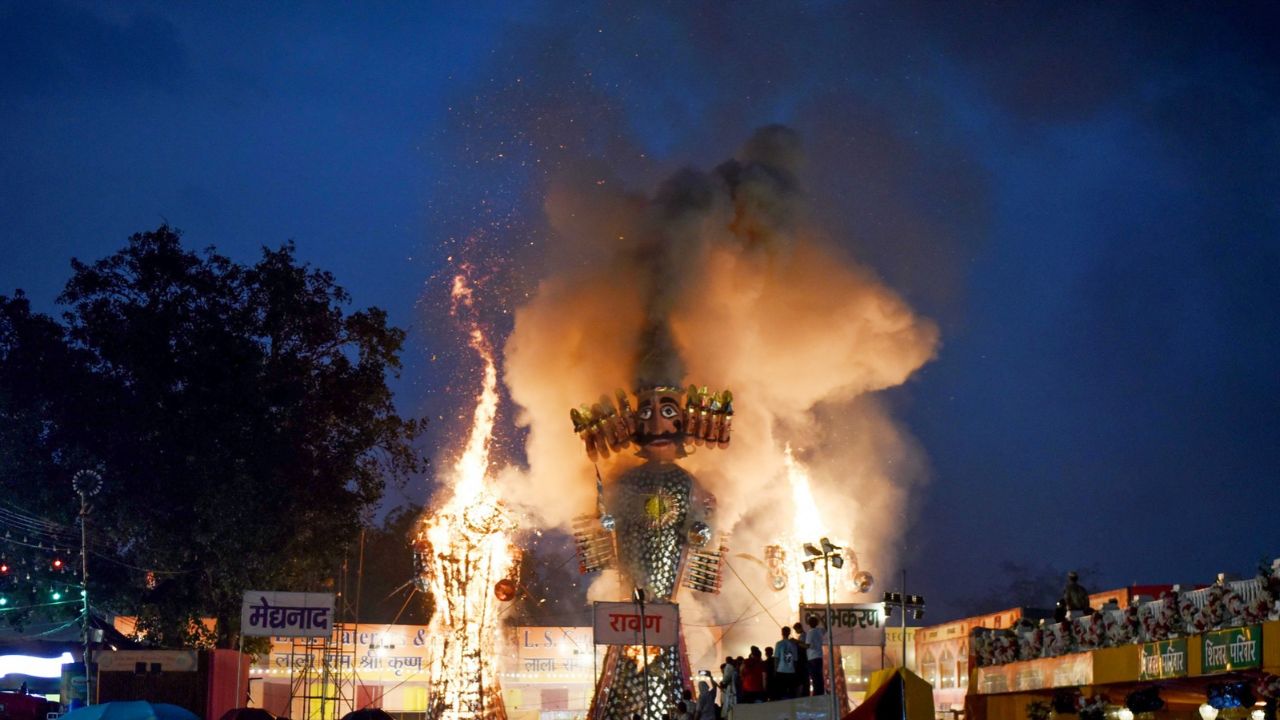
As soon as Dussehra arrives, preparations for burning the effigies of Ravana, Kumbhakarna and Meghnad begin across the country. It is believed that on this day Lord Ram killed Ravana and gave the message of victory of good over evil. But do you know that there is a place in India where the effigy of Ravana is not burnt on Dussehra? Here neither Ravana Dahan nor Dussehra ends in just one day. The way of celebrating this festival in Kullu Valley of Himachal Pradesh is completely different from the rest of the country.
Dussehra of Kullu is famous for its unique traditions and about 370 years old history. Here Dussehra starts on the day of Vijayadashami and the celebrations continue for the next seven days. During this time, a grand Rath Yatra of Lord Raghunath is taken out and hundreds of gods and goddesses of the valley participate in the festival riding in palanquins.
When does Dussehra start in Kullu and for how many days does it last?
In many parts of the country, the celebration of Dussehra ends on Vijayadashami, but in Kullu it starts on this day. This festival is usually celebrated for seven days in Dhalpur ground of Kullu district of Himachal Pradesh. During this time, palanquins and chariots of gods and goddesses reach here from different areas of the valley. The sound of drums, traditional costumes and folk songs make the whole atmosphere special. A large number of local people and tourists participate in this event.
What is the story of Kullu Dussehra?
The history of Kullu Dussehra is believed to be related to the 17th century. According to the legend, a Brahmin had died unknowingly from Jagat Singh, the king of Kullu at that time. After this incident the king deeply regretted his actions. He gradually started falling ill, after which he started looking for a way to get rid of this defect.
The king installed the statue of Ram
It is said that a sage named Payahari Baba advised him to bring the idol of Lord Ram from Ayodhya and install it to get rid of his sins. After this Baba Damodar Das brought the idol of Lord Raghunath from Ayodhya to Kullu. In the year 1651, Raja Jagat Singh dedicated his kingdom to Lord Raghunath and considered himself his servant. This incident is seen to be connected with the beginning of the tradition of Kullu Dussehra.
Why is Ravana’s effigy not burnt in Kullu?
The most different thing about Kullu Dussehra is that unlike other parts of the country, there is no tradition of burning big effigies of Ravana, Kumbhakarna and Meghnad. Here the festival focuses on the worship of Lord Raghunath, Rath Yatra and meeting of Gods and Goddesses. On the last day of the festival, dry grass, bushes and wood are burnt on the banks of river Vyas. It is considered a symbol of Lanka Dahan.
Rath Yatra of Lord Raghunath begins
The most special part of Kullu Dussehra is the Rath Yatra of Lord Raghunath. On the first day of the festival, the idol of Lord Raghunath is brought from the temple and placed on a grand chariot made of wood. After this the devotees pull the chariot with the help of ropes. It is believed that touching the rope removes sins. During this time the entire Dhalpur ground echoes with cheers and drums. There is a religious belief that it is auspicious to join the chariot of Lord Raghunath and have his darshan. Gods and Goddesses from different areas of Kullu also participate in this yatra. Their decorated palanquins and traditional musical instruments make this event more special.